




Network downtime can feel like a roadblock for any business. When systems go offline, productivity drops, customers get frustrated, and revenue can take a hit. The good news? Most downtime is preventable with the right strategies.
By understanding what causes network issues and taking proactive steps, businesses can stay online, keep operations running smoothly, and avoid costly disruptions. In this blog, we’ll explore practical ways to reduce network-related downtime, from monitoring tools to smart maintenance practices, helping your business stay connected, efficient, and ready to grow.
Proactive Network Monitoring Strategies to Prevent Business Network Outages
Real-time monitoring gives you the visibility required to prevent business network outages before users or revenue streams feel any impact whatsoever.
Real-Time Performance Tracking and Alert Systems
Tracking performance metrics in real time allows teams to identify abnormal behavior early and respond proactively. Intelligent alerts and visual reporting support rapid awareness, but effective prevention also depends on understanding root causes. An interesting solution we found is PathSolutions, which focuses on comprehensive network visibility across devices and interfaces while automatically highlighting performance anomalies and likely sources of failure. This can help organizations pinpoint issues more efficiently without relying solely on manual correlation.
Automated Network Discovery and Mapping
Self-updating topology documentation keeps up with infrastructure changes that slip through manual tracking. Automated asset inventory ensures you always know what’s connected. Dependency mapping for mission-critical applications shows you which systems are absolutely non-negotiable for business survival.
The Real Cost of Network Downtime for Modern Businesses
Grasping what’s truly on the line when networks fail makes it easier to justify spending money to protect them. The statistics paint a pretty grim picture.
Direct Financial Impacts on Revenue and Operations
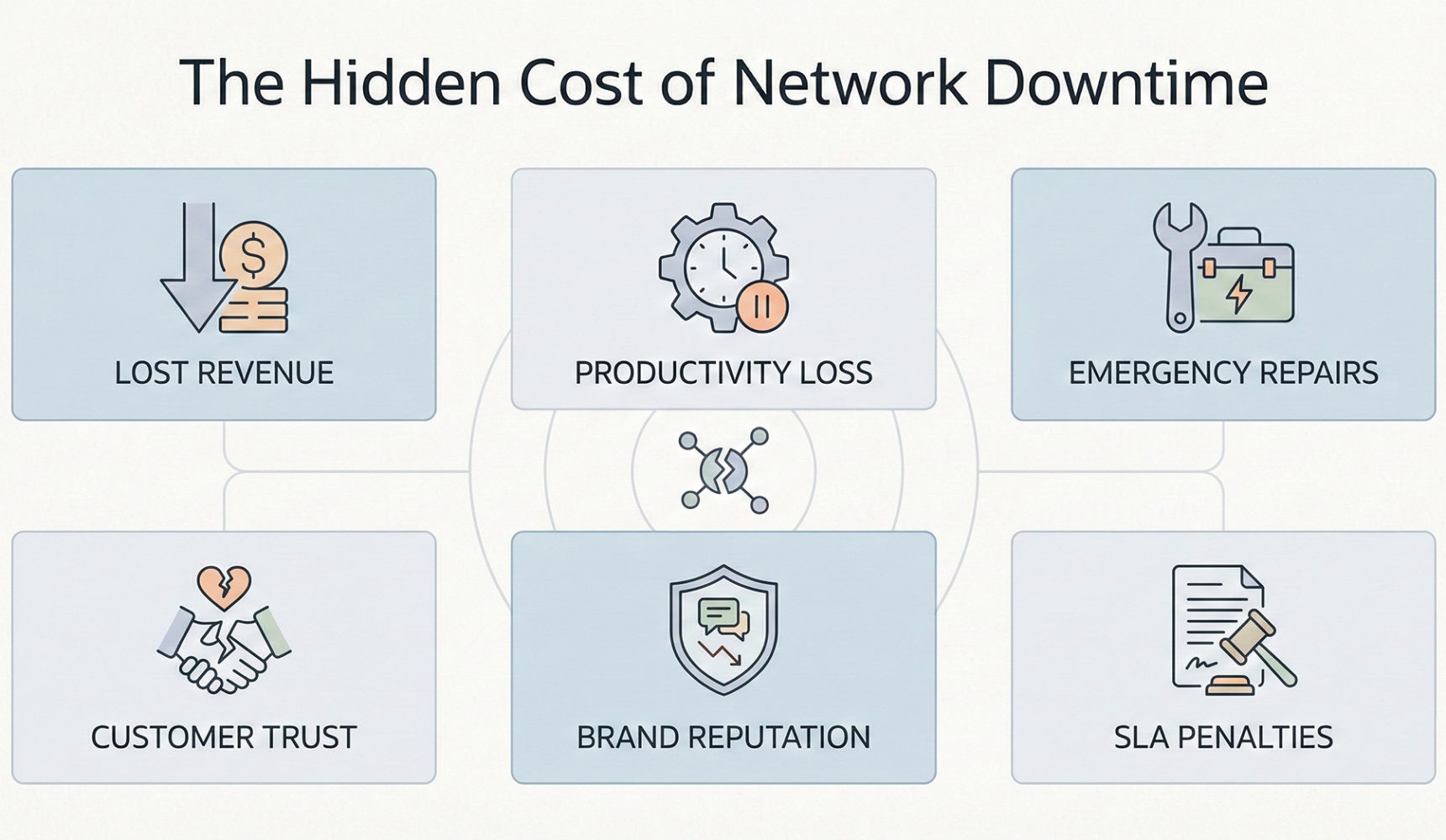
Consider semiconductor manufacturing. One hour of unplanned downtime? Over $1 million gone. Not hyperbole, cold, hard reality for network-dependent operations. You’ve got lost transactions piling up, emergency repair costs exploding, and SLA penalties kicking in. Sure, your business probably isn’t hemorrhaging seven figures hourly, but you’re still losing way more than you realize.
Hidden Costs That Affect Long-Term Business Health
The immediate revenue hit gets all the attention, naturally. But the damage keeps accumulating long after systems return. Your employees become completely unproductive during outages, sitting idle or creating inefficient workarounds. Customers lose faith with every incident, gravitating toward competitors who appear more dependable. Your brand takes reputation hits that outlive the outage by months or years.
Top Causes of Network Downtime Businesses Must Address
Understanding outage triggers helps, sure. But prevention demands relentless vigilance using sophisticated monitoring that spots trouble before it explodes.
Hardware Failures and Equipment Deterioration
Physical gear has a shelf life, period. Aging infrastructure becomes your single biggest exposure point. Power supplies fail without warning. Environmental enemies like excessive heat or moisture gradually corrode components. Equipment lifecycle management sounds boring as dirt, but it’s absolutely critical for keeping things running.
Software Bugs and Configuration Errors
Hardware isn’t your only vulnerability, human mistakes and software gremlins cause nearly 40% of network failures. Patch management creates unexpected complications. One misplaced character in your network configuration? Everything crashes. Compatibility problems between systems multiply as your technology stack becomes increasingly complex.
Cybersecurity Threats and Network Traffic Overload
Internal errors cause headaches, but external attackers actively try to demolish your infrastructure. DDoS attacks flood your bandwidth until it drowns. Ransomware locks down critical systems. Zero-day vulnerabilities sneak past traditional defenses like ghosts. Here’s the thing, not all downtime stems from malicious actors. Sometimes your network just can’t handle legitimate demand during unexpected traffic surges.

Preventive Maintenance Protocols to Minimize IT Downtime
Redundancy guards against surprise failures. But scheduled maintenance actually prevents numerous issues from happening at all when you minimize IT downtime through forward-thinking protocols.
Scheduled Maintenance Windows and Update Strategies
Establishing low-impact maintenance timing minimizes business disruption. Change advisory board processes guarantee modifications receive proper scrutiny before rollout. Rollback procedures create safety nets when updates cause unanticipated problems. Staged deployment and vendor patch evaluation stop problematic updates from contaminating your entire network.
Regular Hardware Health Assessments and Capacity Planning
Thermal monitoring detects cooling system failures before equipment literally melts down. Cable management and physical inspections spot wear before connectivity dies. Proactive component replacement addresses degradation ahead of catastrophic failures. Load testing reveals whether infrastructure can support future demands. Quarterly capacity reviews ensure planning keeps pace with business expansion.
Advanced Security Measures and Disaster Recovery Planning
Security measures lower outage probability significantly. But comprehensive planning ensures you’re ready when prevention eventually fails despite your best efforts.
Next-Generation Firewall Deployment and DDoS Protection
Intrusion prevention systems integration stops threats at your perimeter. Application-aware filtering provides surgical control. SSL/TLS inspection exposes threats concealed in encrypted traffic. Cloud-based DDoS scrubbing services absorb overwhelming traffic floods that would demolish on-premises defenses. Rate limiting and traffic shaping contain attacks before they penetrate critical infrastructure.
Comprehensive Business Continuity Plans
Recovery Time Objective and Recovery Point Objective definitions set clear restoration targets. Critical business function prioritization focuses teams on what actually matters during crises. Communication protocols keep stakeholders informed throughout outages, cutting confusion and panic. The 3-2-1 backup rule, three copies, two media types, one off-site location, delivers dependable data protection.
Leveraging Modern Technologies to Enhance Network Reliability for Businesses
Traditional approaches remain foundational, absolutely. But emerging technologies are revolutionizing how businesses achieve network reliability for businesses through automation and intelligence.
Software-Defined Networking and Network Automation
Centralized network management simplifies operations while boosting consistency across distributed infrastructure. Dynamic traffic routing optimizes performance automatically based on current conditions. Infrastructure as Code eliminates configuration drift and enables rapid deployment. Automated provisioning reduces human error that frequently triggers outages.
Intent-Based Networking and Digital Twin Technology
Self-correcting network configurations align with business objectives without constant manual tweaking. Automated policy enforcement guarantees compliance throughout your infrastructure. Virtual network modeling lets you test changes in simulated environments before touching production systems, exposing potential problems without risking live operations.
Team Training and Budget Optimization
Advanced technology dramatically boosts reliability, no question. But human operators remain critical, and they’re often the weakest link without proper training and business continuity solutions.
Staff Training and Standard Operating Procedures
Comprehensive training programs ensure teams grasp both fundamentals and advanced troubleshooting. Detailed runbooks standardize responses to common scenarios, delivering consistency regardless of who’s working. Peer review requirements for critical changes catch mistakes before they cause outages. Cultivating a culture where reliability is everyone’s job creates lasting organizational change.
Common Questions About Reducing Network Downtime
How to reduce system downtime?
Proactive infrastructure monitoring catches problems early. Automated troubleshooting speed resolution. Routine health checks prevent failures before they manifest. Implement redundancy and high availability configurations that eliminate single points of failure. Create disaster recovery plans with tested backup systems. Emphasize collaborative incident management across all teams.
How to prevent server downtime?
Select hosting providers with proven uptime records and solid service level agreements. Enable DDoS protection to deflect overwhelming traffic attacks. Follow web development best practices that don’t unnecessarily strain infrastructure. Choose registrars offering reliable DNS services. Use CDNs for distributed content delivery. Implement careful monitoring that alerts you to emerging issues immediately.
What metrics should I track for network reliability?
Monitor uptime percentage targets, Mean Time Between Failures, and Mean Time To Repair. Track network latency, packet loss rates, and bandwidth utilization closely. Measure incident response times and resolution efficiency. These metrics expose performance trends and spotlight areas demanding improvement.
Final Thoughts on Network Downtime Prevention
Network outages will happen, complex systems guarantee it. What actually matters is frequency, recovery speed, and whether you’re learning from each incident. The strategies mapped out here give you a blueprint for constructing resilient infrastructure that keeps your business operational when competitors go dark. Begin with assessment. Identify your most serious vulnerabilities. Implement solutions methodically and systematically. Your network’s reliability directly impacts competitive advantage, transforming these investments from optional nice-to-haves into absolute necessities for sustained success.