



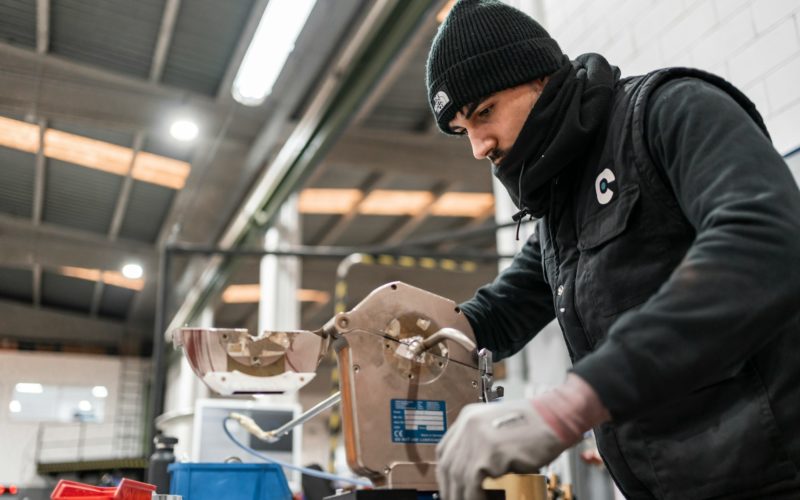
The U.S. manufacturing sector faces a major crisis today. Many workers are leaving their jobs. Mercer’s 2025 U.S. turnover survey reveals that the average voluntary turnover rate reached 13.0% in 2024 and 2025. This excludes people who retire or work as contractors.
High turnover costs businesses a lot of money, around $7,800 to $11,900. This includes costs for finding new people, training them, and the potential loss of production. Multiply that across a facility of hundreds, and the numbers become staggering.
Many of these departures are preventable. Disengagement is the root cause of this turnover. When people don’t feel valued, supported, or connected to their work, they start updating their résumés.
Here’s how you can improve employee engagement in your manufacturing business:
#1. Rethink the Shop Floor Environment
Your shop floor isn’t just where products get made. Rather, it is where your people spend eight to ten hours a day. If it feels outdated, noisy, cramped, or unsafe, engagement tanks fast. Workers who feel physically unsupported or disconnected from their space simply check out.
Are harsh overhead fluorescents creating eye strain and headaches? Switch to natural-spectrum LED panels with motion sensors. Constant noise drains focus, even with ear protection. Combat the clatter with acoustic panels and dedicated quiet zones for precision work.
Then there’s air quality. Cleaning solvents and degreasers leave behind strong odors that linger long after the shift ends. It would be wise to switch to high-purity, low-odor options.
Exxon Isopar G is an excellent example. Ecolink explains that it’s a fast-evaporating solvent, so it’s ideal for vanishing and evanescent oil formulations.
This solvent is virtually odorless and breaks down steadily without lingering or disrupting your workspace. Precisely, the aromatic content of Exxon Isopar G is less than 0.01%. It performs just as well as older solvents but without the heavy chemical smell that used to follow workers home on their clothes.
#2. Invest in Career Mapping and Skill Visibility
Lack of career visibility is a major turnover driver. A survey conducted by Gallup revealed that 70% of preventable turnover is tied to daily management. Around 11% of employees said that they would have stayed if there had been clearer career paths.
Many still see manufacturing as a dead-end career. To boost employee engagement, make growth visible and achievable. When employees can see exactly how today’s work ladders into tomorrow’s opportunities, they stick around and give their best effort.
Begin with clear, written career paths. Post them on a break-room bulletin board or, better yet, in a simple digital dashboard. Show progression from machine operator to lead tech to supervisor, complete with the skills, certifications, and time frames involved. Tie each step to real milestones.
Employees who feel they can acquire future-ready skills are 2.7 times less likely to leave within a year.
Make skill visibility transparent. Use a skills matrix board, such as a giant bingo card on the wall, or a mobile app where employees log completed training and see their progress bar fill up.
Launch quarterly skill spotlights during shift huddles. Track progress in a shared system, so everyone sees how their growth ladders up to bigger roles.
#3. Offer Meaningful Recognition Beyond the Paycheck
Pay matters, but money alone doesn’t keep people engaged. What boosts engagement is feeling seen and valued for the work they do day in and day out.
Move beyond generic “Employee of the Month” plaques. Implement peer-to-peer recognition apps or shift-end shout-outs where teammates nominate each other for things like “zero-defect hero” or “safety champion.”
Tie recognition to your company values. Publicly celebrate when someone mentors a new hire or suggests a process tweak that saves scrap. Gallup’s research shows that well-recognized workers are 45% less likely to turn over after 2 years.
Don’t overlook the medium of recognition. While one team member might thrive on public accolades, another may deeply value a private, handwritten note. Similarly, incentives are not one-size-fits-all. Some prioritize extra time off, while others are energized by growth opportunities.
Ultimately, the time invested in understanding these individual preferences is a powerful act of engagement in its own right.
Improving Your Culture for Peak Employee Engagement
You don’t need to turn your plant into a tech hub to win over your team. Instead of chasing perks, focus on the foundations, and these are visibility, respect, and support.
These pillars aren’t quick fixes. But they are proven, practical, and grounded in what manufacturing workers actually say they need. Start where you can, be consistent, and listen more than you talk. Lower turnover, better safety records, higher productivity, and a workforce that shows up ready to do great work will eventually follow.