



I. Introduction
For years, I’ve dealt with cleaning, tidying, and organizing things, both at home and in the office. Our home was overflowing with possessions, many inherited from family members over the years. It took us many years to achieve something we can call ”almost perfect order”, and most importantly, to establish habits that prevent clutter. We’ve learned a lot through all these years. The following article contains many real-life tips and proven patterns that others have also adopted.

1. The Weight of Clutter: A Relatable Analogy
Think of your life as a computer system, overloaded with outdated files, unnecessary apps, and fragmented data. Over time, performance slows, memory fills up, and crashes become frequent. The same happens when our homes, workspaces, and minds become cluttered. Energy drains away, focus slips, and even simple tasks start to feel heavy.
Decluttering acts like system maintenance: it clears your cache, optimizes performance, and restores efficiency. Whether you’re losing time searching for keys or feeling mentally overloaded by notifications, those frustrations are symptoms of clutter in need of a reboot.
Thesis: Decluttering creates space (physically and mentally) for what truly matters. When you remove the unnecessary, you reclaim time, focus, and peace of mind.
2. What This Guide Covers
- Research-backed benefits for your mental, physical, environmental, and financial well-being
- Room-by-room and digital strategies
- Step-by-step methods for implementation and maintenance
- Emotional and practical solutions for common challenges
- Tools and techniques to sustain results long-term
II. The ”Why”: Benefits of Decluttering
1. The Computer Analogy
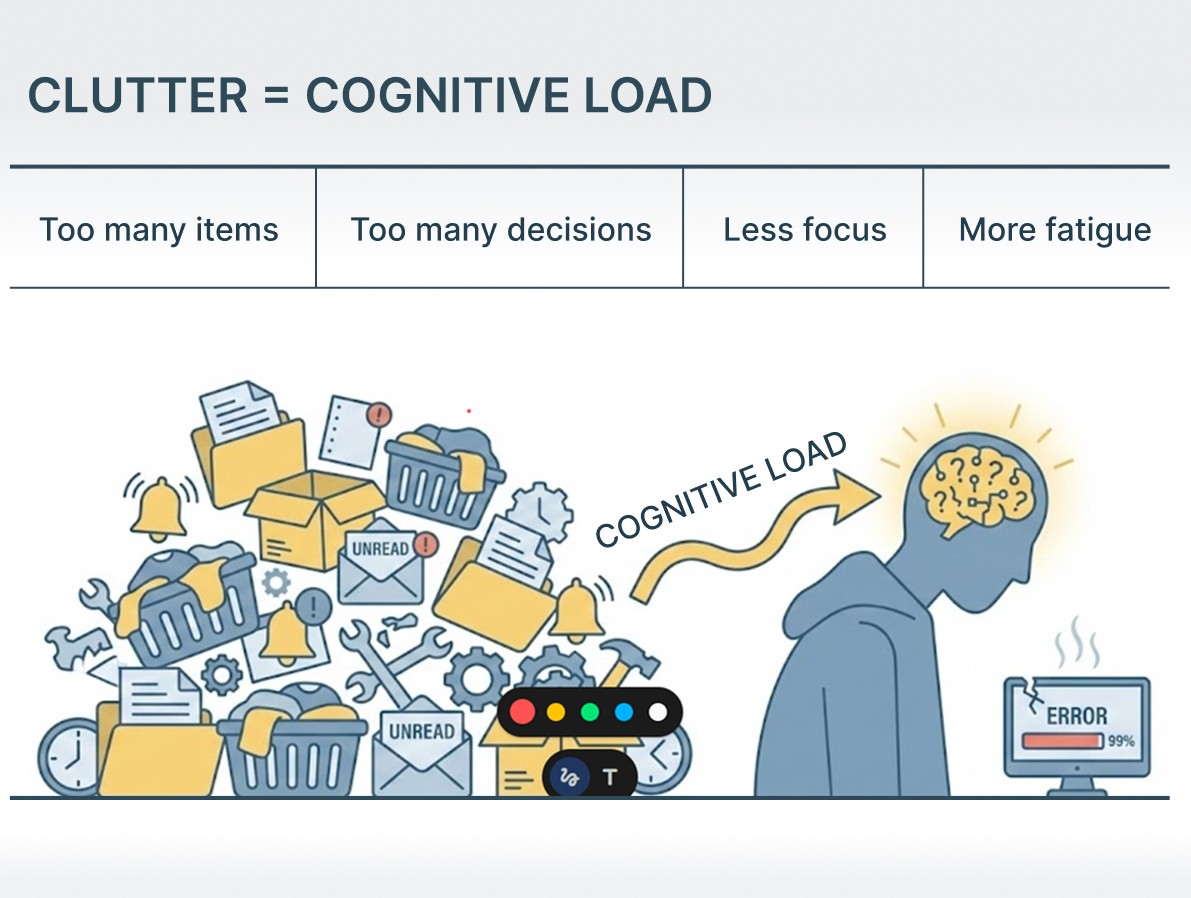
Think of clutter as bloatware. It slows down your life’s processing speed, consumes valuable mental “RAM” and increases the risk of overload. Decluttering removes redundancies, reduces friction in everyday decisions, and improves performance across multiple areas of life.
Psychology Insight: Decision Fatigue
Psychological research suggests that an excess of choices can contribute to mental fatigue. Every object you own invites a micro-decision: where it belongs, whether it needs maintenance, or whether it will be used again. A cluttered environment increases the number of these decisions, gradually draining mental energy that could otherwise support focus, creativity, and problem-solving.
2. Benefits for Home Spaces
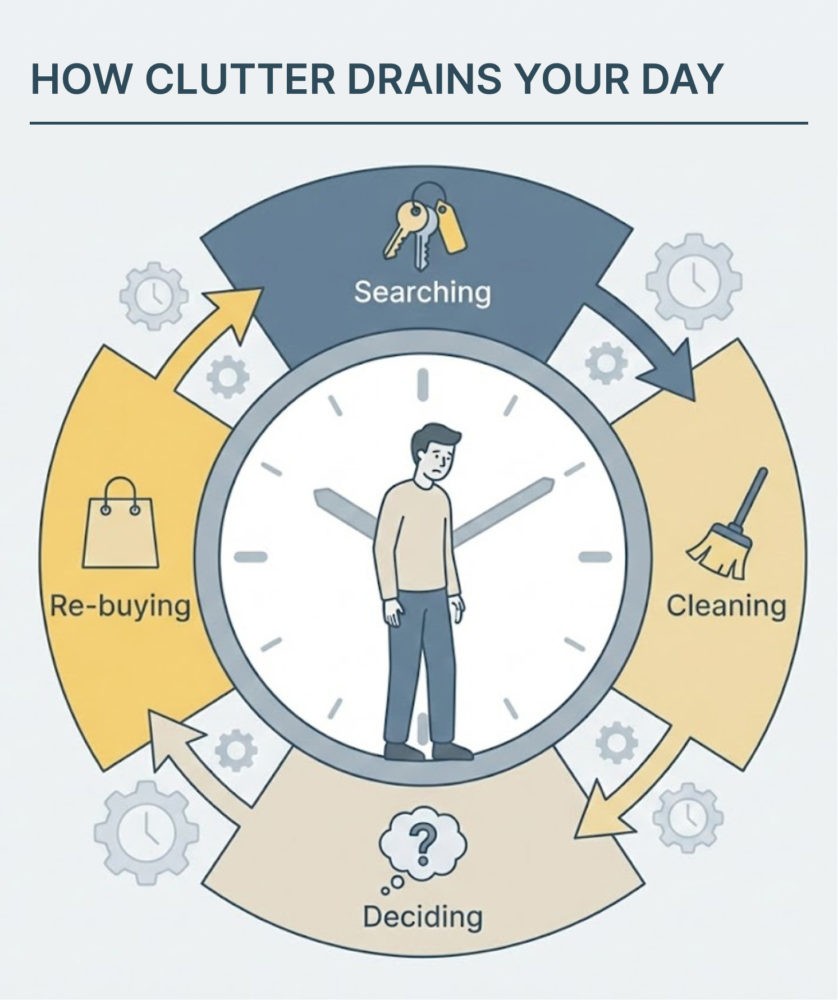
A tidy home creates clarity and calm. Research from the UCLA Center on Everyday Lives and Families found that clutter can elevate cortisol levels (the stress hormone), particularly affecting women, while organized environments support better sleep and lower anxiety.
| Benefit | Impact |
| Stress Reduction | Lowers cortisol levels associated with cluttered environments |
| Time Savings | Reduces time spent searching for items and simplifies daily routines |
| Health & Safety | Fewer hazards, allergens, and easier cleaning |
| Financial Savings | Reduces duplicate purchases by improving visibility of what you own |
3. Benefits for Work and Office Spaces
Clutter occupies more than desk space. It occupies mental space. Research from Princeton University‘s Neuroscience Institute demonstrated that visual clutter significantly reduces cognitive performance and working memory, impairing focus and information processing while increasing mental fatigue.
| Benefit | Impact |
| Productivity Boost | A clear desk enhances focus and cognitive performance |
| Time Efficiency | Reduces time spent searching for tools and files |
| Professional Image | Reflects competence and attention to detail |
| Reduced Burnout | A calm environment lowers cognitive load |
4. Environmental Implications: Decluttering and Waste Awareness
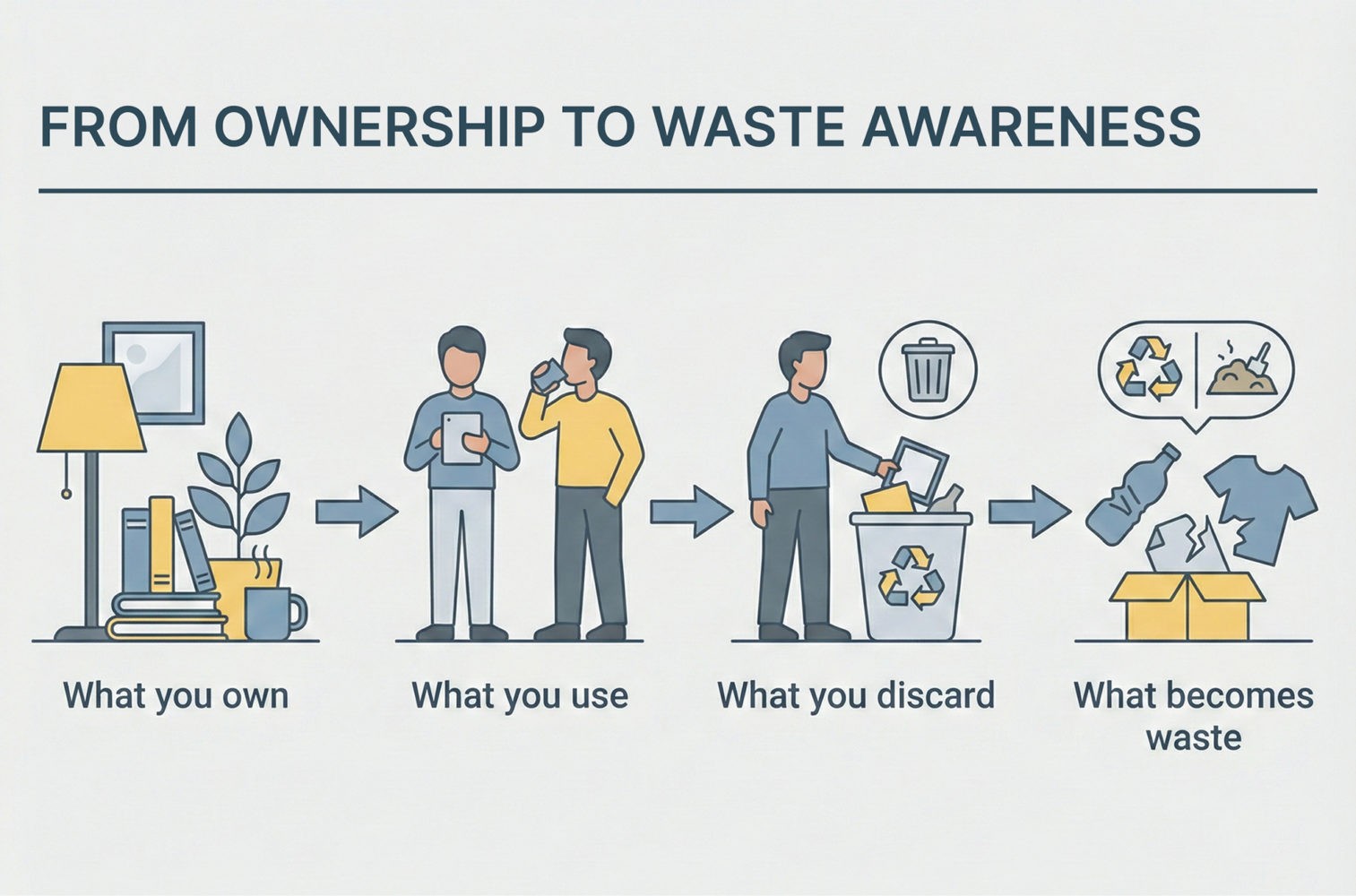
Real environmental impact starts at a much smaller scale than global slogans suggest. Decluttering forces you to confront what you actually own, what you discard, and how much waste you generate, making overconsumption and unnecessary disposal harder to ignore.
Rather than focusing on abstract environmental ideals, decluttering highlights the practical consequences of excess: unused items, premature disposal, and repeated purchases of things already owned.
Practical environmental implications include:
- Greater awareness of consumption patterns:
Seeing what accumulates unused discourages impulse buying and redundant purchases. - Longer product lifecycles:
Donating or rehoming functional items keeps them in circulation and delays disposal. - More responsible disposal decisions:
Sorting items encourages recycling, repair, or proper e-waste handling where available. - Reduced waste by design:
Fewer possessions generally lead to less packaging, fewer replacements, and lower long-term waste output.
Donation and recycling options:
- Clothing and household goods: local charities, shelters, or community exchange groups.
- Furniture: nonprofit reuse centers or furniture banks.
- Electronics: certified e-waste recyclers or municipal collection programs.
- Textiles: retailer or municipality-supported textile recycling schemes.
- Peer-to-peer reuse: local free-sharing or gifting communities.
5. Benefits for Quality of Life
With less to clean, manage, and maintain, you reclaim mental bandwidth. Decluttering eliminates time previously spent searching, cleaning, and managing belongings, freeing you to reinvest in hobbies, health, and relationships.
III. The “How”: Practical Room-by-Room Strategies
Decluttering works best when done systematically. Start with high-impact areas that affect your daily routine. None of this came from a single system. We tested, mixed, and abandoned methods across years. Some ideas from books, some discovered by accident, some still in use in a different form in our daily routine. Occasionally we’d stumble onto something that worked, only to later discover someone else had named and documented the exact same approach. That kind of accidental convergence is actually reassuring: it means the method has merit beyond one family’s experience.
We’ve gathered the best of what we found below. Many of them served us at different stages of the process; what worked when we were drowning in inherited clutter wasn’t always what worked later, when maintenance became the main job — especially as daily routines begin to shift and the reality of living in a home mid-reno sets in. Try what fits your current situation, modify freely, and don’t be surprised if you end up somewhere we’ve already been.
1. Home Decluttering
Kitchen & Dining
- Countertop Rule: Only daily essentials stay visible.
- Expiration Audit: Purge expired or duplicate items monthly.
- Vertical Storage: Use wall hooks, magnetic strips, shelf risers.
- One-In-One-Out: For every new item added, remove one.
- Create functional zones (e.g., “Coffee Zone,” “Prep Zone”) for smoother workflows.
Bedroom & Closets
- 90/90 Rule: Haven’t worn it in 90 days (and won’t in 90 more)? Let it go.
- Reverse Hanger Trick: After six months, donate unworn items.
- Nightstand Limit: Keep only 3–5 essentials.
- Prep Nightly: Lay out clothes to reduce morning decision fatigue.
Living Room & Common Areas
- 10-Minute Reset: Quick nightly tidy-up.
- Hidden Storage: Use ottomans, baskets, or cabinets.
- Cable Management: Label and conceal cords.
Bathroom
- Monthly Expiry Check: Toss expired products.
- AM/PM Baskets: Separate morning vs. night routines.
- Clear Surfaces: Store extras in drawers or bins.
2. Work & Office (Physical + Digital)
Physical Workspace
- Only Today Rule: Keep only active projects visible.
- Drawer-Zone Strategy: Top for daily tools, bottom for rare items.
- 5-Minute Reset: End each day by clearing your desk and writing tomorrow’s priorities.
Digital Workspace
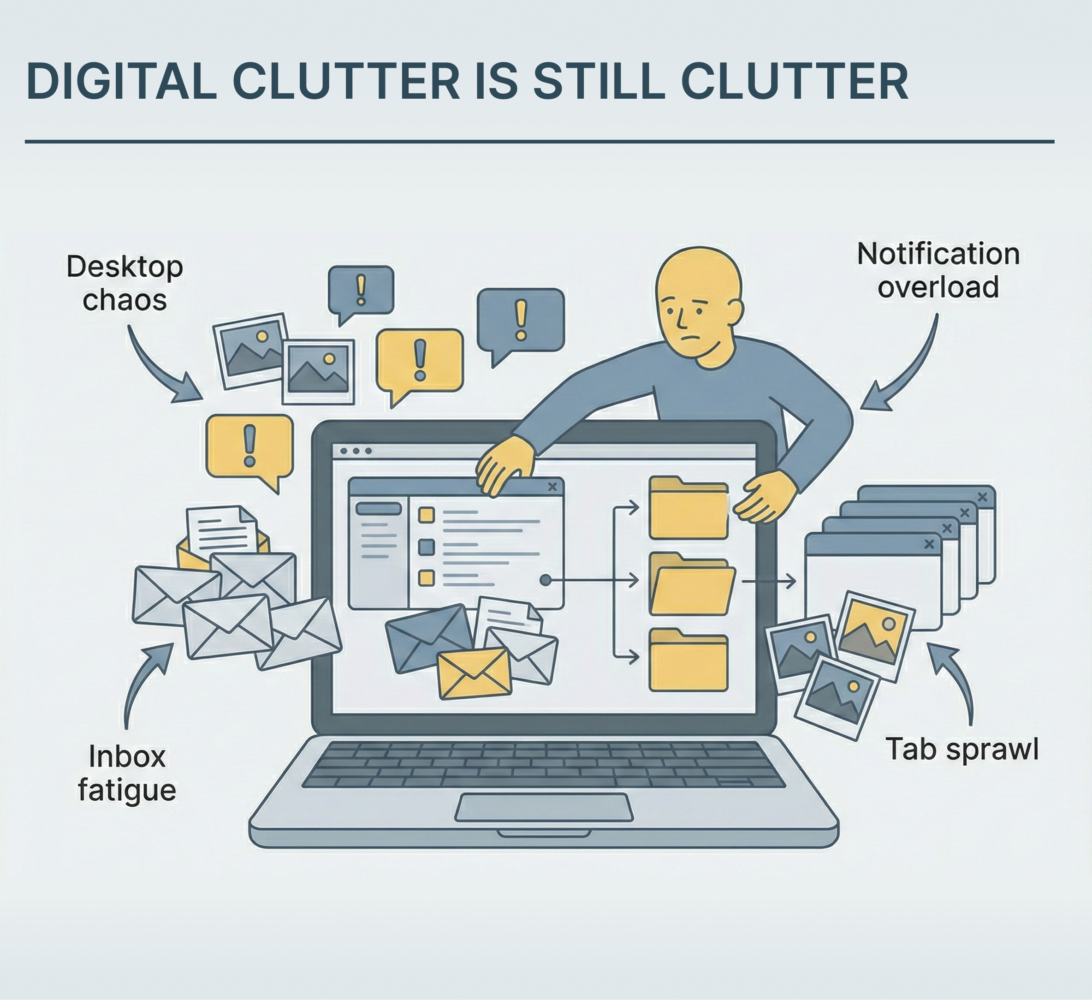
Just as physical piles distract the eye, “mental piles”, unresolved tasks and digital noise, distract the mind. And unlike a messy desk, digital clutter follows you everywhere: from laptop to phone to the back of your mind at 11pm.
Research by Gloria Mark at UC Irvine found that it takes an average of 23 minutes and 15 seconds to fully regain focus after a single interruption. Every notification, unread badge, and overflowing inbox is a potential interruption and the cost accumulates silently across every working day. (Mark, G., Gudith, D., & Klocke, U. (2008). The cost of interrupted work: More speed and stress. CHI ’08 Proceedings.)
The good news: digital clutter responds to the same principles as physical clutter. Clear the environment, and the mind follows.
Desktop Zero
Treat your computer desktop the way you treat a physical desk: nothing lives there permanently. Keep your screen clear and use a structured folder system instead. A cluttered desktop isn’t just visually noisy — your brain processes every icon on it, even when you’re not consciously looking. We set aside the last 10 minutes of each Friday to clear it completely, so Monday starts clean.
Notification Diet
Every ping is a micro-decision: Should I respond? Is it urgent? Can it wait? Multiply that by the number of apps competing for your attention and you understand why evenings can feel as mentally tiring as the working day itself. Turn off all non-human notifications. For work tools (email, project boards, messaging apps) check them at fixed intervals rather than reacting to each alert. Batching your responses is not being unresponsive; it’s being deliberately present on one thing at a time.
Inbox Zero
An inbox is not a to-do list, but most people use it as one, which means it becomes an uncontrollable, externally curated one. Filter aggressively, unsubscribe from anything you scroll past without reading, and archive rather than leave things to “deal with later.” Processing email in a dedicated slot, not continuously throughout the day, removes one of the most persistent sources of digital fragmentation.
File Naming and Structure
Disorganized files are the digital equivalent of things without a home, you know they exist, you just can’t find them when you need them. A simple, consistent naming convention (date, project, version: 2025-01-15_ProjectName_v1) makes your search bar genuinely useful. Standardizing this across a team turns a shared drive from a source of friction into a reliable tool.
Photo and App Purge
Delete duplicate and blurry photos monthly. They accumulate faster than any physical object and consume storage, sync time, and the mental weight of “I really should sort those.” Uninstall apps you haven’t opened in 30 days. Each one represents a background process, a potential notification source, and a small claim on your attention you never consciously agreed to.
Credential Clutter
Password reuse and scattered login details are security risks disguised as minor inconveniences. A password manager (such as Bitwarden or KeePass) is the digital equivalent of having a proper home for every key in your house.
Digital Workspace — Overview
- Desktop Zero: Keep your screen clear, use structured folders.
- Notification Audit: Disable all non-essential alerts.
- Inbox Zero: Filter, unsubscribe, and archive aggressively.
- Photo Purge: Delete duplicates monthly.
- Tab & Bookmark Management: Use tools like Pocket or Momentum.
- Credential Clutter: Use a secure password manager like KeePass Password Safe.
IV. Step-by-Step Implementation: Your Decluttering Upgrade Process
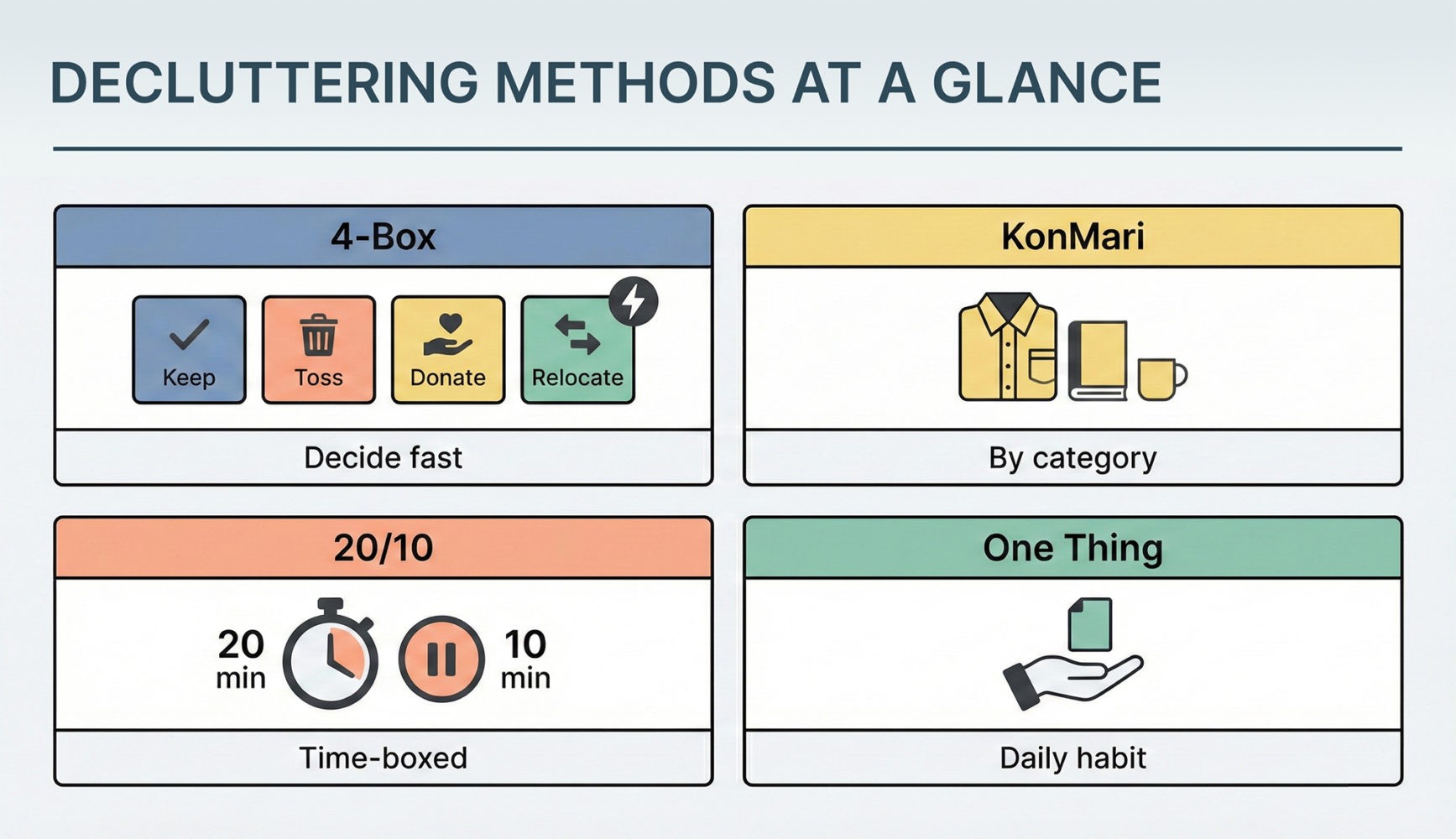
Method 1: The 4-Box Method (Room-by-Room)
| Phase | Actions |
| 1. Preparation | Define your “Why,” gather four boxes (Keep, Donate/Sell, Trash, Relocate) |
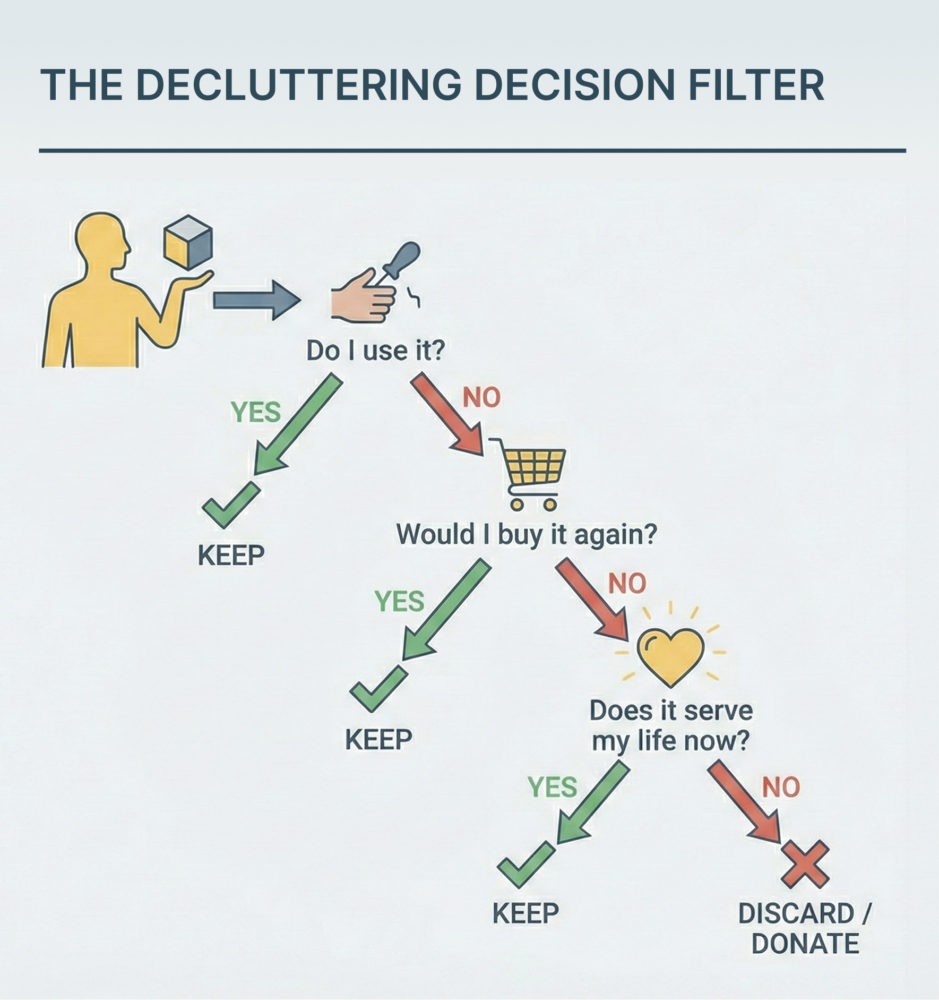
| 2. Sorting | One area at a time. Ask: “Would I buy this again?” |
| 3. Organization | Assign a “home” for each item; label and containerize |
Method 2: The KonMari Method (Category-by-Category)
Popularized by Marie Kondo, this focuses on decluttering by category rather than location.
- Declutter by category, not room.
- Ask: “Does this spark joy?”
- Thank and discard items that don’t.
- Follow this order: Clothes → Books → Papers → Miscellaneous → Sentimental.
Method 3: The Ski Slope Method (Zigzag Decluttering)
This method focuses on momentum by moving through a space without stopping or backtracking.
How it works:
- Move through the room in a zigzag or linear path
- Do not return to previously cleared areas
- Make quick, intuitive decisions to avoid overthinking
Best for: Easily distracted people or those who lose focus when decluttering feels slow.
Method 4: The Core 4 Method
A structured, visual approach that breaks decluttering into four repeatable actions.
The Core 4 steps:
- Clear – Remove everything from the space
- Categorize – Group similar items together
- Cut – Decide what to keep and what to let go
- Contain – Store remaining items in clearly defined containers
Best for: Visual learners and people who prefer systems and checklists.
Method 5: The 20/10 Method
Designed to prevent burnout by alternating short work and rest periods.
How it works:
- Declutter for 20 minutes
- Take a 10-minute break
- Repeat as needed
Best for: Busy, overwhelmed, or low-energy individuals.
Method 6: The Minimalism Game
A time-based challenge that builds motivation through small daily wins.
Rules:
- Day 1: Remove 1 item
- Day 2: Remove 2 items
- Continue adding one item per day
Best for: People who need motivation and enjoy challenges or gamified habits.
Method 7: Swedish Death Cleaning (Döstädning)
A reflective approach focused on reducing the burden on loved ones.
Key principles:
- Declutter with future heirs in mind
- Prioritize meaningful and practical items
- Let go of excess sentimental belongings intentionally
Best for: Sentimental decluttering and long-term life planning.
Method 8: The Packing Party Method
A radical reset that highlights what you actually use.
How it works:
- Pack all belongings as if moving
- Only unpack items when you truly need them
- Donate or discard what remains boxed after a set period
Best for: Identifying true necessities and breaking attachment habits.
Decluttering Methods Overview
| Method | Description | Best For |
|---|---|---|
| 4-Box Method | Sort items into Keep, Donate/Sell, Trash, Relocate | Room-by-room declutterers |
| KonMari Method | Declutter by category; keep what sparks joy | Emotion-driven decisions |
| Ski Slope | Zigzag through the room without backtracking | Easily distracted types |
| Core 4 | Clear, Categorize, Cut, Contain | Visual learners |
| 20/10 Method | 20 minutes decluttering, 10 minutes rest | Busy or overwhelmed people |
| Minimalism Game | Remove 1 item on Day 1, 2 on Day 2, etc. | Those needing motivation |
| Swedish Death Cleaning | Declutter to avoid burdening others | Sentimental decluttering |
| Packing Party | Box everything; unpack only what you use | Revealing true needs |
4. Maintenance Phase
Organization is a habit.
- Daily (5–10 min): Reset surfaces, apply OHIO (“Only Handle It Once”).
- Weekly (30 min): Digital cleanup, mini tidy (Inbox, desktop, junk drawer).
- Monthly (1–2 hrs): Deep clean one zone (Pantry, closet).
- Quarterly (3–4 hrs): Seasonal rotation (Clothes, décor, audit systems).
V. Overcoming Obstacles: Troubleshooting Common Problems
| Challenge | Mindset Shift / Fix |
| Emotional Attachment | Take a photo; the memory isn’t in the item. |
| Sunk Cost Fallacy | Keeping it won’t recover money; reclaim space instead. |
| Future-Regret Fear | Apply the 20/20 Rule: if replaceable within $20 and 20 minutes, let it go. |
| Overwhelm | Start with 15 minutes; use time-boxing. |
| Family Resistance | Lead by example; focus on your spaces first. |
VI. Advanced Strategies: Power-User Optimizations
- 90-Day Box Test: Label and revisit later. If unopened, donate.
- 12-12-12 Challenge: Trash 12, donate 12, relocate 12.
- Capsule Wardrobe: Keep 30–40 quality, mixable pieces.
VII. Special Situations: Adapting to Different Needs
- Moving/Downsizing: Declutter before you pack; digitize documents.
- Life Transitions: Assess what fits your new lifestyle.
- Small Spaces: Prioritize vertical and modular storage.
- Neurodivergence Considerations: For those with ADHD, transparent storage helps combat “out of sight, out of mind.” Those on the autism spectrum may benefit from consistent systems that reduce sensory overload.
- Budget-Friendly Organizing: Use shoeboxes, mason jars, and repurposed containers. The goal is organization, not consumption.
VIII. Resources & Tools: Your Decluttering Toolkit
| Category | Examples | Purpose |
| Task & Habit Apps | Tody, Habitica, Clutterfree | Routine tracking |
| Inventory/Email | Sortly, Unroll.me | Inventory & inbox cleanup |
| Digital Tools | Bitwarden, Momentum, Pocket | Passwords, browser clarity |
| Physical Tools | Clear bins, label maker, cable clips | Storage & organization |
IX. Conclusion: The Upgraded Life
I won’t pretend this process has a clean ending. Our home (and office) is genuinely tidy now. Ttidier than it has ever been, but the work didn’t stop when the big inherited backlog was cleared. It became something else: a daily rhythm, a set of habits so embedded we barely notice them anymore. That, I think, is what success actually looks like. Not a single transformative weekend, but a point where maintaining order costs less effort than tolerating disorder.
What surprised me most was how much the physical and digital ran in parallel. Clearing a room and clearing an inbox produce the same sense of restored capacity: the feeling that you can think clearly again, that you know where things are, that you’re in control of your environment rather than managed by it. The space you live and work in shapes how you feel and how you perform. Change the space; change the output.
Start small. Pick one drawer, one folder, one corner. Do it properly and give it a permanent home. Then do the next one. Consistency compounds in a way that intensity never quite manages and unlike the marathon sessions that leave you exhausted and half-finished, a small daily habit leaves you with the rest of your day intact.
The clutter will reduce. The habits will form. And you’ll have spent the good hours actually living. Not just managing what you own.
A clear space creates a clear mind, and clarity fuels creativity, calm, and connection.
Appendix A: Quick Reference Checklists
Daily Reset (5–10 min)
- Clear surfaces
- Return items to “homes”
- Process papers (OHIO Rule)
- 5-minute desk reset
Weekly Refresh (30–60 min)
- Declutter one problem zone
- Drop off donations
- Digital cleanup
- Plan meals
Appendix B: Digital Declutter Action Plan
Week 1: Audit & Purge
- Desktop: Organize files, delete duplicates.
- Email: Unsubscribe & archive old mail.
- Photos: Remove blurry or redundant shots.
- Apps: Uninstall unused ones, clear caches.
Week 2: Optimize & Maintain
- Notifications: Disable all non-essential alerts.
- Bookmarks: Remove dead links, categorize.
- Passwords: Store safely in a password manager.
Additional Resources
Research
Methods:
Donation:
⸻ Author Bio ⸻
Sophie E. Vall is a UI/UX designer with a background in IT, and an entrepreneur currently building a new startup. She has managed UI/UX teams, run two startups, and helped banks build their systems, as well as productivity tools and content management tools. She writes about organization, planning, and productivity, drawing on hands-on experience designing systems that are both efficient and human-centered. Her broader interests include self-development, the arts, sports, business, and photography.