

Modern work is no longer defined by effort alone. It’s defined by flow. Teams today are less concerned with how much they produce and more focused on how smoothly ideas move from concept to execution. Nowhere is this shift more visible than in social content creation, a process that has quietly evolved from a creative task into a complex operational workflow.
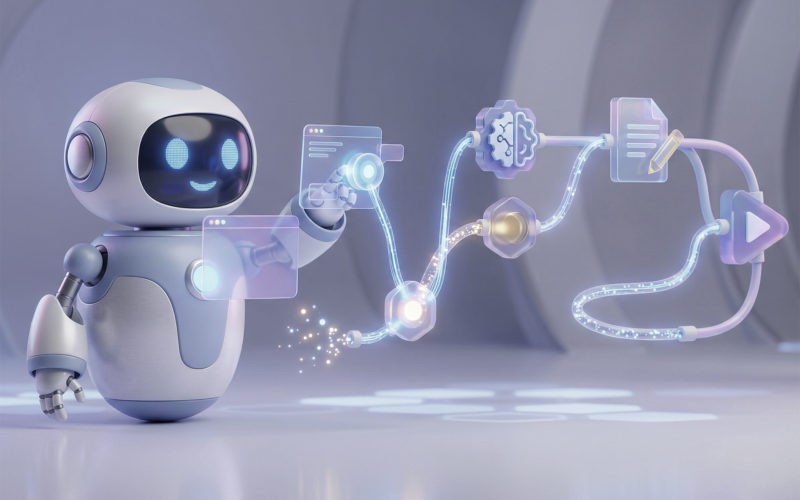
As content demands increase and platforms multiply, manual processes are struggling to keep up. To bridge the gap, more organizations are turning to AI-powered content workflows that automate repetitive steps, connect data to action, and allow people to focus on creative and strategic decisions rather than logistics.
This change isn’t about speeding people up. It’s about redesigning how work happens.
Social Content Creation as a Workflow Problem
For a long time, social content creation was treated as a series of isolated tasks. Someone came up with ideas, someone wrote captions, someone scheduled posts, and someone reviewed performance later. This approach worked when content volumes were low and expectations were modest.
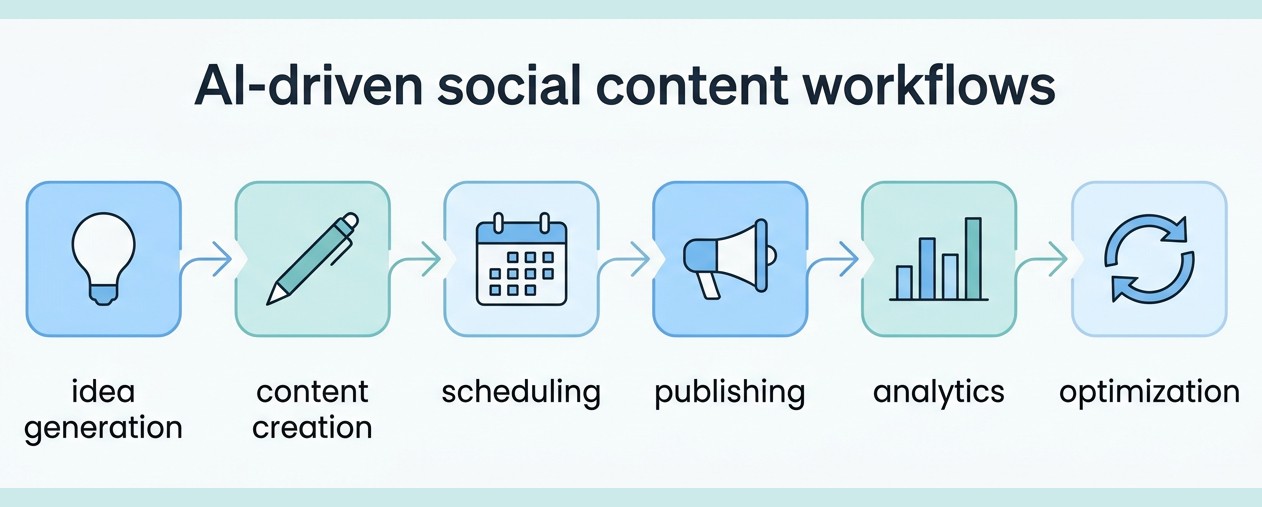
Today, social content creation resembles a production pipeline. It involves planning, writing, editing, formatting, scheduling, publishing, monitoring, and optimizing, often across multiple platforms at once. Each step depends on the previous one, and delays compound quickly.
When these workflows remain manual, friction accumulates. Teams spend more time coordinating than creating. Execution slows. Insights arrive too late to matter.
AI changes this by treating content creation not as a collection of tasks, but as a system.
From Task Automation to Workflow Automation
Early automation tools focused on individual steps. They helped schedule posts or generate captions, but left the surrounding workflow untouched. While helpful, these tools didn’t fundamentally change how work moved through the system.
AI-powered workflows take a different approach. Instead of automating tasks in isolation, they connect steps together. Content generation feeds directly into scheduling. Performance data feeds back into creation. Decisions are informed continuously rather than reviewed periodically. This shift mirrors a broader trend in work design: moving from linear processes to adaptive systems.
Designing Workflows That Think
The defining feature of AI-driven workflows is not speed, it’s intelligence. These systems don’t simply execute instructions; they learn from outcomes and adjust future actions accordingly.
In social content creation, this means AI can analyze which topics perform well, when audiences are most active, and how engagement changes over time. That information is then used to guide what content is created and when it is published. As a result, workflows become self-improving. Instead of relying on static calendars or assumptions, teams work with systems that adapt automatically.
Reducing Cognitive Load for Creative Teams
One of the least discussed benefits of AI automation is cognitive relief. Creative work requires mental space. When teams are burdened with scheduling decisions, formatting requirements, and constant monitoring, creativity suffers.
AI-powered workflows absorb much of this mental overhead. Decisions about timing, frequency, and prioritization happen in the background. Teams no longer need to constantly ask, “What should we post next?” or “Did we miss the best time?”
This frees people to focus on direction, storytelling, and experimentation, the parts of work that benefit most from human judgment.
Workflow Automation Without Losing Control
A common concern around AI automation is loss of control. In poorly designed systems, this fear is justified. But effective AI-powered workflows are built around human-defined constraints.
People still decide tone, values, and goals. AI operates within those boundaries, optimizing execution rather than inventing intent. The relationship is supervisory, not autonomous. This balance ensures that workflows remain aligned with organizational priorities while benefiting from automation.
Smarter Workflows Scale Better Than Bigger Teams
As organizations grow, workflows often become the bottleneck. Adding more people increases coordination costs and slows decision-making. AI offers a different scaling model.
By automating execution and feedback loops, teams can increase output without linear growth in headcount. This is particularly valuable for distributed teams and organizations operating across time zones. Instead of expanding teams to manage complexity, businesses redesign workflows to handle complexity themselves.
Workflow Intelligence and the Future of Work
This shift toward intelligent workflows reflects a larger transformation in how work is organized. Harvard Business Review has noted that the most effective applications of AI are those that augment workflows rather than replace workers, allowing organizations to reallocate human effort toward judgment, creativity, and problem-solving.
Social content creation is a clear example of this principle. AI doesn’t eliminate creative roles, it reshapes them. People move from execution to orchestration, from doing to directing.
Continuous Feedback as a Design Principle
Traditional workflows rely on delayed feedback. Content is published, metrics are reviewed later, and adjustments are made in the next cycle. AI-powered workflows collapse this delay.
Performance data feeds directly into the system, allowing immediate adjustments. This creates a tighter loop between action and insight, improving responsiveness and reducing wasted effort.
Over time, these feedback loops compound, making workflows more efficient and resilient.
Designing for Flow, Not Output
One of the most important mindset shifts AI introduces is a move away from output obsession. Productivity is no longer measured solely by volume, but by flow, how smoothly work moves through the system.
Well-designed workflows minimize interruptions, reduce handoffs, and eliminate unnecessary decisions. AI supports this by handling routine choices automatically.
When work flows, people feel less friction and more focus. Creativity becomes sustainable rather than exhausting.
What This Means for Teams and Organizations
Teams that adopt AI-powered workflows often experience a cultural shift. Meetings become more strategic. Less time is spent managing tools. More time is spent refining ideas and improving quality.
Organizations benefit from greater consistency and adaptability. Social content creation becomes a reliable system rather than a recurring scramble.
Importantly, these gains don’t come from working harder. They come from working smarter.
Looking Ahead: Workflows as Living Systems
As AI continues to evolve, workflows will become increasingly autonomous, not in replacing people, but in managing complexity. Social content creation is just one example of a broader trend toward systems that learn, adapt, and support human work.
The future of work belongs to teams that design workflows intentionally, using AI to remove friction rather than add speed.
AI is changing social content creation not by automating creativity, but by automating everything around it. Through AI-powered content workflows, teams can move ideas from concept to publication with less friction, less fatigue, and more focus.
By designing smarter workflows, organizations aren’t just producing more content. They’re creating better conditions for meaningful work to happen. In a world where attention is limited and complexity is rising, that may be the most valuable automation of all.