


Professional networking has undergone a structural shift. As digital communication becomes effortless, scalable, and increasingly AI-mediated, effort itself no longer signals value. What differentiates professionals now is judgment: what they contribute, where they engage, and when they choose restraint.
Traditional networking models — based on contact accumulation, transactional outreach, and constant visibility — are increasingly ineffective. In their place, networking has evolved into a relationship ecosystem shaped by public thinking, private contribution, third-party validation, and long-term behavioral consistency.
Trust is no longer built through proximity or volume. It is inferred from patterns: coherence of thought, contextual generosity, reliability over time, and the quality of one’s intellectual footprint. Algorithms amplify this dynamic by filtering visibility and mediating discovery, while private, unindexed communities increasingly host the highest-trust professional interactions.
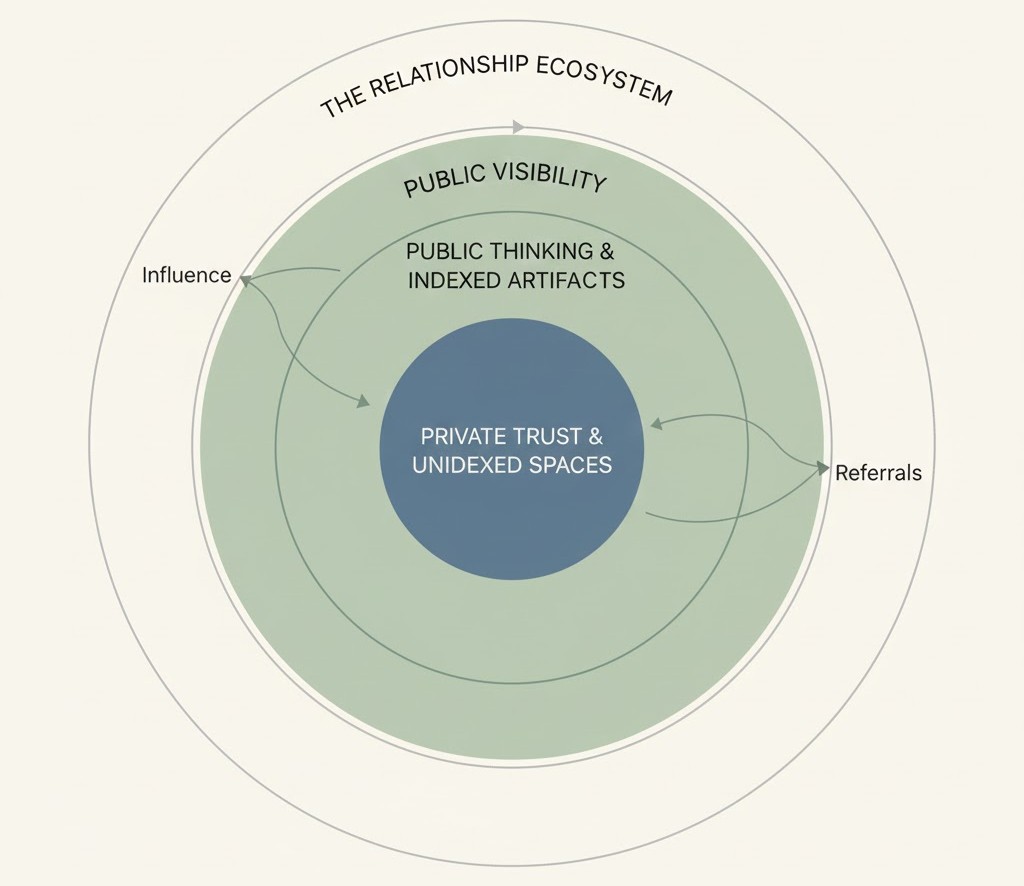
The Relationship Ecosystem
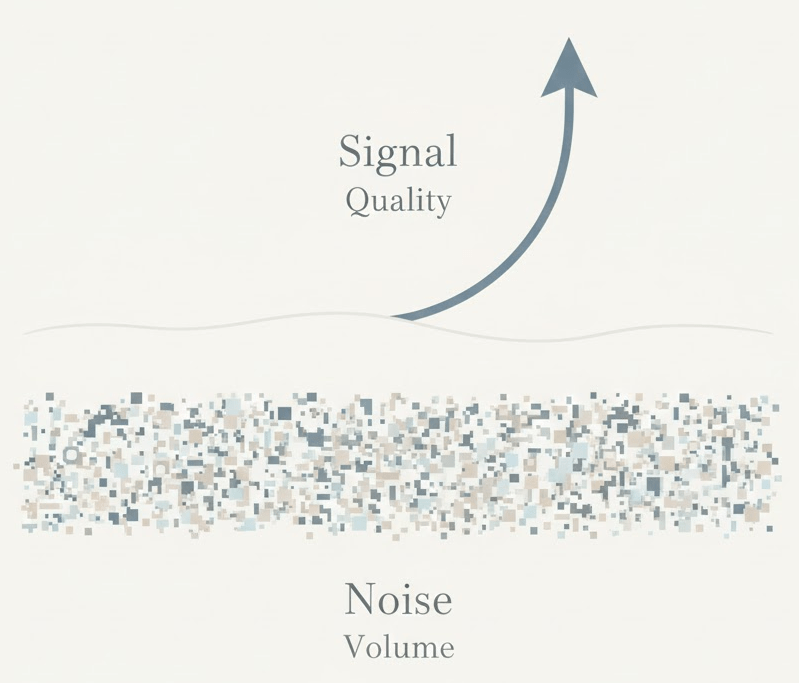
- Visibility without coherence creates noise, not credibility
- Strategic restraint often signals maturity, not disengagement
- Reputation travels through artifacts, not introductions
- AI accelerates exposure but cannot establish judgment
Networking in 2026 and beyond should be treated as professional infrastructure — a long-term asset that compounds through trust, clarity, and contribution, rather than a short-term growth tactic.
The professionals who thrive will not be those who connect most aggressively, but those whose presence consistently improves the quality of conversations they enter.
The Signal and the Soul in a Saturated Professional World
In late 2024, a senior consultant shared a quiet concern: “I’m more visible than I’ve ever been — and less trusted than I was five years ago.”
Their LinkedIn following had grown. Their inbox was full. Yet the caliber of conversations had declined. Opportunities felt noisier, thinner, more transactional.
This is not an isolated experience. It is a structural consequence of how professional networking now works.
As digital communication has become effortless, scalable, and increasingly AI-assisted, the value of effort has collapsed. What remains scarce — and therefore valuable — is judgment: what you choose to say, where you choose to say it, and just as importantly, when you choose not to speak.
Networking in 2026 and beyond is no longer about visibility alone. It is about signal quality, contextual trust, and the accumulation of a credible intellectual footprint over time.

A Brief Hypothetical: How Modern Trust Actually Forms
Consider two professionals with similar credentials entering a new industry conversation in 2026. The first publishes weekly posts, comments broadly, sends polite follow-ups, and accepts every introduction. Their name appears often, but rarely in the same context twice. When asked what they stand for, responses vary.
The second publishes sparingly. Over six months, they write two pieces clarifying a misunderstood industry shift, privately summarize a regulatory change for a small peer group, and quietly connect two people solving adjacent problems. They decline most calls. They ask for nothing.
By the end of the year, the first professional has more visibility. The second has fewer conversations, but higher-stakes ones, arriving via introduction rather than outreach.
Nothing about this difference is accidental. It reflects how modern networking systems reward coherence, restraint, and contribution over activity.
Two Networking Paths
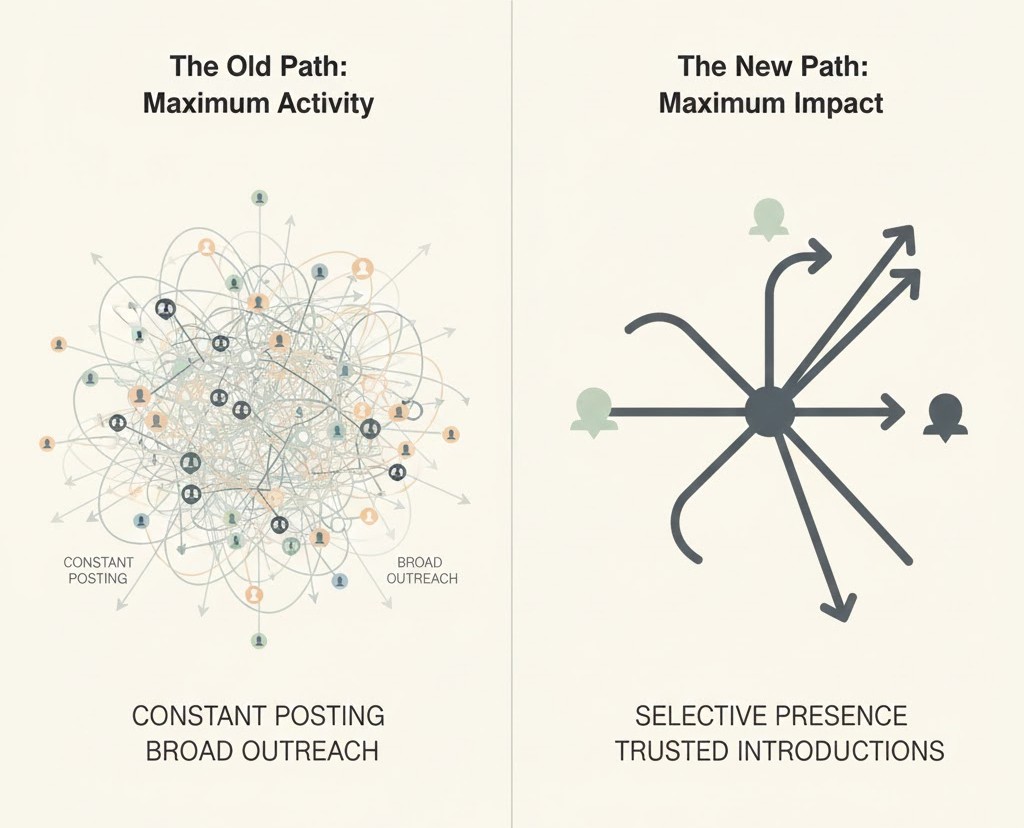
From Contact Accumulation to Relationship Ecosystems
Traditional networking advice treated relationships as linear transactions: meet, exchange value, follow up, repeat. In a digitally mediated world, this model no longer holds.
Modern networking functions as a relationship ecosystem, a living system shaped by public thinking, private contribution, third-party validation, and long-term behavioral consistency. People do not evaluate you based on a single interaction, profile, or message. They infer trust from patterns.
Crucially, this ecosystem is observable. Writing, comments, collaborations, and even silences leave artifacts. Over time, these artifacts form a reputation that travels faster, and further, than you do.
This is why networking can no longer be reduced to follower counts, outreach volume, or optimized profiles. Those are distribution mechanics. Trust is an interpretive act.
A Structural Shift, Not a Cultural One
What has changed is not etiquette, it is infrastructure. AI now assists with writing, discovery, matching, and filtering. Algorithms determine who is visible and credible before humans ever engage. Remote work has dissolved proximity as a proxy for trust. Professional audiences, overwhelmed by performative engagement, have developed sharper filters.
While in-person relationships remain critical in many industries, even traditionally physical professions now rely on digital reputation trails for referrals, credibility checks, and opportunity flow.
In this environment, being everywhere often signals a lack of depth. As seen in the earlier example, coherence — not frequency — has become the dominant credibility marker.
How Trust Is Actually Formed Online Now
Radical Generosity and Contextual Relevance
Trust begins asymmetrically. In early relationships, value must flow primarily in one direction, without an immediate ask. However, generosity alone is insufficient. It must be precisely contextual.
Helping someone think more clearly about a problem they are already solving builds far more trust than offering broadly useful but untimely advice. Radical generosity does not require grand gestures; it can be as simple as privately synthesizing a complex issue for someone actively navigating it, without attaching a meeting request or expectation of return.
Consistency Over Intensity
Trust accrues through repeated, low-friction interactions, not bursts of visibility. Professionals remember those who show up predictably, not performatively.
The second professional in the earlier example benefits not from activity, but from reliability.
Intellectual Footprint
People trust those who help them think better.
An intellectual footprint is the cumulative trace of how you frame problems, synthesize information, and exercise judgment across contexts. Unlike content volume, it cannot be easily automated and that is precisely why it matters.
Platforms as Reputation Ledgers, Not Stages
Professional social platforms function less like stages and more like public ledgers of professional intent. They record what you pay attention to, how you engage, and what you choose to amplify.
The most effective professionals here do not optimize for discovery. They optimize for recognition. Like the second professional in the earlier example, they are remembered for clarity, not frequency.
Profiles increasingly act as working documents, reflecting current thinking rather than static résumés.
Ghost Networking and Private Trust
As public platforms inflate with noise, high-trust conversations migrate to unindexed spaces: private Slack groups, Discord servers, WhatsApp threads, invitation-only forums.
This is often called ghost networking. Not because it is secretive, but because it leaves fewer visible traces.
These environments are where reputations are stress-tested. Contribution matters. Posturing fails. This is where the second professional’s trust compounds, outside public feeds, through quiet usefulness.
Trust in private spaces compounds quietly but travels far.
In 2026, owning your relationship graph — moving your most valuable connections from platform-owned feeds to private, portable channels — is the ultimate career insurance policy.
The Trust Shift
| Legacy (Pre-2024) | Modern (2026+) |
| Volume | Signal |
| Focus on reach, follower counts, and mass visibility. | Focus on depth, relevance, and the quality of contributions. |
| Automation | Judgment |
| Using tools to scale outreach and generic engagement. | Using human discernment to choose when and where to speak. |
| Transactional | Ecosystem |
| Short-term “exchange” of value for immediate gain. | Long-term reputation built through sustained, credible presence. |
Content Without Burnout: Curated Participation
Not everyone needs to be a creator.
Modern ecosystems reward participation clarity, not constant output. Some professionals articulate original frameworks. Others synthesize complex threads. Others connect people across domains.
All three roles create value. None require ubiquity.
Curated participation allows professionals to build trust without exhaustion and without diluting their signal.
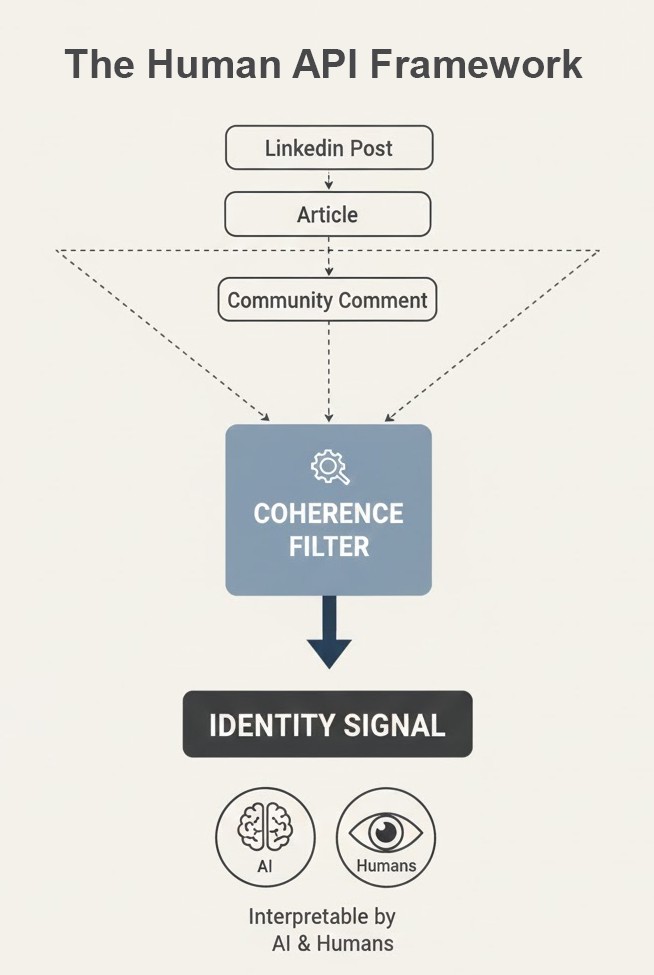
AI-Mediated Discovery and the “Human API”
As AI agents increasingly mediate discovery and introductions, professionals face a subtle challenge: how to be legible to machines without flattening themselves for machines.
The answer is not optimization. It is coherence.
Consistent terminology, stable conceptual pillars, and repeated framing across platforms make thinking interpretable to algorithms and humans alike. Being legible to AI means using consistent language for your core pillars across your LinkedIn bio, articles, repositories, and collaborations.
AI may accelerate exposure. It cannot establish judgment on your behalf.
Common Failure Modes in the Modern Landscape
Mass outreach signals low discernment. Performative engagement creates noise, not memory. Over-automation erodes trust faster than it saves time. Confusing access with relationship leads to premature asks.
Strategic restraint is a signal of maturity, not a universal rule. Early-career professionals often need to earn visibility before restraint becomes interpretable as authority.
The most damaging mistake is treating networking as episodic effort rather than observable behavior over time.
The 2026 Networking Audit
A self-diagnostic for professional relevance and signal strength.
| Audit Metric | Key Diagnostic Question | Success Signal |
| Searchability | Do your public artifacts provide a clear, high-fidelity signal for AI discovery agents? | An AI agent can accurately summarize your expertise using only unindexed or public data. |
| Contribution Ratio | Are you providing 5× more value than the value you are requesting? | Your “value-out” (help, synthesis, intros) significantly outweighs your “asks.” |
| Intellectual Coherence | Does your visible thinking form a recognizable, consistent through-line across platforms? | A peer can describe “what you stand for” after seeing only two disparate pieces of your work. |
| Trust Velocity | Are your highest-quality opportunities arriving via warm introductions rather than cold outreach? | Inbound interest and referrals have replaced the need for aggressive “top-of-funnel” hunting. |
Networking as Long-Term Infrastructure
Networking is no longer a growth tactic or career accessory. It is professional infrastructure. The professionals who thrive beyond 2026 resemble the second case: fewer signals, stronger trajectories, and reputations that precede them.
In a digital world optimized for speed and scale, meaningful connection remains deliberately human and therefore increasingly valuable.
Appendix: Tools as Networking Infrastructure
Tools do not create trust; they shape the conditions under which trust compounds. When a tool encourages volume over judgment, it is working against you.

| Category | Description |
|---|---|
| Context-Aware Relationship Managers (CRMs) | Moving beyond the static “address book,” these tools (e.g., Dex, Clay, or localized AI agents) map the “interconnectedness” of your network, surfacing why you should reach out based on shared context rather than calendar reminders. |
| Encrypted Peer Communities | High-trust conversations are migrating to gated, unindexed environments (e.g., Signal groups, Farcaster channels, or private Discord “War Rooms”). These tools prioritize data sovereignty and verified identity. |
| Knowledge Synthesis & “Public Thinking” Platforms | Tools that allow for long-form reasoning (e.g., Substack, Obsidian Publish, or Tana) preserve your intellectual footprint in a way that social feeds cannot. |
| Verified Digital Identity Protocols | As AI impersonation rises, tools that verify “Proof of Personhood” or portable reputation scores (e.g., WorldID or ENS-linked credentials) will become the gatekeepers for high-value introductions. |
| AI Discovery Agents | Instead of “searching” for people, we use agents to match us with peers based on “Human API” legibility — finding collaborators based on deep conceptual alignment rather than keyword matching. |