



Artificial intelligence has become a regular feature of the process of how individuals write articles, marketing text, essays, and even posts on social media. However, despite the usefulness of such tools, AI generated writings tend to experience the same problems. They vary from being too perfect, oddly polished to being flat or affected. The result? Readers are able to feel that something is off yet they are unable to articulate the cause of the same.
To make your AI-assisted content sound warm, relatable, and based on everyday human experience, you must approach this differently. You’re not just editing words; you’re shaping voice and intention. This guide discusses how to make AI writing feel more human by focusing on emotional tone, clarity, narrative flow, and context awareness. You’ll also find practical ways to add personality and real-world examples so the writing feels less machine-generated and more like a real person wrote it.
Why AI Writing Often Feels Robotic
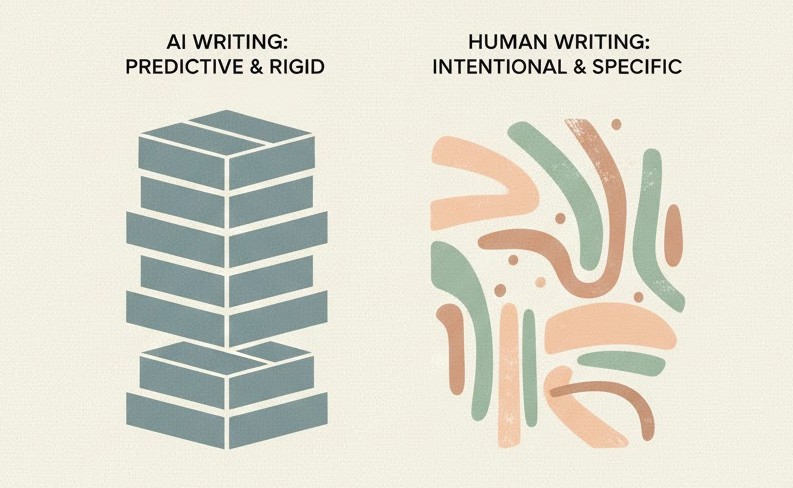
AI writing applications are occasionally too predictive. It starts to seem algorithmic when you read a paragraph with perfect transitions and perfectly structured sentences. There are three main reasons why this happens:
- High structural asymmetry: Human beings are predisposed to using long and short sentences interchangeably, unlike AI.
- Emotion without specificity: AI expresses general emotion, not lived emotion.
- Lack of context memory: AI is concerned with accuracy as opposed to voice.
The goal isn’t to make AI copy unpredictable or sloppy. The goal is to make it sound intentional, like it came from a real person thinking through a topic.
How To Make AI Writing Feel Human
The following tips will help make AI feel more human.
1. Apply Emotion as It is Applied by Humans
People are not monotonous when expressing emotion so when we are writing something informational, we tend to incorporate nuanced responses. In order to get AI writing closer to human content, you need to consider:
- Micro-expressions in text
- Self-consciousness
- Light humor or warmth
These minute details make the writing feel like a conversation rather than a formal report. Moreover, do not repeat words that are too common in machine-generated texts.
2. Use Variation Within a Single Paragraph
AI tends to hold a steady pace, but we humans don’t. We switch between the following effects:
- Lists
- Short transitions
- Long reflective sentences
- One-liners for emphasis
If you have ever worried that your content might get flagged by an AI detector for ChatGPT, you’re not alone. Many creators want their work to read as genuine and conversational. The real goal isn’t to trick machines, it’s to create human-sounding AI content that reflects the tone and clarity people expect when they read something truly thoughtful.
3. Insert Real-life Scenario
One of the effective ways to humanize AI writing is to include short and specific examples. These do not need to be full stories as even tiny fragments make the content feel grounded. Small details such as “a colleague reacted” or “I first tried rewriting” mimic genuine human-centric memory and therefore reduce robotic tone. Use simple moments such as something you observed or something a client said.

4. Incorporate Less Predictable Flow
Humans rarely write in perfect outline format. As we drift, we return to ideas. It is basically switching gears in the middle of our thoughts. Well, that’s part of the charm. To recreate the style, you just have to let some sentences run longer than others, add transitional phrases, and intentionally break the rhythm.
This sense of natural flow makes the writing feel more textured and alive. When you pay attention to these subtle elements, your AI writing begins to take on a more natural flow, and it feels less algorithmic and more intentional.
5. Reduce Generics and Increase Specifics
AI loves generic enthusiasm, but we humans love specifics. For example, if you want to write a text as mentioned below:
AI: “AI helps writers improve productivity and generate high-quality text.”
Human: “I use AI when I’m stuck on a headline or when a paragraph needs a push in the right direction.”
You may notice how the second sentence feels closer and more familiar. It has a tiny confession, a purpose, and a relatable challenge. Most readers trust writing that sounds like lived experience, so try adding lines like:
“Here’s the part I struggled with…”
“At first, I didn’t think this mattered, but…”
“A friend pointed this out to me…”
These simple anchors bring your writing back to reality.
6. Insert an Actual Point of View
AI tends to utilize everything it can get, whereas human writing displays a real opinion. In order to correct this, we can add a personal stance or minor criticism. Many AI text improvement tools are fairly good at formatting, but are unable to tell the emotional relevance of some topics unless you guide them.
7. Add Imperfect Elements on Purpose
Humans don’t write flawlessly, and the reason is that we pause and shift tone. This sometimes leads to us contradicting ourselves. A perfectly clean paragraph can actually read as artificial, so consider adding:
- A rhetorical question
- A moment of self-doubt
- A sentence fragment for emphasis
- A conversational shrug (e.g., “…and honestly, that surprised me.”)
8. Make Every Paragraph Matter
Another thing that you can do to enhance authenticity is by making sure there is a reason why information is important in each paragraph. AI is likely to provide facts without context and emotional attachment. In order to make writing sound like a human being, relate points to actual motivations. Also, associate ideas with real life scenarios and involve transitions that are thoughts-based.
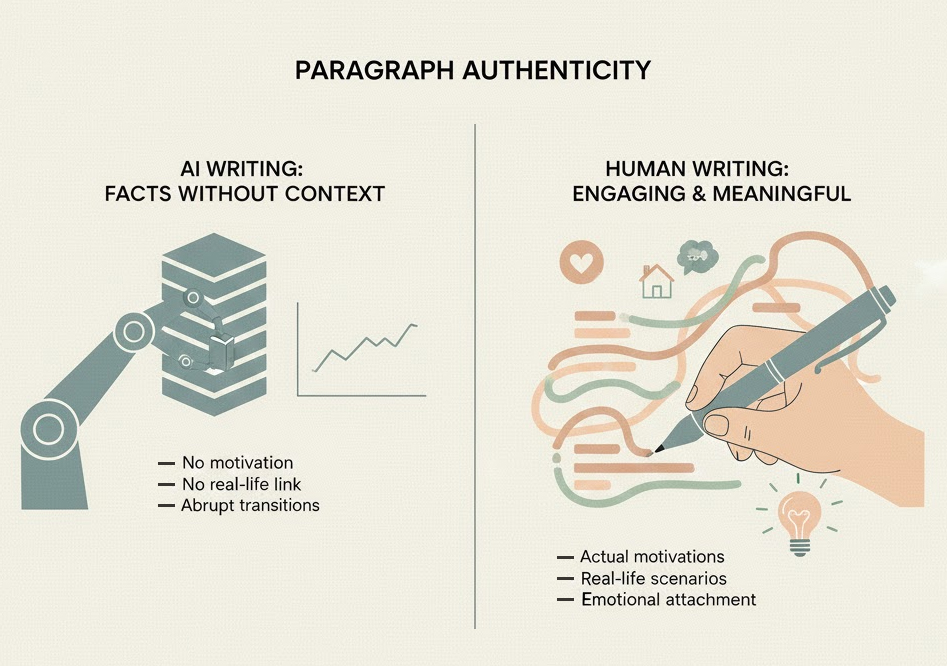
For example: “Understanding emotional tone isn’t just about sounding warmer; it’s about giving readers a reason to stay.” You can see here that the paragraph has purpose, unlike ordinary information.
Top 5 Tools for Humanizing Texts
After applying the core techniques that make AI writing feel more human, the right tools can help take things a step further. AI humanizers are designed to refine wording, improve flow, and smooth out patterns that still feel machine-generated. Below are some of the most effective tools available for turning AI text into natural-sounding, human-like content.
1) EduBrain.ai – AI Humanizer

EduBrain’s AI Humanizer is designed to rewrite AI-generated text into language that feels natural, clear, and genuinely human. Instead of aggressive rewriting, it focuses on improving flow, sentence variety, and readability while preserving the original meaning. The tool works well for academic and informational content, offering balanced results that sound human without overcorrecting. Its clean interface and reliable output make it a strong choice for users who want subtle, effective humanization rather than drastic rewriting.
2) StealthGPT
StealthGPT is a simple and focused AI humanizer that does one thing well: it rewrites short AI-generated texts into more natural language. With a 350-word limit, it’s best suited for small sections rather than long documents. While it lacks advanced controls like tone or mode selection, the output reads smoothly and performs well against AI detectors. It’s a solid option for quick edits when you want straightforward, human-sounding text.
3) QuillBot

QuillBot isn’t a dedicated AI humanizer, but its paraphrasing tool is widely used to make AI content sound more natural. It excels at simplifying complex sentences and improving clarity, which often results in text that feels more human. The free version is limited to 125 words and fewer modes, but it’s still useful for refining short passages. QuillBot works best when readability and simplicity are the main goals.
4) Undetectable AI

Undetectable AI combines text rewriting with built-in AI detection, making it appealing for users who want both tools in one place. It supports large inputs and offers detailed customization options, such as readability level and output preference. While its rewritten text doesn’t always feel fully human and may require manual cleanup, it performs reasonably well in detection tests. This tool is better suited for longer documents where detection checks matter as much as tone.
5) BypassGPT
BypassGPT aims to humanize AI text while testing it against multiple AI detectors, but results can be inconsistent. The tool offers different modes, including an enhanced option meant to bypass strict detectors, though outputs may still be flagged. The free plan is very limited, making it difficult to test thoroughly. While it improves readability, users often need to edit the output manually to achieve a truly human writing style.
A Simple 5-Step Framework to Humanize AI Draft
In case you need to humanize an AI draft quite fast, you can use the next 5 steps that can be repeated:
- To begin with, you must rephrase the first sentence in a conversation tone. Start by adding a real observation instead of a grand robotic statement.
- Then alternate between long and short sentencing. When doing that, you can also include rhythms to sustain the flow.
- The third process involves inclusion of a fragment of the story to supplement the writing. Having said that, you need to know that one little illustration can turn the voice into either formal or conversational.
- Insert a point of view because a soft opinion makes writing feel intentional.
- Finally, add a final thought. This does not need to be a perfect summary, so insert just a thoughtful conclusion.
Conclusion
The goal is not to fool detectors or mimic human flaws but to communicate with clarity and empathy. There are things AI cannot produce on its own without your guidance. When shaping emotional tone, use real-life examples and adjust the narrative flow. By doing all these, you can transform AI-generated text into something clearer and truly engaging. If you build your content with that intention, your AI-assisted writing won’t just avoid sounding robotic, but it will feel meaningful and real.
⸻ Author Bio ⸻
Harry Southworth is Head of AI Development with a strong focus on information technology and innovation. He believes effective leadership is rooted in continuous learning and sustained curiosity within an ever-evolving digital environment.
With a hands-on approach to AI development, Harry actively explores emerging technologies and challenges conventional boundaries. Beyond his professional work, he enjoys active sports and traveling, drawing inspiration from new environments that inform both his technical perspective and personal growth.
LinkedIn: https://www.linkedin.com/in/harry-southworth-b79530188/