




Sales teams dealing with complex pricing and custom configurations often struggle with slow quotes and errors that erode trust. Salesforce CPQ centralizes product configuration, pricing rules, discount limits, quote generation, and approvals within a controlled workflow. The system reduces quote time, improves accuracy, protects margins, and supports a consistent customer experience. When integrated with ERP, billing, and custom systems, CPQ can evolve from a standalone quoting tool into a core component of the revenue process.
Speed matters when competition moves fast. A small workflow improvement often delivers more impact than a large strategic initiative, which explains why “what is CPQ Salesforce” often starts as a simple question and ends as a broader revenue transformation.
What Is CPQ Salesforce and Why Does It Matter
Someone asking what CPQ Salesforce is usually faces a familiar pattern. Sales representatives search product tables, consult pricing teams for discounts, manage multiple versions of quotes, and wait for approvals that take days. CPQ replaces that manual journey with intelligent configuration, automated pricing logic, and instant quote creation built directly into Salesforce.
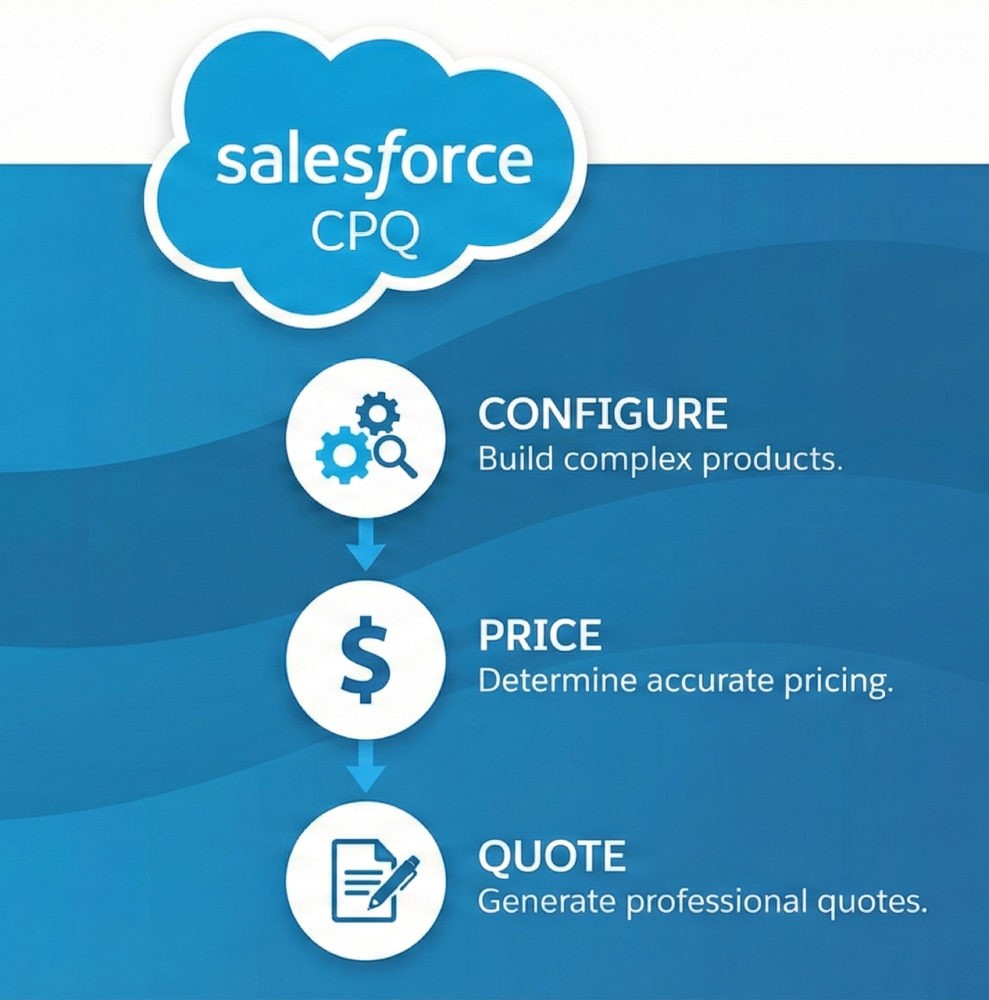
At its core, CPQ stands for Configure, Price, Quote. Salesforce CPQ operates as a managed package within Sales Cloud. It extends native CRM objects with logic for product compatibility, tiered pricing, subscriptions, renewals, and automated approval routing. Teams gain control over complex quotation flows without relying on spreadsheets or disconnected systems.
Salesforce CPQ replaces time-consuming steps with guided workflows. Representatives select valid products, apply pricing rules, submit discounts for approval, and generate branded PDFs without leaving the CRM. Mobile access allows a field representative to produce a formal quote during a meeting rather than days later.
How Partners Support Implementation
Implementation quality determines outcomes. Organizations sometimes work with consulting partners such as Think Beyond to support revenue process design, approval logic definition, and user enablement during CPQ adoption. A CPQ tool introduced without process alignment often underdelivers, while implementations aligned with revenue strategy are more likely to produce measurable results.
Technical integration is equally important. CPQ depends on clean data flows into ERP, billing, and accounting platforms. In more complex environments, this can also include FPGA Development work or other specialized engineering systems, particularly when product configurations rely on hardware permutations. Firms like INTechHouse support the connection of product and configuration data across business and engineering systems to help maintain consistency in pricing, inventory, and technical constraints. In other cases, organizations rely on internal teams or alternative integrators, depending on system complexity and scale.
How Salesforce CPQ Configuration Logic Works
Configuration addresses a simple requirement: sales teams need to select the right products without constant involvement from technical specialists. The CPQ engine uses product rules to prevent invalid combinations and surface recommended bundles.
Sales organizations in industries with modular offerings gain the most leverage. A manufacturer quoting machinery with optional accessories maintains consistency. A SaaS provider selling tiered subscriptions avoids incompatible modules. Firms delivering IoT solutions can combine hardware and services without configuration errors. Rule sets are defined once and enforced consistently, ensuring incorrect combinations never reach customers.
Pricing: Where Automation Creates Real Value
For many teams exploring what CPQ Salesforce is, pricing automation is the primary driver. CPQ applies centralized rules that reflect how a business defines and protects value. Tiered pricing, contract duration, region, negotiated rates, partner models, and promotional logic become structured rules rather than informal knowledge.
Discount controls support margin discipline without excessive oversight. Representatives can apply predefined discounts independently, while higher thresholds trigger approval workflows automatically. Approvers receive full context within Salesforce, enabling faster and more informed decisions. Without structure, discounts erode value; with structure, they support a deliberate pricing strategy.
CPQ also manages subscription pricing and renewals, an area where manual processes frequently introduce errors. Automated renewals apply existing contract terms, and renewal quotes are generated early enough to reduce churn and support predictable revenue.
Quote Generation: Why Consistency Shapes Perception
Quote output reflects organizational maturity. Salesforce CPQ produces consistent, branded PDF templates that include line items, descriptions, terms, and signature blocks. Templates can vary by region, product family, or customer segment. Representatives send quotes directly from Salesforce and track activity without managing separate documents.
Consistency reinforces trust. Customers expect accurate pricing, clear language, and predictable structure. A clean, well-presented quote communicates reliability and professionalism, often influencing buying decisions beyond price alone.
What Features Make CPQ Powerful for Complex Sales
Guided Selling Adds Intelligence to the Process
Guided selling uses structured questions to narrow large catalogs into relevant bundles based on customer needs. New representatives reach productivity faster, while experienced sellers benefit from timely cross-sell and upsell suggestions.
Discounting and Approvals Protect Margins
Approval workflows support governance. Managers see margin impact before approving exceptions, helping maintain pricing discipline while preserving flexibility for strategic deals.
Product Rules Eliminate Configuration Errors
Dependencies, compatibility rules, and bundle logic run automatically. This allows organizations with complex offerings to scale expert knowledge without sacrificing accuracy.
Contract Amendments and Renewals
CPQ tracks contract history, negotiated rates, and term changes. Amendments link back to original agreements, improving data quality and forecast reliability.
How CPQ Salesforce Accelerates Sales Cycles
Performance data helps explain why interest in CPQ Salesforce continues to grow. Organizations commonly report significantly faster quote generation, shorter sales cycles, and sharply reduced approval times after replacing manual processes with CPQ workflows.
Faster quotes improve conversion rates by responding while customer interest is high. Representatives focus on negotiation rather than corrections, and managers approve requests more quickly because all context is available in one interface. Sales capacity increases without adding headcount, as administrative work declines and selling time expands.

How CPQ Improves Quote Accuracy and Customer Experience
Errors undermine confidence quickly. Incorrect pricing or invalid configurations cause customers to question the entire engagement. CPQ replaces manual calculation with enforced rules, significantly reducing error rates and ensuring quotes reflect current pricing logic.
Customers value speed and clarity. Instant quotes, precise descriptions, and tailored bundles demonstrate operational maturity. This experience supports higher win rates and stronger retention by reinforcing trust throughout the buying journey.
How CPQ Salesforce Increases Deal Value
Deal size often grows when intelligent recommendations surface at the right moment. CPQ suggests bundles, services, and add-ons tied to selected products, helping representatives identify opportunities that are easy to miss manually. Many organizations report noticeable increases in average deal value after adoption.
Revenue growth compounds across several dimensions. Faster proposals increase conversion, better bundles raise value per deal, accuracy reduces rework, and improved visibility strengthens planning. Together, these incremental gains produce measurable financial impact.
When a Business Truly Needs CPQ
Organizations with small catalogs and simple pricing models may operate effectively without CPQ. The need typically emerges when product complexity, multi-tier pricing, global sales models, or subscription lifecycles introduce operational friction.
Common indicators include slow quoting, repeated errors, lengthy approvals, inconsistent discounting, and steep onboarding curves for new representatives. Companies selling configurable manufacturing equipment, telecommunications bundles, software subscriptions, logistics plans, and medical technology often encounter these thresholds first.
CPQ Salesforce in the Wider Revenue Process
CPQ sits at the center of the quote-to-cash lifecycle. When integrated with billing, ERP, and contract management systems, quoting flows into invoicing without re-entry. Operations teams gain cleaner data, aligned revenue reporting, and improved forecasting accuracy.
Real-time visibility enables leaders to identify bottlenecks, prioritize deals by value, and adjust strategy quickly. Data generated through CPQ informs pricing optimization, territory planning, and margin management initiatives.
How Management Measures ROI
Organizations commonly evaluate CPQ ROI through faster sales cycles, increased deal sizes, reduced rework, and higher sales capacity. Reported outcomes often include dramatically faster quote generation, shorter cycle times, significant reductions in approval delays, and improvements in average deal value within the first year, although results vary by industry and implementation scope.
Conclusion
Understanding what CPQ Salesforce is reveals more than a feature set. The platform transforms quoting into a controlled, scalable revenue process. Configuration relies on rules rather than intuition. Pricing logic replaces manual calculation. Discounts operate within defined policies. Quotes reach customers faster and with consistent presentation.
Sales teams spend less time on administration and more time engaging customers. Managers protect margins using data instead of documents. Customers receive accurate, professional proposals without delays. When integrated with ERP and billing systems, CPQ becomes a foundational element of the commercial process.
Organizations that begin by asking what is CPQ Salesforce? often seek efficiency. Over time, they uncover strategic advantages. Faster deals, higher deal values, fewer errors, stronger governance, and better forecasting reshape how a business competes. The strongest outcomes typically combine technology with thoughtful process design and disciplined integration.
Frequently Asked Questions
What is CPQ Salesforce in simple terms?
It is a Salesforce managed package that automates configuration, pricing rules, discounts, approvals, and quote generation within Sales Cloud.
How does guided selling support representative performance?
It uses structured questions to filter catalogs, highlight relevant bundles, and prevent invalid configurations, helping both new and experienced sellers.
Can CPQ support subscription and renewal cycles?
Yes. CPQ tracks contract terms, generates renewal quotes automatically, and maintains negotiated pricing across the contract lifecycle.
Does CPQ integrate with ERP or billing platforms?
Most enterprise ERP and billing systems integrate through APIs or middleware, allowing quote data to flow into invoicing without re-entry.
How does CPQ protect margin discipline?
Discount rules define thresholds. Requests that exceed limits route to approvers automatically, preventing unauthorized discounts while keeping deals moving.