




Most professionals believe they are good at giving feedback. The evidence suggests otherwise.
The pattern was identified as far back as 1996 and the core problem has not changed much since. A landmark meta-analysis published in Psychological Bulletin by Kluger and DeNisi reviewed over 130 studies on feedback interventions and found that roughly one-third had a negative or null effect on performance. Feedback did not consistently improve results — and in many cases made things worse. The culprit was rarely the accuracy of the content. It was how the message was shaped and received.
Feedback, it turns out, is a design problem as much as a communication one.
Why Feedback Often Fails (Even When It’s Accurate)
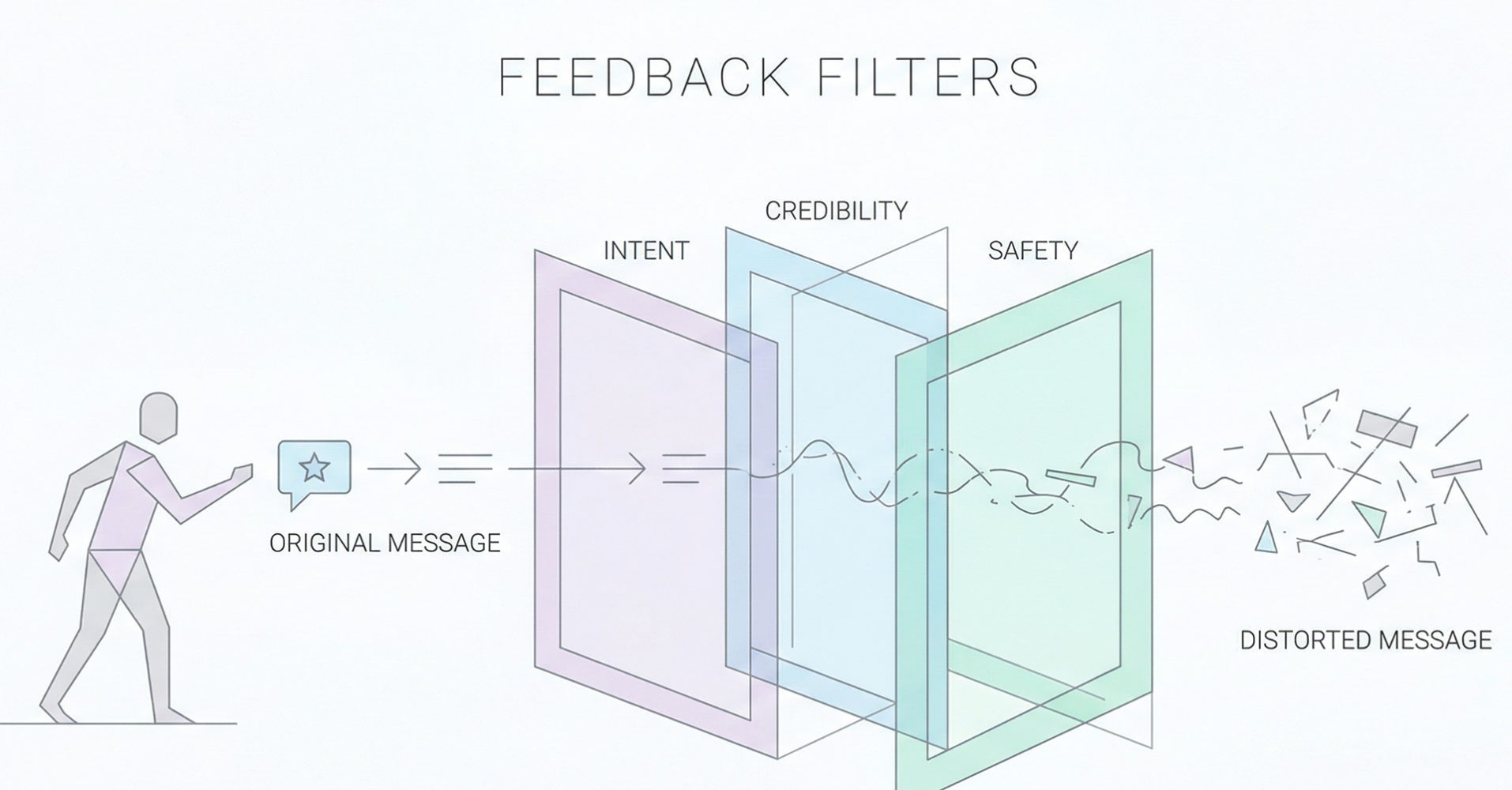
The common assumption is that clearer wording leads to better outcomes. In practice, recipients evaluate feedback through three filters before they even process the content: intent, credibility, and psychological safety. If any of these breaks down, the message loses its impact regardless of how well it is phrased.
Research by Buckingham and Goodall, published in Harvard Business Review in 2019, highlights that employees are significantly more likely to reject feedback when they question whether the person giving it genuinely understands their work or context. Their analysis also found that more than half of any rating of another person reflects the rater’s own characteristics — not the person being evaluated. Feedback often carries more of the giver’s perspective than the receiver’s reality.
Timing compounds the issue further. Feedback delivered too late becomes irrelevant. Delivered too early, it lacks sufficient context. Delivered under pressure, it feels reactive rather than considered — and defensive responses almost always follow.
Before focusing on phrasing, ask three questions:
- Does this person trust my intent?
- Do I have enough context to speak credibly about this situation?
- Is this the right moment for them to hear this?
If the answer to any of these is no, the conversation will struggle regardless of how carefully it is worded.
The Shift from Telling to Designing
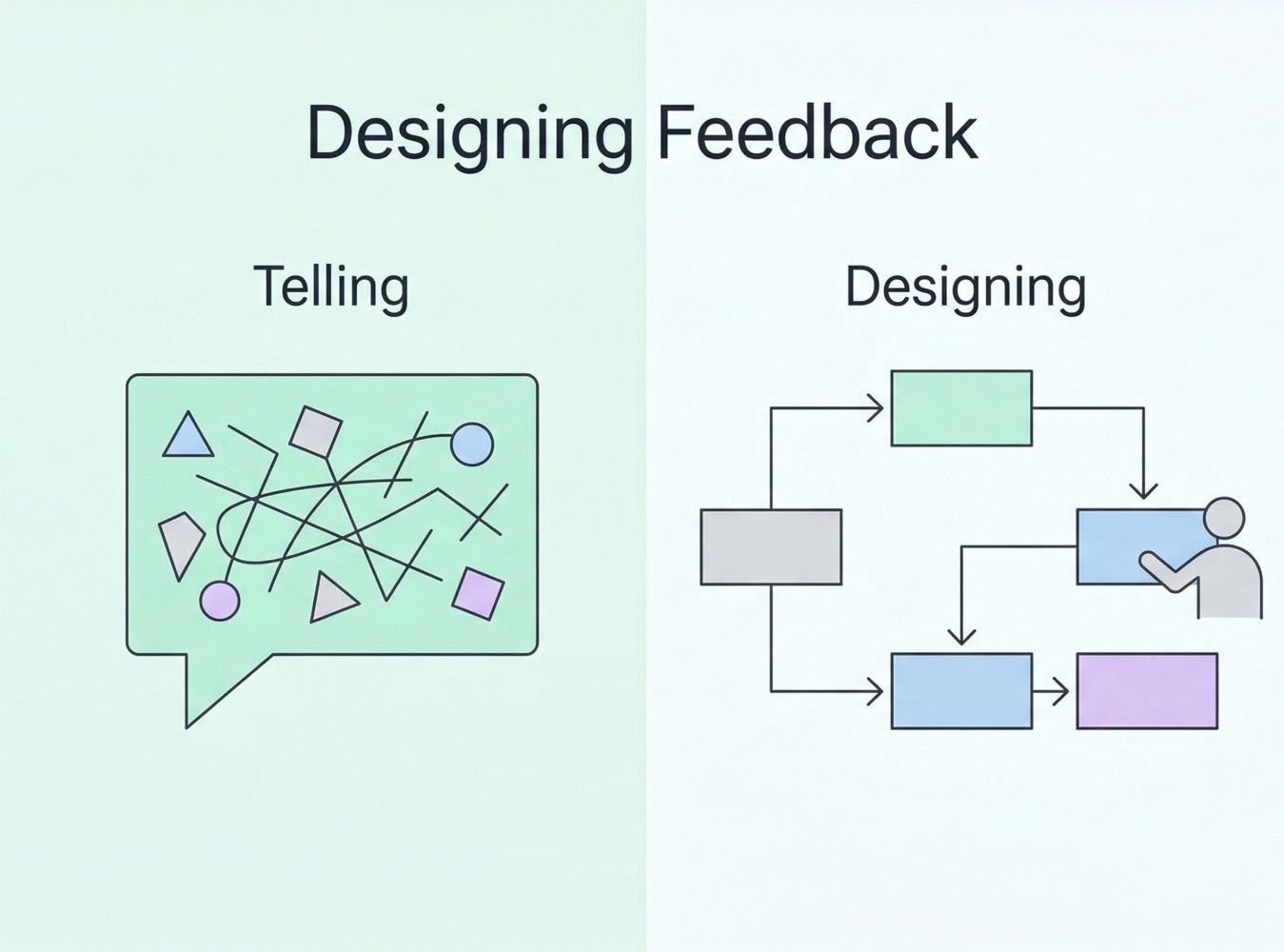
Effective feedback is not simply a message — it is an experience shaped by how the other person receives and processes it. The most consistent results come from treating feedback as something to design rather than deliver. That means thinking through how the message will be interpreted, where confusion might arise, and what the recipient is expected to do next.
Research in organizational behavior consistently shows that feedback should reduce uncertainty, not create it. When feedback introduces ambiguity, people either disengage or become defensive.
The difference in practice is significant. Consider two versions of the same feedback:
Version A: “Your presentation lacked clarity.”
Version B: “In yesterday’s client presentation, the key recommendations were spread across multiple slides, which made it harder for the client to follow the main takeaway.”
Version B removes the guesswork. It shifts the conversation from judgment to analysis, and from a question of character to a question of structure — something the person can actually change.
Designing feedback this way means working through three elements before the conversation begins:
- Context — what situation does this refer to, specifically?
- Behavior — what did the person do or not do?
- Impact — what consequence followed for the team, client, or project?
Separating Observation from Interpretation
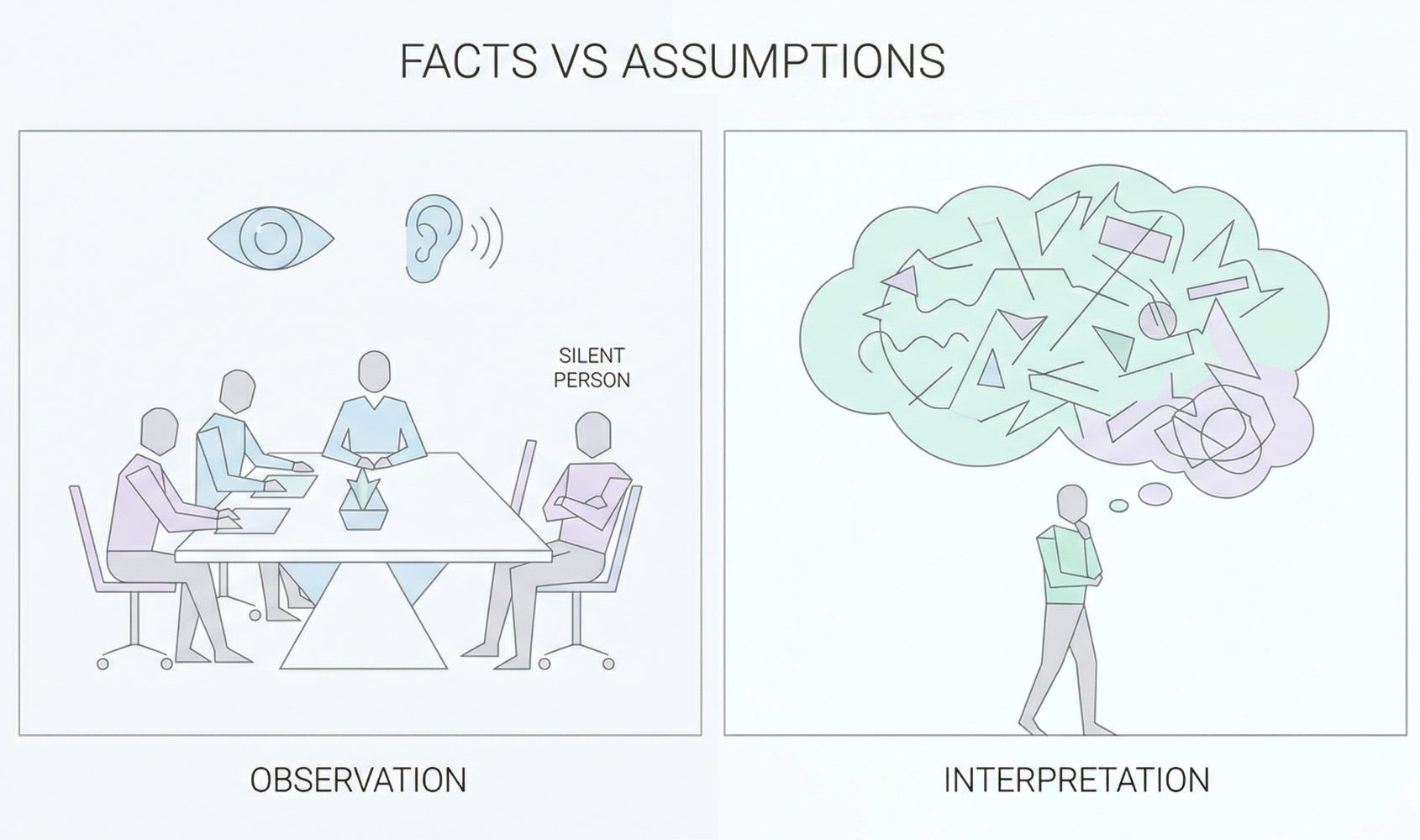
One of the most persistent mistakes in feedback is blending facts with assumptions. We observe a behavior, attach a story to it, and by the time we sit down to give feedback, the story feels like the fact.
“You seemed disengaged in the meeting” is not an observation. It is an interpretation. The distinction matters because interpretations invite disagreement, while observations create shared ground.
I learned this distinction directly. I told a colleague they had seemed disengaged during discussions. The pushback was immediate — from their perspective, they had been listening closely and taking notes throughout. The conversation stalled because both of us were debating perceptions rather than addressing behavior.
When I revisited the feedback, the framing changed: “In the last two meetings, you didn’t contribute during the discussion on the rollout plan, and we missed your input on several decisions that affected your area directly.”
That shift changed everything. Instead of defending intent, the conversation moved toward what could change going forward. The issue was not the feedback itself — it was the absence of shared, observable ground on which to stand.
Research from the Center for Creative Leadership supports this consistently: feedback grounded in specific, observable behavior is significantly more likely to be accepted and acted upon than feedback grounded in inferred intent or perceived attitude.
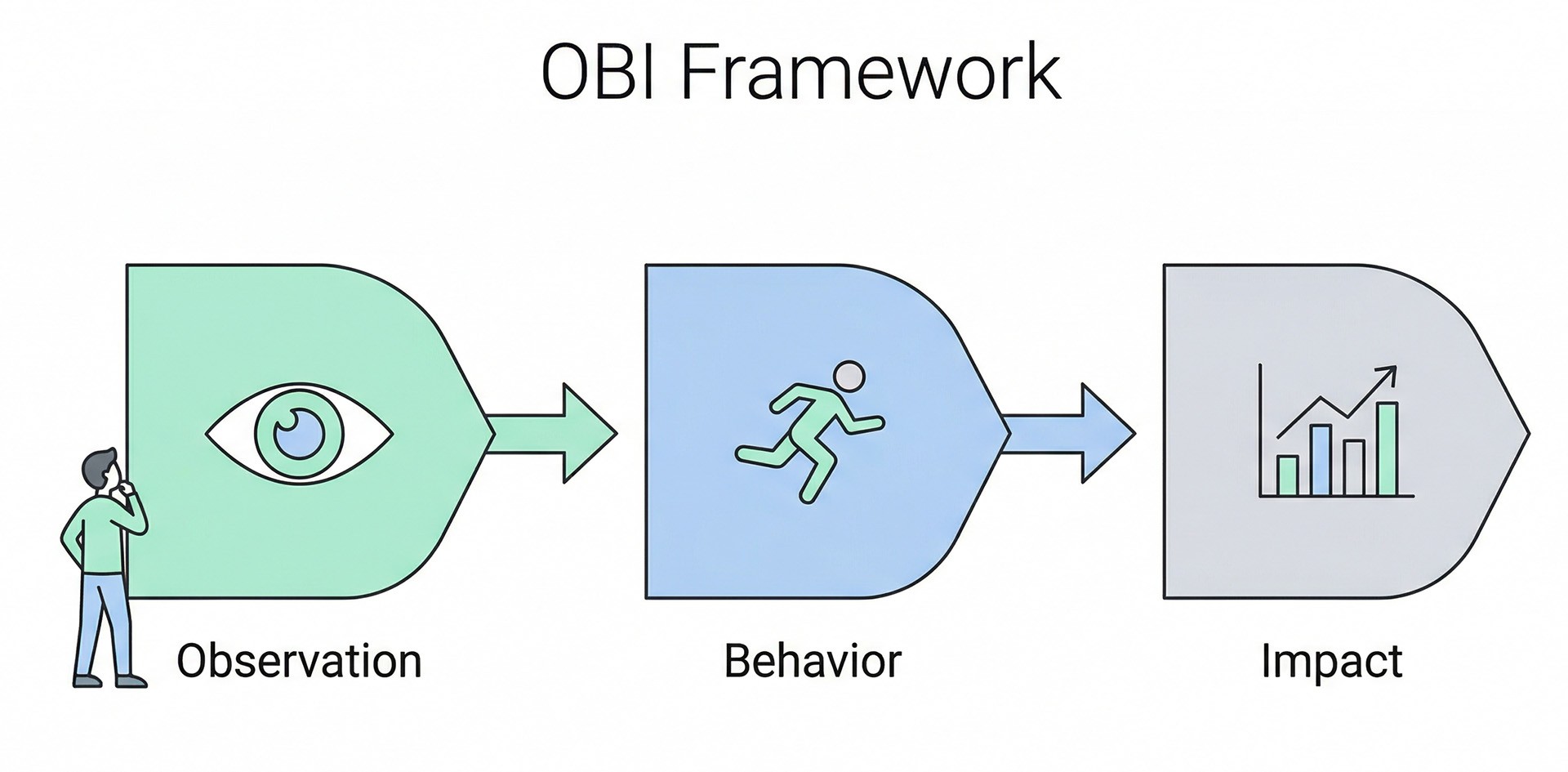
The OBI Framework
- Observation — objective context (when, where)
- Behavior — specific actions the person took
- Impact — the consequence for the team, project, or business
“During the sprint review, you interrupted two team members while they were explaining blockers, which limited the team’s visibility into potential risks before the release.”
Every element is verifiable. None of it requires the recipient to accept a characterization of who they are.
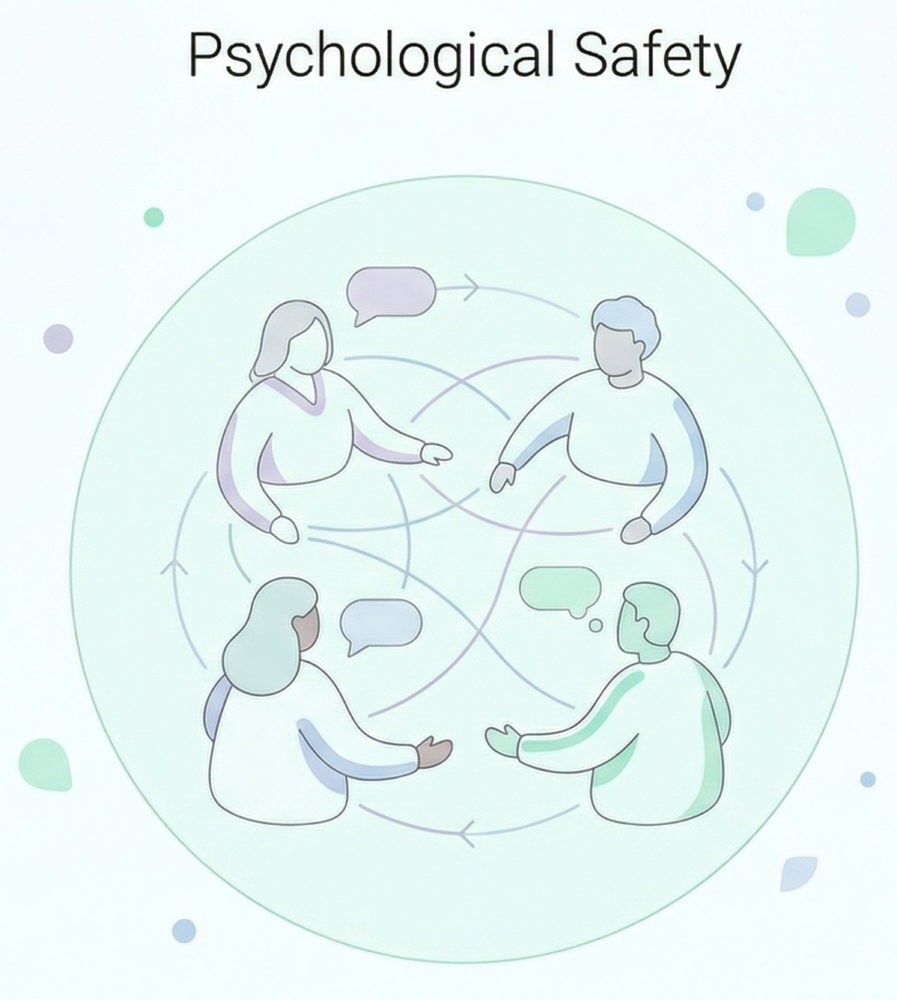
The Role of Psychological Safety
Feedback cannot land in an environment where people feel exposed — and this is less a philosophical point than a physiological one.
Neuroscience research shows that perceived social threats activate the same neural pathways as physical danger. The brain’s threat-detection systems can override analytical thinking before a person has consciously processed what is being said. This explains why even measured criticism can trigger responses that feel disproportionate to the issue at hand.
Educational Insight: The Neuroscience of Feedback
To understand why feedback often fails, it helps to look at the biology mentioned in your article. When a person receives “blunt” feedback, the amygdala (the brain’s threat-detection center) triggers a fight-or-flight response.
(Threat Signal → ↑ Cortisol → ↓ Prefrontal Cortex Activity)
When the prefrontal cortex—the area responsible for logic and problem-solving—is “offline” due to stress, the recipient literally cannot process your advice, no matter how accurate it is. This is why Psychological Safety is a physiological requirement for learning, not just a “nice-to-have” cultural trait.
Google’s Project Aristotle, which analyzed over 180 teams, identified psychological safety as the single most critical factor in team effectiveness — more important than individual talent, team composition, or access to resources. Teams with high psychological safety were more likely to admit mistakes, seek input, and act on feedback constructively.
Psychological safety is not created during a feedback conversation. It is built over time through consistent behavior. Three signals matter most:
Regular feedback, not episodic feedback. When feedback only appears in response to problems, it will always feel corrective rather than developmental.
Balanced recognition and critique. Gallup and Workhuman research (2024) found that among employees who receive both feedback and recognition at least once a week, 61% are actively engaged — compared to 38% who receive feedback alone at the same frequency.
Modeling reciprocity. Willingness to receive feedback yourself — genuinely, without defensiveness — does more to establish psychological safety than almost any formal process.
Feedback in an AI-Augmented Workplace
AI tools are changing how work is evaluated, and with that, how feedback is generated. As outputs become easier to measure, there is a growing temptation to let the data do the talking. The problem is that data can tell you what happened. It cannot tell you why it matters in context, or what should change next.
A McKinsey report on AI in the workplace notes that AI adoption is accelerating the pace of performance evaluation across teams — which means more feedback signals, not necessarily better ones.
Consider a content team that started receiving weekly AI-generated performance reports tracking engagement metrics per post: views, shares, time-on-page, scroll depth. The data was accurate. But when low-performing content was flagged in team reviews, the conversations that followed almost always became debates about distribution, timing, or algorithm changes — not the editorial decisions behind the content itself. Numbers were defended. Behavior didn’t change.
When the team shifted its approach and used the same data as a prompt for behavioral discussion — asking “what did we decide when we chose this angle, and what would we do differently?” rather than “why did this number come in low?” — the dynamic changed. Writers left those conversations with something they could act on in their next piece. The metrics stayed the same. What changed was how they were used.
Three principles for feedback in data-rich environments:
- Use data as a starting point for the conversation, not a conclusion.
- Translate metrics into behavioral observations before raising them.
- Focus on decisions and actions, not outcomes alone — many outcomes are partly outside an individual’s control.
Balancing Directness and Relationship Preservation
Many professionals default to one of two extremes: blunt to the point of damaging trust, or so hedged that the message never actually lands. Neither produces consistent results.
Kim Scott, in Radical Candor, frames the goal as pairing direct challenge with genuine personal care. The aim is not to soften the message. It is to make the message land clearly without the relationship becoming collateral damage in the process.
One practical technique is to open by aligning on intent before delivering the content:
“I want to share something that could strengthen your next presentation.”
This takes fifteen seconds and changes the frame entirely. It signals that what follows is in service of the person’s development, not an indictment of their character. From that position, the feedback itself should be delivered without hedging language, excessive apologizing, or qualifiers that dilute the point.
Clarity, when paired with respect, tends to strengthen professional relationships rather than weaken them. Vagueness, even when well-intentioned, tends to erode them over time.
Making Feedback Actionable
Insight without direction rarely leads to change. Many feedback conversations end with awareness and no clear next step — which creates frustration for both parties and is unlikely to result in different behavior.
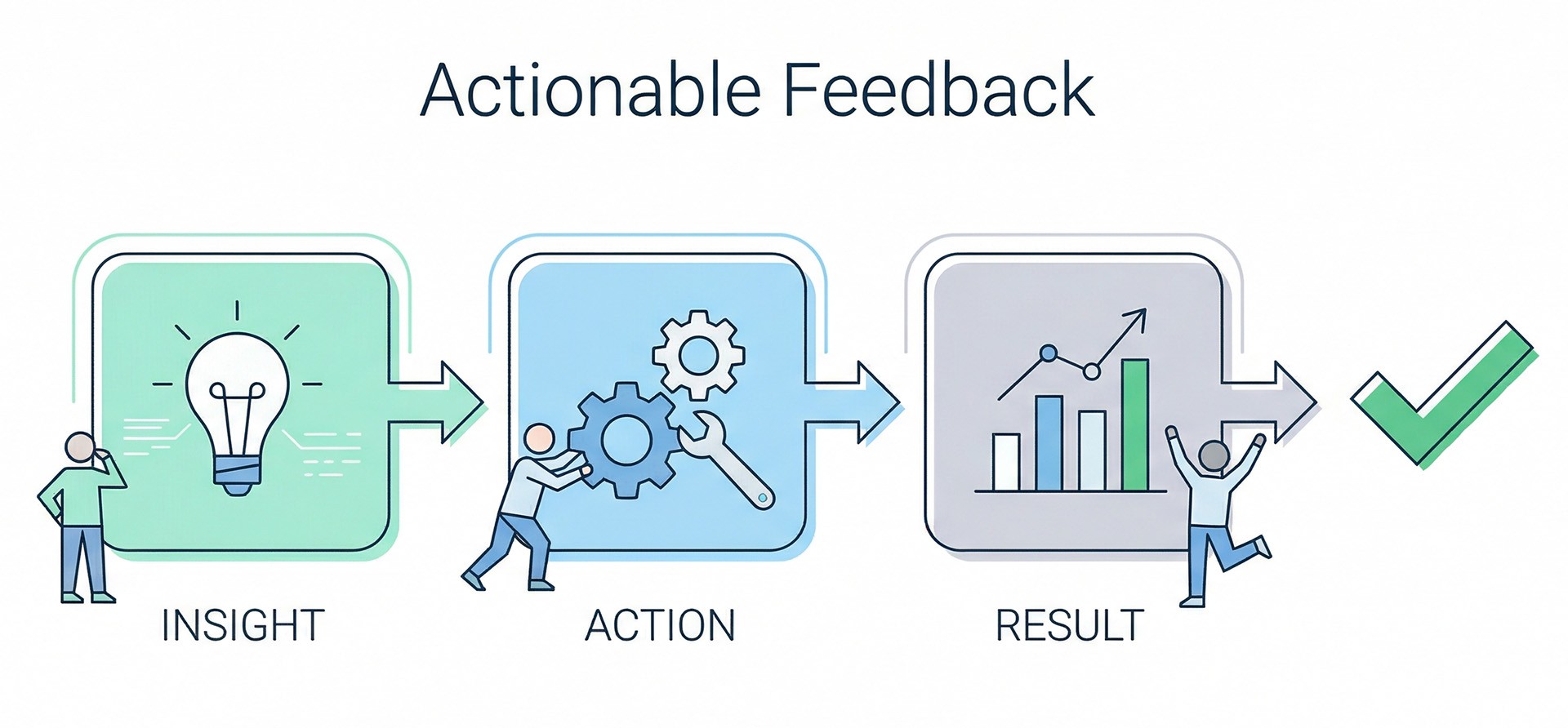
Gallup research consistently finds a strong relationship between the quality and actionability of feedback and levels of employee engagement. The key variable is not frequency but whether feedback provides a specific direction a person can act on, not merely a reflection of how they have been perceived.
End every feedback conversation with:
- One or two specific actions the person can take
- A clear context for when or where to apply them
- An optional offer of support or follow-up
“For your next presentation, start with a single summary slide before going into the detail. I’m happy to review it with you beforehand if that would be useful.”
This turns feedback from a one-sided critique into a collaborative process. The person leaves knowing exactly what to do — not just how they were seen.
A useful test: if the person cannot act on what you have said within the next week, the feedback is not specific enough yet.
⸻ Author Bio ⸻
Ann Wisniewska is a project management professional with a strong background in collaboration and cross-functional coordination. She focuses on aligning teams, optimizing workflows, and ensuring efficient delivery of complex initiatives. Her experience spans managing distributed teams and fostering productive partnerships that drive projects from concept to completion.