




A missed deadline rarely triggers a system review. Instead, the conversation turns to focus, discipline, or time management. Someone should have planned better. Someone should have communicated earlier. Someone should have worked smarter. That explanation is convenient. It is also often wrong.
Most productivity breakdowns are not failures of effort. They are predictable outcomes of how work is designed. Processes, priorities, communication flows, and incentives quietly determine what gets done and how efficiently it happens.
When those elements are misaligned, even highly capable people struggle to perform consistently. You can improve personal habits, adopt better tools, and refine your workflow. But if the structure around you is flawed, those improvements hit a ceiling quickly. The real leverage lies elsewhere.
The Productivity Illusion
Many professionals approach productivity as a personal optimization problem. Better routines. Better tools. Better focus. This mindset creates a sense of control. If output is low, the solution is to improve yourself.
The issue is that most work does not happen in isolation. It depends on inputs from others, decisions made elsewhere, and systems you do not control. You can execute perfectly within your own scope and still produce poor outcomes because something upstream or downstream breaks. This is the productivity illusion: the belief that individual effort directly determines results. A more accurate view is that individual effort interacts with a broader structure. That structure defines what is possible.
Improving your own workflow can help, but it rarely fixes delays caused by unclear priorities, fragmented communication, or slow decision-making. Those are not personal problems. They are structural constraints.
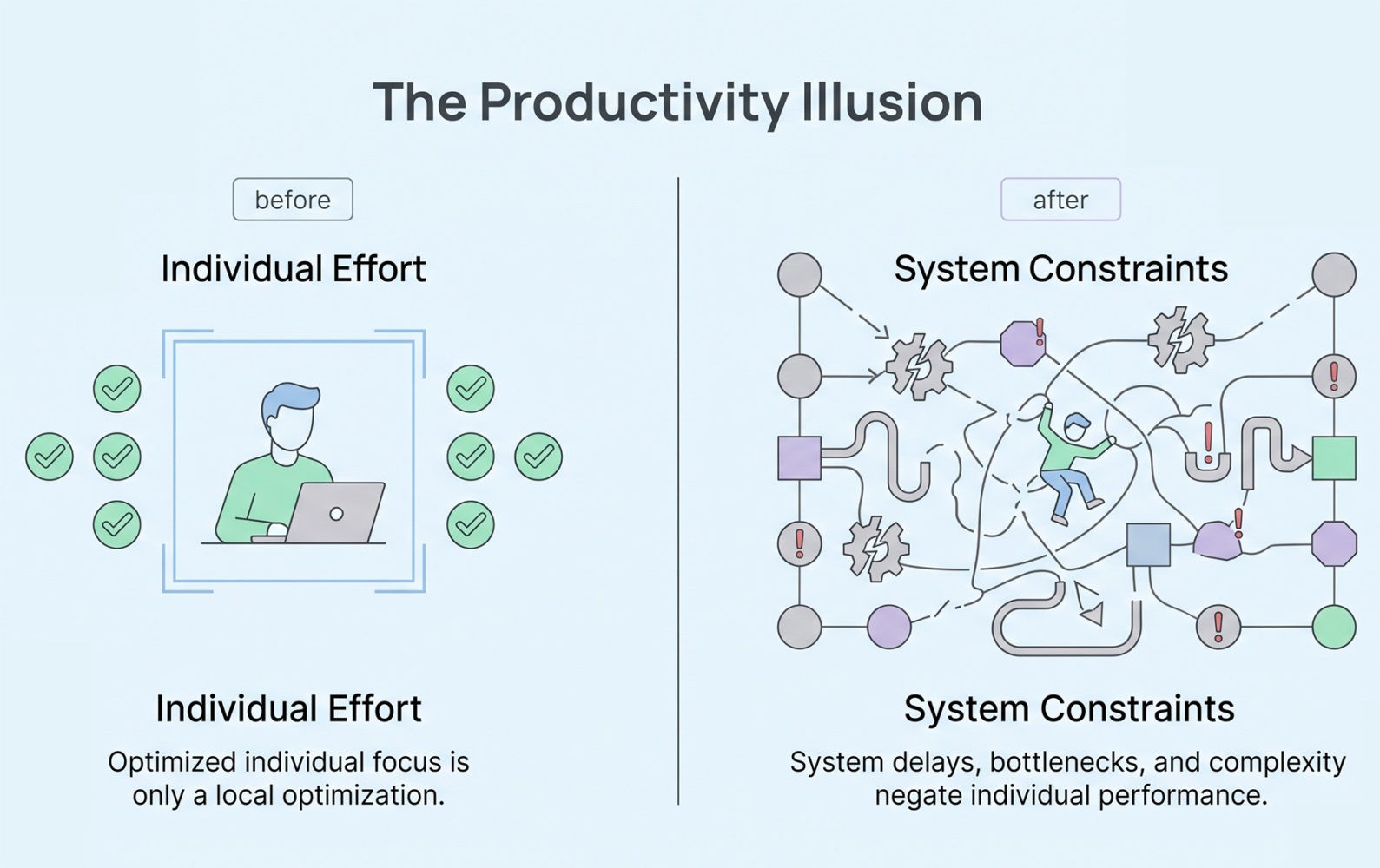
Local Optimization vs. System Outcomes
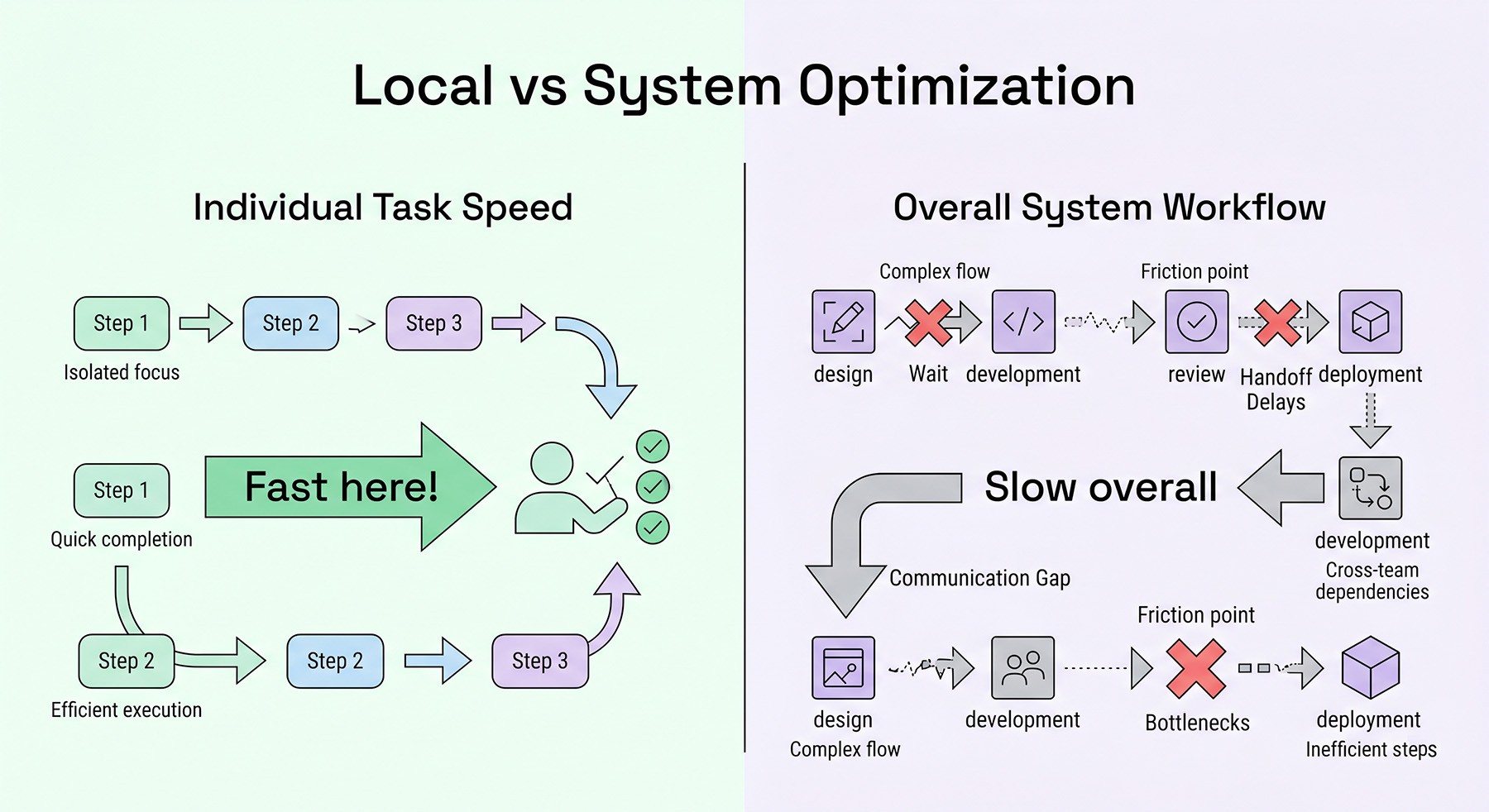
This gap between effort and results becomes clearer when you compare local and overall performance. An individual can optimize their own work: faster execution, cleaner organization, tighter focus. But if their work depends on multiple teams, tools, and approvals, the final outcome reflects the entire chain.
This pattern shows up in everyday work:
- A developer writes efficient code but waits days for approval
- A marketer launches campaigns quickly but relies on delayed input from sales
- A manager plans effectively but constantly reprioritizes due to shifting directives
Each person is acting rationally within their own scope. Yet the overall output remains inconsistent. This is a coordination problem, not a capability problem.
The principle aligns with systems thinking long emphasized by W. Edwards Deming, who argued that most performance issues originate from the system rather than the individual. His work focused on how processes, not people, determine consistency and quality. When organizations overlook this distinction, they end up optimizing parts while the whole underperforms.
Why Individuals Get Blamed First
If structural issues are so common, why do teams default to individual explanations? Because they are visible and immediate. You can see someone miss a deadline. You cannot easily see the chain of dependencies, unclear expectations, or decision delays that led to it.
There is also a simplicity factor. It is easier to coach one person than to redesign a workflow that spans multiple teams. System improvements require coordination, time, and often uncomfortable changes. Performance frameworks reinforce this bias. Reviews focus on individual output. Metrics rarely capture friction between teams or inefficiencies in processes. As a result, the easiest explanation becomes the dominant one.
There is also a cultural layer. Many professionals are conditioned to assume responsibility for productivity issues, even when those issues originate outside their control.
That instinct keeps problems contained at the individual level, where they are easier to discuss but harder to solve.
What Broken Systems Quietly Drain
When work is poorly structured, the impact is not always dramatic. It accumulates through small inefficiencies that compound over time.
People spend time chasing information instead of using it. They redo work because requirements shift late. They wait for decisions that could have been made earlier with clearer ownership.
Research highlights how common this is. According to McKinsey & Company, knowledge workers spend a significant portion of their time searching for information rather than applying it. This is not a failure of individual organization. It is a sign that information is not structured or accessible enough within the workflow.
Similarly, coordination overhead often replaces actual output. Meetings, status updates, and follow-ups consume time that could be spent on focused work. The system absorbs effort without converting it into meaningful progress.
Meetings as a Symptom, Not the Problem
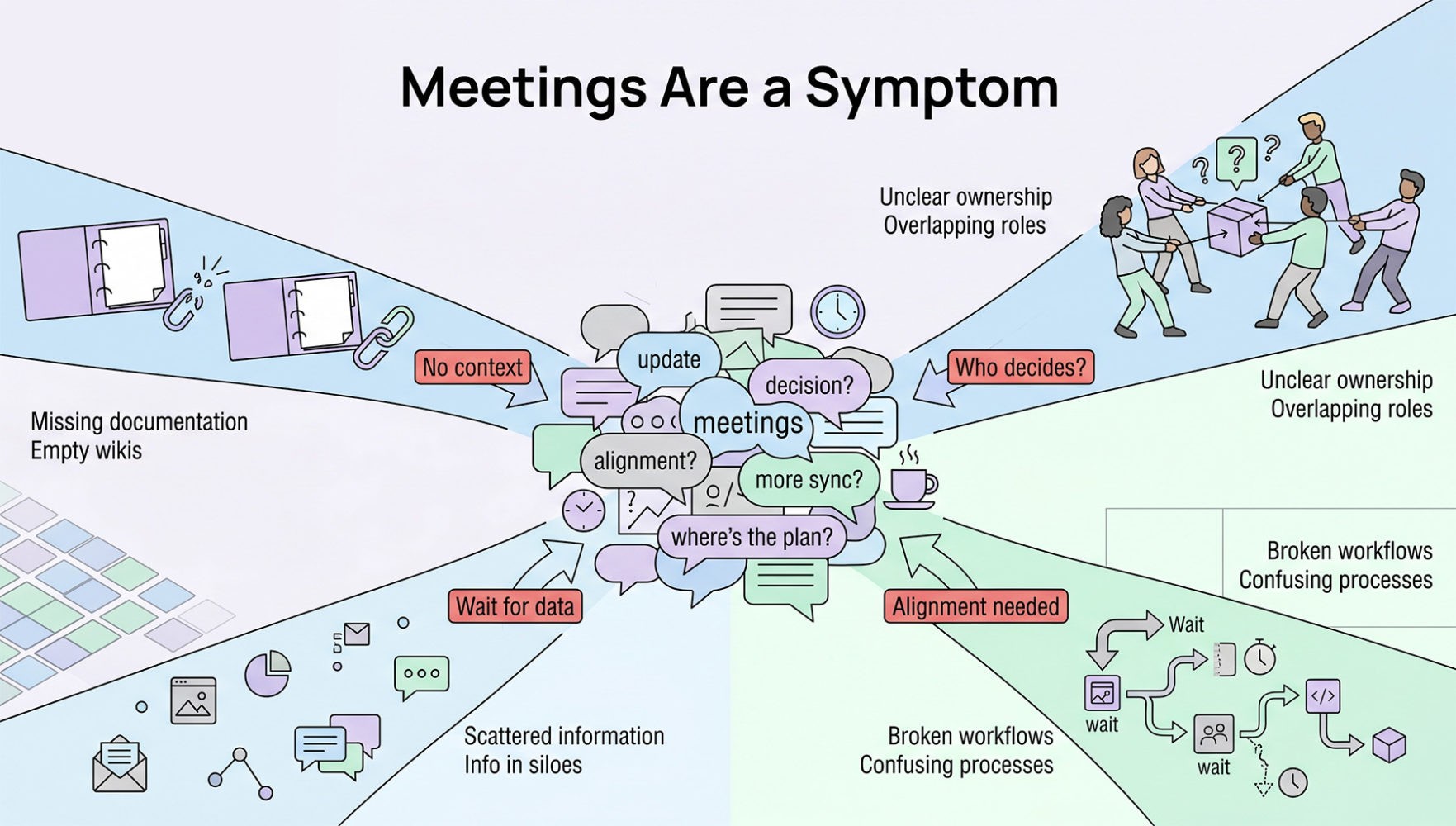
Complaints about meetings are common, but meetings themselves are not the root issue. They are a symptom. Teams rely heavily on meetings when other parts of the workflow are unclear. When decisions are not documented, people need discussions to align. When ownership is vague, meetings fill the gap. When information is scattered, real-time conversations become the default.
Data from the Microsoft Work Trend Index shows how much time communication consumes, with employees spending a large share of their workday in meetings, emails, and chat ().
Trying to reduce meetings without addressing the underlying causes rarely works. The demand for coordination remains, and it surfaces elsewhere.
The more effective approach is to reduce the need for meetings by improving how decisions, information, and responsibilities are structured.
Context Switching Is a System Issue
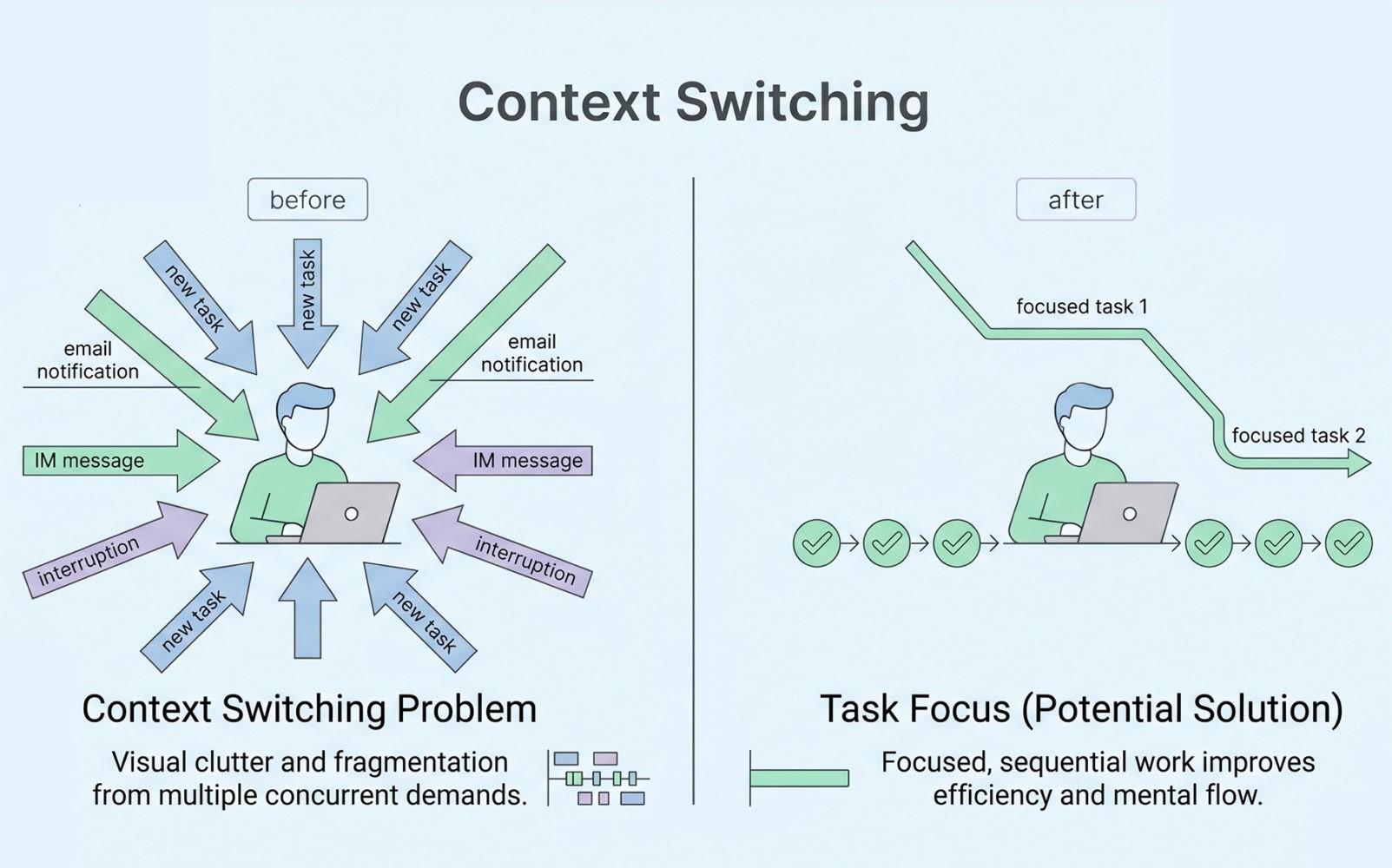
Another common productivity challenge is constant interruption. Professionals jump between tasks, projects, and conversations throughout the day. This is often framed as a focus problem. In reality, it is usually a prioritization and coordination problem. When priorities are unclear, everything feels urgent. When workloads exceed capacity, people are forced to juggle tasks. When communication channels are fragmented, interruptions increase.
Research from the American Psychological Association shows that task switching can significantly reduce productivity. The implication is straightforward. Reducing context switching is less about individual discipline and more about structuring work so that sustained focus is possible. Clear priorities, realistic planning, and better coordination reduce the need to constantly shift attention.
A Real-World Example: Cross-Functional Teams
Consider a typical product team. Designers aim for high-quality user experience. Developers are measured on delivery speed. Product managers push for feature completion within tight timelines. Individually, each role performs well. Designers refine details. Developers optimize implementation. Product managers drive progress.
But without alignment, these efforts conflict. Design iterations delay development. Development constraints limit design quality. Product timelines force trade-offs that satisfy no one. The result is friction, rework, and inconsistent output. No amount of personal productivity improvement resolves this. The issue lies in how goals, incentives, and workflows are structured across the team. When alignment improves, productivity follows without requiring individuals to work harder.
Tools Amplify What Already Exists
When productivity issues emerge, teams often adopt new tools to solve them. Sometimes that helps. Often it does not. Tools reflect the processes they support. If workflows are unclear, tools do not create clarity. They introduce another layer where confusion can spread.
If ownership is ambiguous, assigning tasks in a platform does not resolve responsibility. It simply relocates the ambiguity. Effective tools depend on clear processes. Without that foundation, they amplify existing inefficiencies.
This is why some teams see immediate gains from new tools while others see little change. The difference is not the tool itself. It is the structure around it.
Incentives Shape Behavior
Productivity is closely tied to what organizations reward. If responsiveness is valued, people prioritize quick replies over deep work. If visibility is rewarded, appearing busy becomes more important than producing meaningful outcomes. If short-term output is emphasized, long-term improvements are neglected.
These patterns are not failures of judgment. They are rational responses to incentives. Changing productivity outcomes often requires adjusting what is measured and rewarded. When incentives align with meaningful work, behavior follows. Without that alignment, individuals are forced to choose between effectiveness and expectations.
Information Flow Determines Speed
One of the most practical ways to improve workplace productivity is to improve how information moves. When information is accessible, consistent, and well-structured, decisions happen faster. Work progresses with fewer interruptions. Teams spend less time clarifying and more time executing. When information is fragmented, everything slows down. People rely on others for context. They duplicate effort. They make decisions with incomplete data.
Improving documentation, centralizing knowledge, and standardizing communication may not seem like productivity strategies, but they directly reduce friction. Better information flow reduces the need for coordination, which increases overall efficiency.
How to Apply This in Real Work
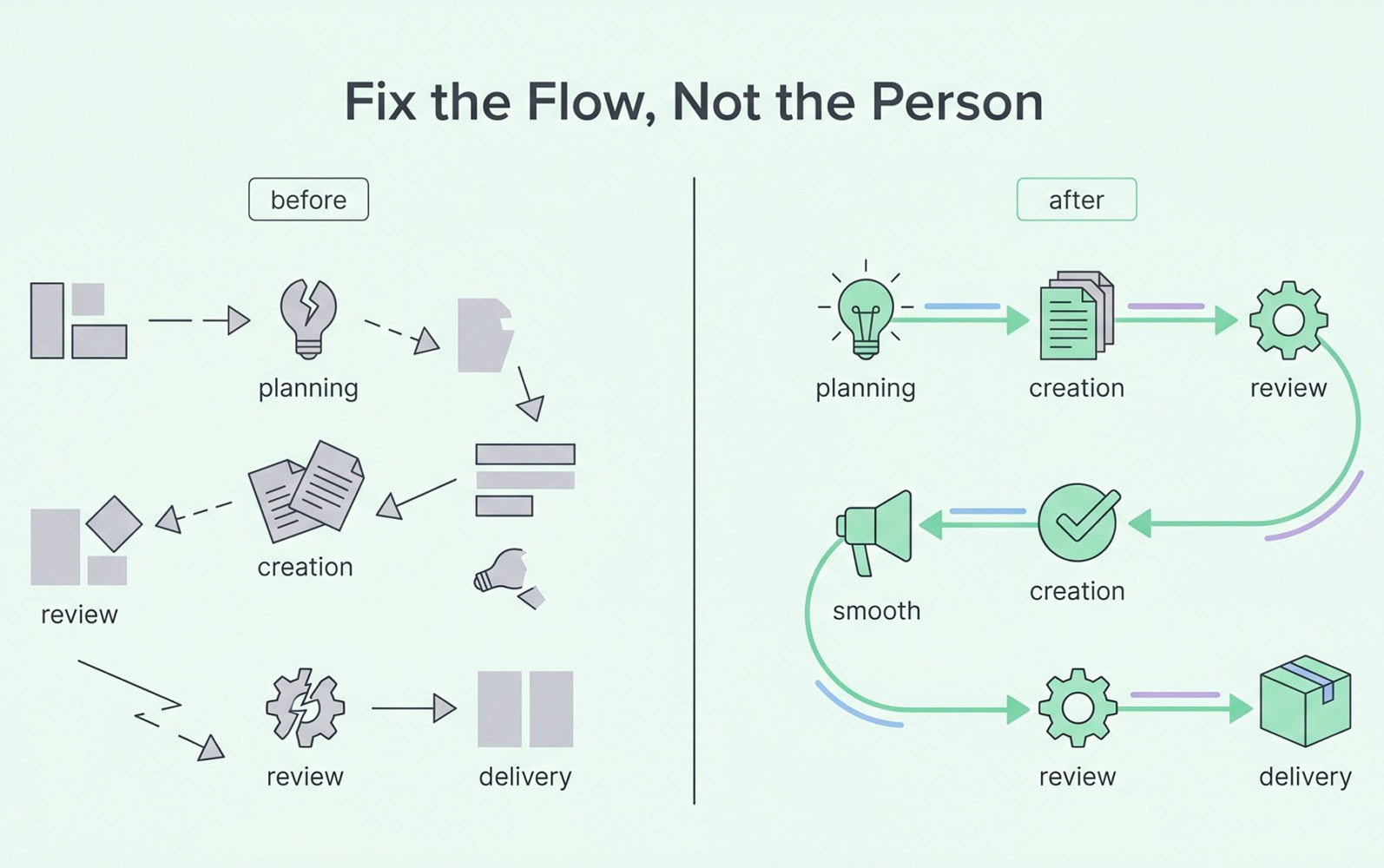
You do not need to redesign an entire organization to benefit from system thinking. Small changes at the team level can have a meaningful impact. Start by identifying recurring friction. Where does work slow down? Where do delays repeat? Where does confusion appear? Instead of asking how to work faster, ask why the work is difficult in the first place.
- Look at handoffs between people or teams. These are common points of failure. Clarifying responsibilities and expectations can remove significant delays.
- Examine how decisions are made. If the same topics require repeated discussions, the issue is not effort. It is a lack of clear decision structures.
- Pay attention to information gaps. If people frequently ask for the same context, the system is not capturing or sharing knowledge effectively.
These are practical entry points for improving how work flows.
The Role of the Individual
Recognizing structural constraints does not remove individual responsibility. It reframes it. Effective professionals do two things at once. They manage their own work well, and they actively improve the environment they operate in. That might mean documenting processes, clarifying expectations, or raising issues that slow the team down. It might involve pushing back on unclear priorities or suggesting better ways to coordinate.
These actions require more initiative than optimizing personal habits alone. They also create broader impact.
Why System Improvements Are Often Ignored
Structural changes are harder to implement than personal ones. They require coordination across teams. They may challenge existing habits or expectations. They often take longer to show results. Personal improvements, by contrast, are immediate. You can change your routine today. You can adopt a new tool tomorrow. This creates a bias toward individual solutions, even when they are less effective.
But system improvements offer leverage. When the structure improves, everyone benefits. Work becomes easier, faster, and more consistent without requiring additional effort from individuals.
Rethinking Productivity
Productivity is often treated as a personal skill. In reality, it is an emergent property of how work is organized. Individuals contribute effort. Systems determine how that effort translates into results. When you shift your focus from optimizing yourself to improving how work flows, you unlock a different level of impact. You stop compensating for inefficiencies and start removing them.
Takeaway
If your productivity feels inconsistent, look beyond your habits. Identify one recurring point of friction in your work this week. Instead of working around it, address its cause. Clarify a process, improve a handoff, or make information easier to access. The most effective teams do not rely on constant effort to perform well. They design workflows where good work happens by default.
⸻ Author Bio ⸻
Ann Wisniewska is a project management professional with a strong background in collaboration and cross-functional coordination. She focuses on aligning teams, optimizing workflows, and ensuring efficient delivery of complex initiatives. Her experience spans managing distributed teams and fostering productive partnerships that drive projects from concept to completion.