




A design team updated a deadline. They posted it in the shared channel. Engineering saw it, acknowledged it, and kept building to the original timeline anyway. No one owned the change. The release slipped two days. That is not a communication failure. That is a coordination failure and most teams never learn to tell the difference.
There is a gap that quietly undermines most modern teams. They confuse communication with coordination. The two feel similar, but they are not the same and treating one as a substitute for the other is one of the most common, and most costly, mistakes in team design.
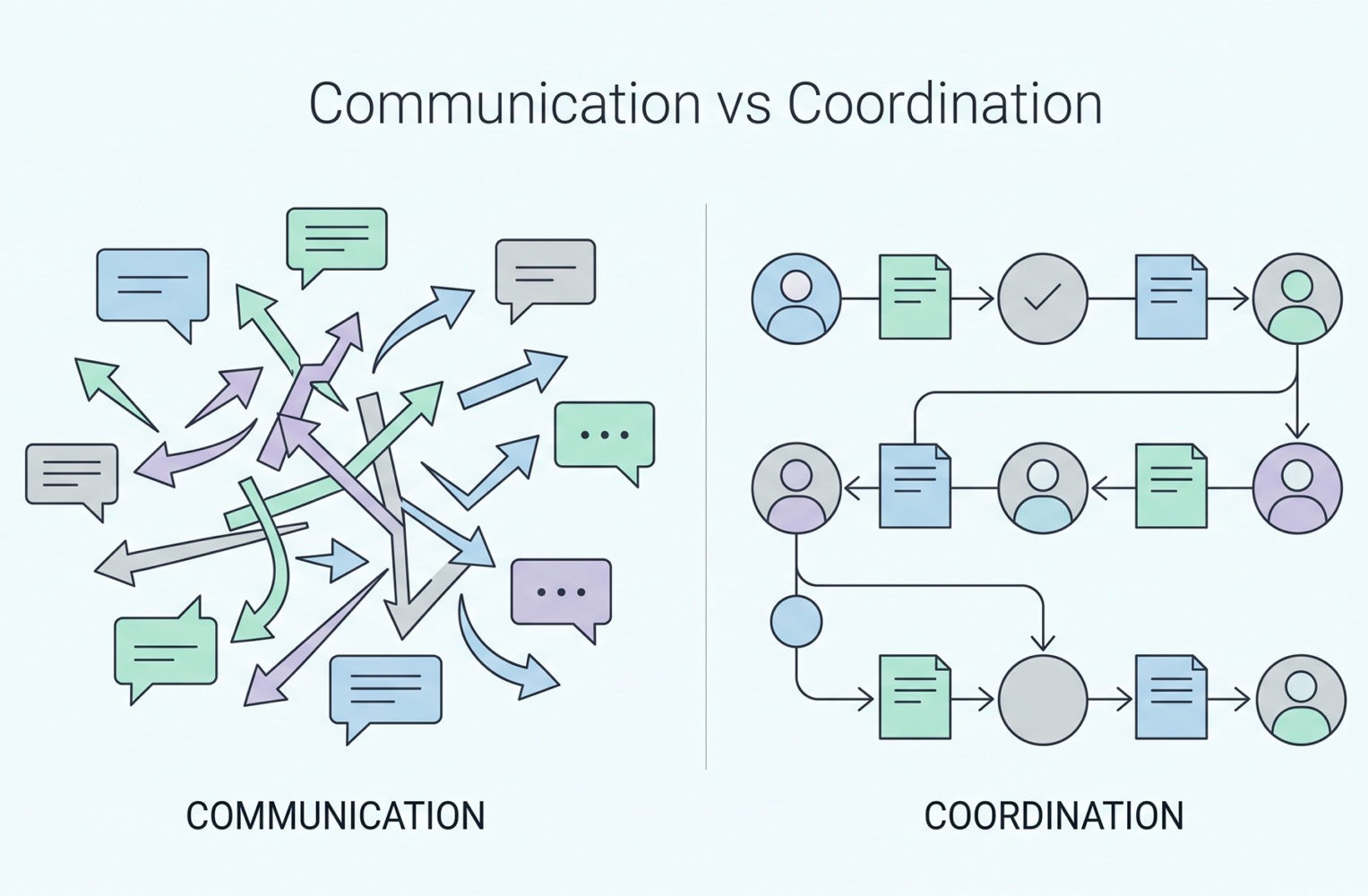
Communication — the exchange of information between two or more people.
Coordination — the alignment of action toward a shared outcome.
In short: communication shares information, while coordination ensures the right actions happen in the right sequence.
Communication is necessary for coordination. But it is not sufficient.
A team can have Slack pinging all day, daily standups, and a shared document for everything and still have no coordination whatsoever. Busy, but not aligned. Informed, but not moving in the same direction.
Why teams confuse the two
When something goes wrong, the instinct is almost always to add more communication: another meeting, more updates, better documentation. The assumption is that people were not informed.
Often, they were.
The information existed. The problem was that nothing happened with it.
There was no clear owner. No agreed next step. No shared definition of what “done” meant, or whose job it was to unblock whom.
That is not a communication failure. It is a coordination failure and no amount of additional information will fix it.
Coordination is what happens after the meeting ends. Communication is the meeting itself.
- A status update is communication.
- A decision on who does what by when is coordination.
- A retrospective is communication.
- Changing the workflow as a result is coordination.
The distinction is not semantic. It determines what you actually do when things break down.
Why communication does not guarantee alignment
Teams can be fully informed and still misaligned.
Alignment depends on decisions, ownership, and execution, not just awareness. Without structure, communication can amplify confusion instead of resolving it.
The same scenario, two lenses
The clearest way to see the difference is to take the same failure and diagnose it twice.
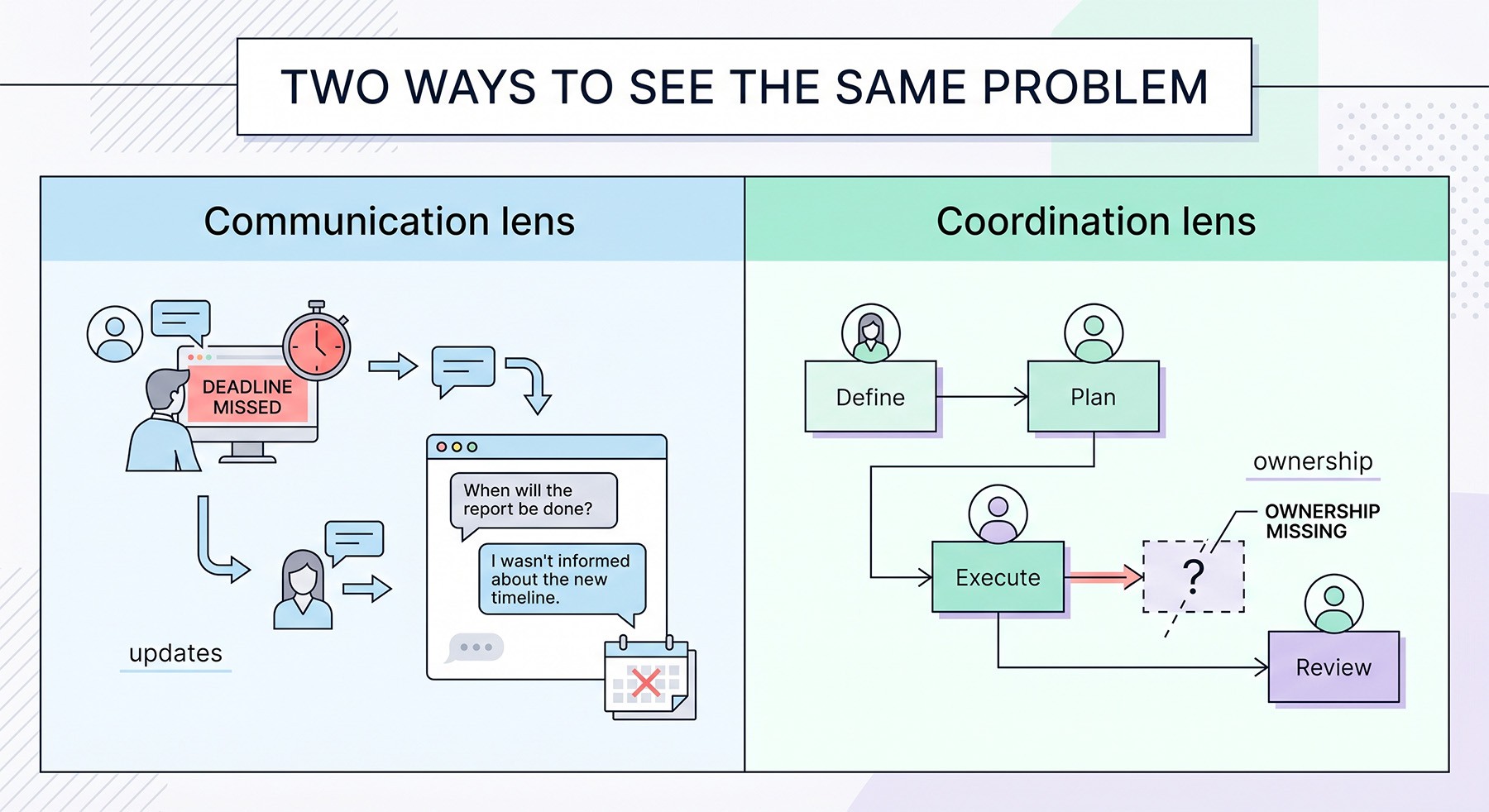
Scenario A — missed deadline
Communication lens: “The design team didn’t know the deadline moved. We need better updates.”
Coordination lens: “There is no clear owner for deadline changes. We need a handoff protocol.”
Scenario B — duplicated work
Communication lens: “People are duplicating work because they don’t talk enough.”
Coordination lens: “There are no agreed scope boundaries. Roles need to be explicitly defined.”
Both lenses can coexist. But if you only apply the communication lens, you will keep scheduling syncs that do not resolve anything.
The coordination lens asks the structural question: where does ownership break down?
A real example
On a product release involving a design team and an engineering team working in parallel, design updated a key deadline and shared it in a common channel. The message was visible, acknowledged, and briefly discussed. Engineering continued working against the original timeline.
From a communication standpoint, nothing was missing. The information had been shared clearly and on time.
But no one owned the deadline change. There was no defined process for propagating it into the implementation plan. The handoff between design and engineering was implicit, assumed rather than structured.
The result: misalignment discovered late, two days of rework, and a delayed release.
Not a communication failure. A coordination failure and the distinction determined exactly where the fix needed to go.
We didn’t need more updates. We needed a clearer system for ownership and handoffs.
What coordination actually requires
Coordination depends on three structural elements that communication alone cannot provide:
01 — Shared goals
Everyone understands not just what they are doing, but why and how it connects to others’ work.
02 — Clear ownership
Every task, decision, and change has a named owner. Ambiguity here is the primary source of coordination failure.
03 — Defined handoffs
Work moves predictably between people, with explicit expectations at each transition point.
These are design questions, not conversation questions. They are answered by restructuring how work is organized,not by meeting more often.
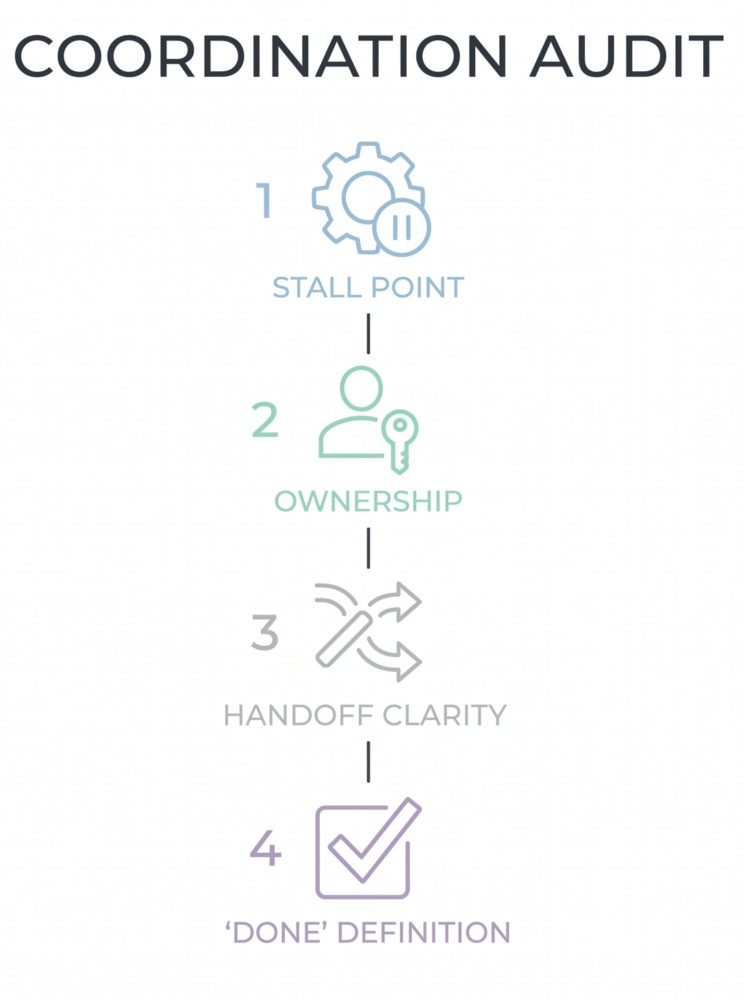
The coordination audit — four questions
When something goes wrong, run this test before reaching for another sync. If the answer to any question is “no” or “unclear,” you have a coordination problem.
01 — Where did the work stall or diverge?
Identify the exact moment, not just the downstream symptom.
02 — Was ownership clearly defined at that point?
A named person, not a team or a role.
03 — Was the handoff explicit and expected by both sides?
Assumed handoffs are the most common failure point.
04 — Did both parties share the same definition of “done”?
Mismatched completion criteria create silent misalignment.
If all four pass, you may genuinely have a communication problem and a better update process may help. In most cases, at least one will fail. That is where to intervene.
Start by fixing ownership at the point where work breaks, not by adding more updates.
Tools improve communication. They do not guarantee coordination.
Teams often use multiple tools — issue trackers, design platforms, and documentation systems. Each improves visibility within a function, but coordination breaks down across them if ownership and handoffs are unclear.
Tools improve communication. They do not replace coordination design.
AI is exceptionally good at the communication layer: summarizing discussions, drafting updates, and surfacing information across channels. It reduces friction in how information moves between people.
But coordination the structure of ownership, accountability, and sequenced action remains a human design problem.
No tool, however capable, resolves unclear responsibility or an implicit handoff. The risk is that better communication tooling masks coordination failures longer, because information appears to be flowing even when action is not.
Teams that use AI effectively treat it as a communication accelerant, not a coordination substitute. The structural questions, who owns this, what happens next, where does it go when it’s done, still need to be explicitly designed.
Tools Worth Knowing
The distinction between communication and coordination also maps cleanly onto the tools teams reach for. Here is a short reference organized by what each tool actually does.
Communication tools — moving information between people
- Slack / Microsoft Teams — real-time messaging; good for fast updates, bad for decisions
- Loom — async video updates; reduces meeting load for status sharing
- Notion / Confluence — shared documentation; keeps information visible across teams
Coordination tools — structuring ownership, sequencing, and handoffs
- Linear / Jira — issue tracking with clear ownership and status; forces explicit assignment
- Asana / Monday.com — task and project management with defined handoff points
- RACI frameworks (not software, but worth naming) — a simple ownership mapping tool that answers “who is Responsible, Accountable, Consulted, and Informed” for any given task
The overlap zone — tools that try to do both
- ClickUp — combines docs, tasks, and goals in one place; useful if the team actually commits to the structure
- Basecamp — flat, opinionated project tool; reduces tool sprawl but requires coordination discipline to work well
Key takeaways
- Communication is the exchange of information; coordination is the alignment of action
- Teams often fail due to unclear ownership, not lack of updates
- More communication increases noise if structure is missing
- Coordination requires shared goals, ownership, and defined handoffs
- Tools and AI improve communication, but do not resolve coordination
Final thought
Communication tells people where things stand. Coordination gets them to move.
When something breaks, the instinct is always to add more updates. But if ownership is unclear and handoffs are assumed, more information just accelerates the confusion.
Fix the structure first. The conversations will follow.
⸻ Author Bio ⸻
Ann Wisniewska is a project management professional with a strong background in collaboration and cross-functional coordination. She focuses on aligning teams, optimizing workflows, and ensuring efficient delivery of complex initiatives. Her experience spans managing distributed teams and fostering productive partnerships that drive projects from concept to completion.