



Construction sites generate some of the most operationally valuable – and disclosure-sensitive – video footage in any industry. When an incident happens, CCTV can help establish sequence, timing, access, equipment movement, and response. But the same clip that clarifies what happened to one worker can also expose unrelated subcontractors, site visitors, vehicle details, delivery schedules, and internal site conditions that were never meant to circulate outside the project team.
That is why construction video handling should not be treated as a simple question of whether footage exists. The more useful question is how to use it safely. In practice, that means preparing incident footage in a way that supports internal review, insurer requests, legal follow-up, or external disclosure without exposing more people and context than the situation actually requires.
Beyond compliance, structured video handling plays a practical role in how construction teams collaborate. Clear, well-prepared footage reduces back-and-forth between project managers, safety teams, insurers, and subcontractors, allowing faster decisions with fewer misunderstandings.
Why construction footage is unusually difficult to share cleanly?
Construction environments are visually dense. A single frame may contain workers from multiple subcontractors, hard-hat colors that signal trade roles, branded vehicles, equipment markings, visitor badges, safety signage, and documents or plans visible in temporary offices. Unlike a quiet office lobby or a single retail checkout lane, a construction site is full of overlapping activity.
That density creates two related challenges. First, many people can appear in the same sequence even if only one person is relevant to the incident. Second, contextual details often matter as much as faces. A worker may be recognizable not just by facial features, but by reflective gear, a company logo, a known location on the site, or the vehicle they arrived in.
As a result, raw video from a site can quickly become over-disclosure if it is shared too broadly or too quickly.
Incident footage is often requested for more than one purpose
On a construction project, the same clip may be reviewed by several audiences in a short period of time. Site management may need it for an internal safety review. A general contractor may need it for coordination with a subcontractor. Insurers may request it after a claim. Counsel may want a preserved segment for dispute handling. In some cases, outside investigators or public authorities may also ask for access.
Those different audiences do not necessarily need the same version of the footage. Internal evidentiary preservation is one thing. A clip prepared for an insurer, subcontractor, or external review is another. Treating all recipients as though they need the raw source file is usually the point where avoidable risk enters the process.
Without a structured approach, this often leads to repeated requests, duplicated exports, and inconsistent versions of the same incident circulating across teams. Over time, that fragmentation slows decision-making and increases the risk of misinterpretation between stakeholders.
Start with the question the footage needs to answer
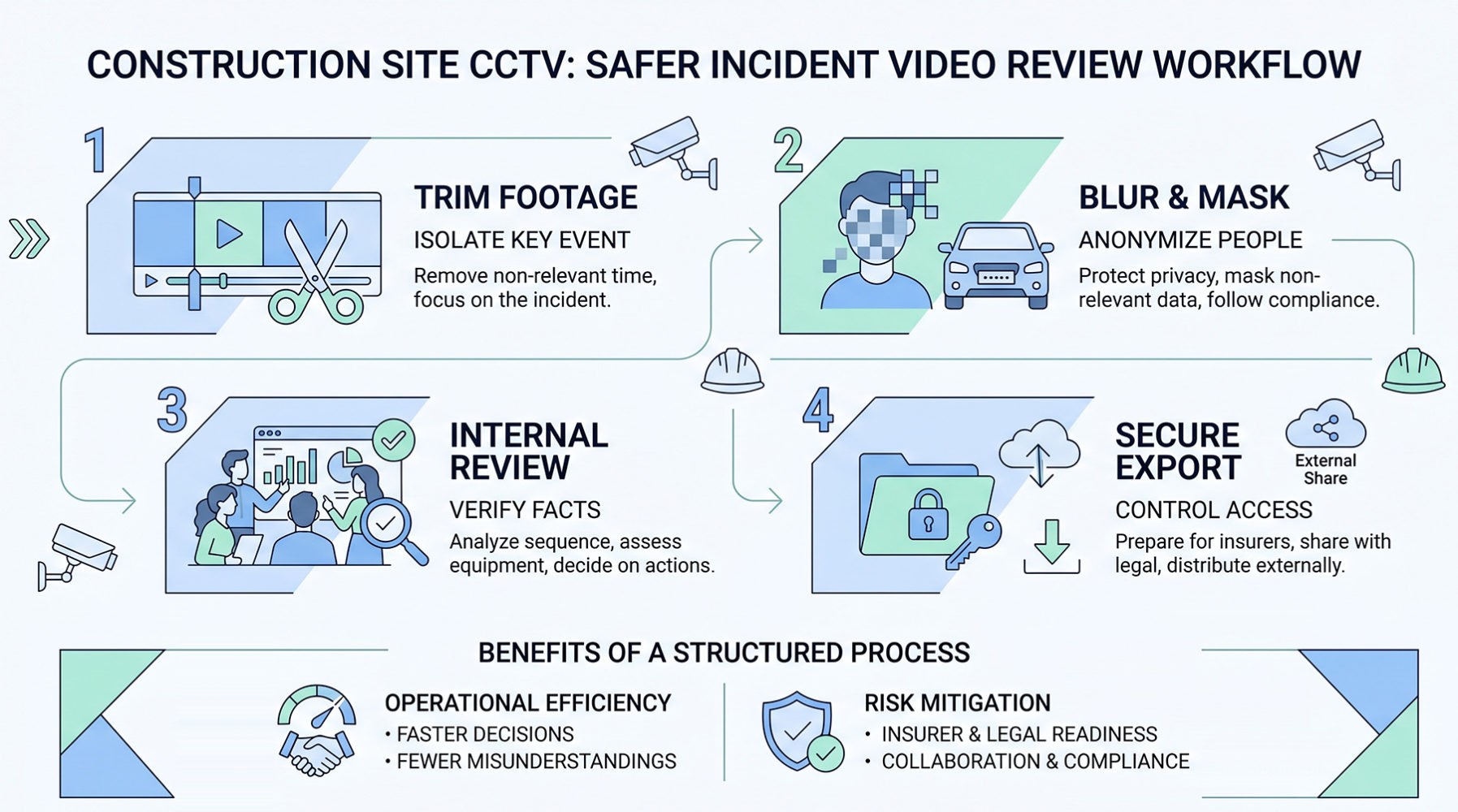
The best incident-video workflows begin with a narrow operational question. Was a worker in the restricted zone? Did a vehicle reverse into equipment? Was PPE worn at the relevant time? Did a fall occur before or after a barrier was moved? Once that question is clear, the footage can be reduced to the shortest segment that actually answers it.
That matters because overlong exports usually add risk without adding value. Ten minutes of gate, corridor, and staging footage may contain dozens of irrelevant workers and vehicles when the key event lasts ninety seconds. Narrowing the clip first is not only a privacy measure. It is one of the fastest ways to make later review more accurate and more defensible.
This question-first approach also helps teams avoid unnecessary internal discussions. When everyone aligns on what the footage is meant to demonstrate, reviews become shorter, more focused, and easier to document across teams.
Faces and license plates are only the first layer
In most construction incident footage, faces and vehicle plates are the most direct identifiers. They should be treated as the first redaction layer when the people or vehicles involved are not necessary to the disclosure purpose. A worker unrelated to the incident does not need to become visible to an insurer or vendor merely because they crossed the frame. The same logic applies to parked or passing vehicles that have nothing to do with the event under review.
That approach also aligns with a practical risk-minimization standard used in many other sectors. In Western Europe, blurring license plates in footage shared externally is generally treated as standard practice and often effectively mandatory. In Poland, the legal treatment of plates is less consistent, but Gallio PRO’s client guidance makes clear that if identifiability is realistic, blurring remains the safer operational choice. The same common-sense logic applies on construction projects in the U.S.: if the identity is not necessary, there is little benefit in exposing it.
The background often carries more risk than the incident itself
Construction video is full of secondary identifiers. A company name on a vest or truck door, a temporary access card, a delivery note on a clipboard, a drawing package left open in a site office, or a monitor showing scheduling or subcontractor data may all reveal more than intended. In a dispute, that kind of incidental information can create a second problem unrelated to the original incident.
This is why construction footage should not be handled with a one-step export mentality. Automatic blurring is useful, but it should be followed by contextual review. What matters is not just whether faces are covered, but whether the overall clip still discloses information that the recipient does not actually need.
Why local, file-based redaction fits site operations
Construction incident footage often moves across a complicated project structure: owner, general contractor, subcontractors, health and safety teams, insurers, legal advisers, and security vendors. Every additional handoff creates another opportunity for raw files to be copied, forwarded, or retained in places the original operator no longer controls.
That is one reason local, file-based redaction makes practical sense. If the original recording stays within the contractor’s or operator’s environment while a disclosure-ready version is prepared for the specific recipient, the organization retains far more control over what actually leaves the site’s evidentiary chain.
Gallio PRO supports that kind of workflow. It is built around stored photos and pre-recorded video files, which makes it suitable for site incident handling, insurer submissions, internal safety review, and other controlled-use scenarios. A practical overview of the video workflow is available here: https://gallio.pro/anonymize-video/
Its automatic scope is intentionally focused. Gallio PRO blurs faces and vehicle license plates in stored files. It does not blur full body silhouettes, and it does not provide real-time anonymization or video stream anonymization. That narrower design is often useful in construction environments because it keeps the automated layer centered on the identifiers that most often create disclosure risk, without pretending to solve every contextual issue automatically.
Other elements – such as logos, tattoos, name badges, documents, or content visible on screens – are not detected automatically. These can be masked manually using the built-in editor. In construction footage, that balance between automation and human review is often the right one: the software handles repeated direct identifiers at scale, while a reviewer resolves the site-specific details that depend on the clip, the audience, and the purpose of the disclosure.
Gallio PRO also does not collect logs containing face or license plate detection data and does not store logs containing personal or sensitive information. For contractors and project teams trying to keep incident handling controlled without creating unnecessary metadata sprawl, that can be an operational advantage.
Internal use and external use should not follow the same rules
One of the most useful discipline points in construction video handling is separating internal evidentiary retention from external sharing. The preserved original may need to remain intact under restricted access. The working copy can be used for trimming, review, and redaction. The version sent to an insurer, subcontractor, or outside adviser should be the disclosure-ready clip, not a duplicate of the raw source.
That distinction prevents a common failure point on projects: someone sends the original because the request feels urgent and the team wants to move quickly. In practice, that often solves the short-term problem while creating a longer-term one, especially if unrelated workers or site details are exposed.
Consistency beats improvisation on active projects
Construction sites move fast, and that is exactly why ad hoc decision-making becomes dangerous. One project manager may send a broad clip, another may crop aggressively, and a third may refuse disclosure until legal review. Even if each person acts in good faith, inconsistent handling makes the organization harder to defend operationally and contractually.
A repeatable workflow is usually more efficient than case-by-case improvisation. Trim the clip to the relevant window. Blur unrelated faces and plates. Review for contextual identifiers. Export one version for the defined purpose. Keep the original controlled internally. That structure is simple enough to use under time pressure and strong enough to stand up later if someone asks how the footage was handled.
From a team operations perspective, consistency reduces dependency on individual judgment. Project managers, safety officers, and external partners can rely on a predictable process instead of interpreting each situation differently. This improves handovers, reduces delays, and makes it easier to onboard new team members into established workflows.
How Standardized Video Handling Improves Team Coordination
Standardizing how incident footage is prepared and shared has a direct effect on team coordination. When video outputs follow the same structure – trimmed, anonymized, and purpose-specific – stakeholders spend less time clarifying context and more time acting on it.
For example:
- Safety teams can complete reviews without requesting additional footage
- Project managers can communicate incidents clearly to subcontractors
- Insurers receive only the relevant material, reducing follow-up questions
Over time, this consistency reduces communication overhead and supports faster, more confident decision-making across the project.
Safer sharing protects more than privacy
On construction projects, careful video handling is not only about worker privacy. It also protects the project team from avoidable side issues. A poorly handled clip can reveal subcontractor identities, operational practices, delivery patterns, or site conditions that were never relevant to the original incident. A properly prepared clip keeps the focus where it belongs: on the event being reviewed.
In practice, safer incident-video handling supports more than compliance. It helps construction teams communicate clearly, respond faster, and avoid unnecessary friction when incidents occur. By keeping footage focused, controlled, and purpose-driven, teams can make better decisions without exposing themselves to avoidable risks.
FAQ – Construction Site CCTV
Should construction teams ever send raw CCTV footage to insurers or subcontractors?
In many cases, a narrowed and redacted clip is safer because site footage usually includes unrelated workers, vehicles, and operational details in the same sequence.
Why blur license plates on a construction site?
Because vehicles in site access roads, delivery zones, and parking areas can often be linked to specific workers, subcontractors, or visitors even when they are unrelated to the incident.
Can Gallio PRO automatically detect logos, documents, or screen content on site footage?
No. Automatic detection is limited to faces and license plates. Other visible identifiers can be masked manually using the built-in editor.
Does Gallio PRO support live-stream anonymization for active construction cameras?
No. It works with stored photos and pre-recorded video files rather than real-time or live-stream footage.
How does structured CCTV video handling improve team productivity on construction projects?
When incident footage is consistently trimmed, anonymized, and prepared for a specific purpose, teams spend less time clarifying context or requesting additional materials. Safety officers, project managers, and external stakeholders can review the same focused version of events, which reduces back-and-forth communication and speeds up decision-making. Over time, a standardized approach also makes it easier to onboard new team members and maintain consistency across projects.