


Modern farm operations face the same problems most operations teams do: siloed data, reactive fixes, and tools that don’t talk to each other. Farming just makes the stakes unusually visible. A poorly timed breakdown or a disconnected software stack can cost an entire season’s revenue, which is why the principles behind smarter farm infrastructure translate well to how any team manages its tools and workflows.
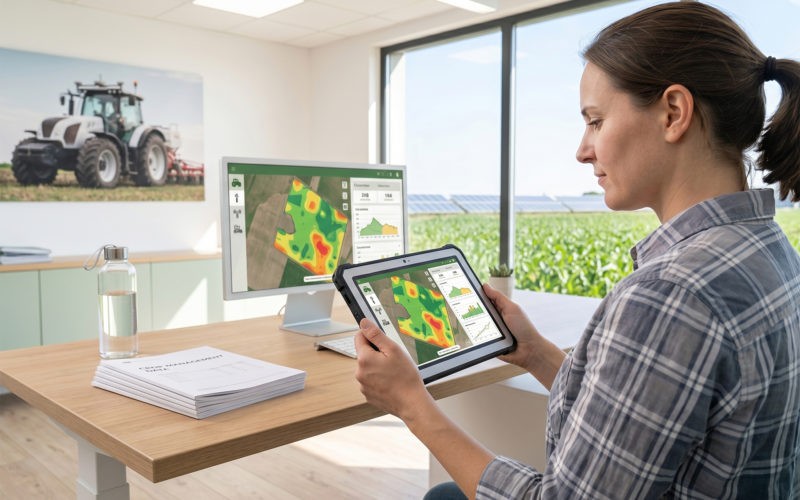
When most people talk about modernizing farming, they focus on high-tech machines: self-driving tractors, drones, and other specialized robotics. However, the real key to productivity may lie in better data management. New technologies hold great promise, but many farmers still lack access to high-precision agricultural data and that limits how effectively these cutting-edge tools can be used. So while new machinery helps, it is not a complete solution on its own. Most of the challenges farmers face today require them to gather, use, and share data in order to make better decisions.
Start with what you already have
The natural impulse is to replace existing equipment with something newer. In many cases, the more careful decision should be squeezing a bit more life out of the old stuff.
Adding IoT sensors to grain silos and irrigation pivots costs a fraction of installing new ones, and you immediately gain remote visibility into moisture and temperature. Manual inspection rounds become alerts. Problems get caught before they cause downtime instead of after.
Same goes for machinery. You can either invest six figures in a new harvester, or you can invest a comparatively small amount in telematics systems and install it on your entire combine fleet for 1% of the harvester’s cost. Repeat for your tractors, sprayers, and trucks. Suddenly you’re tracking GPS location, hours of operation, fuel usage, and idling time across the entire fleet. Inefficiencies that used to surface only in end-of-month fuel reports become visible the same day, which is usually when you can still do something about them.
Modernizing transport and logistics
Although field operations account for a large share of costs, the post-harvest logistics side is an area where significant gains can be made. Time and fuel are often wasted through uncoordinated scheduling and repeated handling of produce.
Understanding how farming transport fits into the broader infrastructure picture is worth spending time on early in the planning process. Decisions around ATVs, UTVs, or larger vehicles all need to be made with the full logistics chain in mind.
Coordinating harvest logistics is mostly about planning early enough that you can stress-test the system before the season actually starts. Most of the failures show up in the gap between what the plan assumed and what the equipment, drivers, and weather actually did.
Predictive maintenance over reactive repairs
Equipment failure during harvest is extremely costly. Repairs are the obvious cost, but the larger losses are usually downtime and the yield that gets left in the field. In a bad year, a breakdown at the wrong moment can mean losing an entire crop.
One of the most effective ways to reduce this risk is to shift from reactive maintenance, fixing things when they break, to predictive maintenance. With a predictive approach, sensors monitor the condition of components in real time, and maintenance is performed when it is actually needed, well before something fails at a critical moment.
Predictive maintenance, done well, meaningfully reduces unplanned downtime during harvest. For a medium-sized farm working within tight weather windows, that reduction is often the difference between a profitable year and a losing one.
Vibration analysis on harvester bearings, oil condition monitoring on hydraulic systems, and thermal readings on electrical connections are three practical entry points. None of them require a full sensor overhaul — most can be retrofitted to existing machinery and fed into a single dashboard alongside your telematics data.
Building for interoperability, not just capability
Many modernization efforts fail not because the tools are bad, but because the tools do not talk to each other. Imagine a farm that adopts new precision agriculture software and improves fertilizer application uniformity — and therefore crop yields — by 10%. It then adds a second application to track field equipment for labor and fuel savings, but the two systems share no data. The result: the equipment tracking tool generates usage data, but none of it feeds back into crop productivity decisions. Machinery still overlaps in the field at the end of the season, quietly undoing some of the earlier gains.
Interoperability is not a technical detail to sort out later. It should be a requirement from the start.
Scaling without overbuilding
Modernizing does not mean replacing everything at once. Farms that expand their capabilities efficiently tend to do so gradually, adopting one solution at a time while keeping in mind how each new component will interact with what is already in place.
A sensible sequence: start by improving visibility. Add a telematics system. Install sensors in areas that currently require too much manual oversight. Build an integrated view of your transport logistics. Once you have reached that point, you will be in a much better position to assess whether new machinery is genuinely justified, or whether your existing fleet, now connected and monitored, can simply perform better.
None of this is unique to farming. Whether you run a field operation or a distributed software team, the underlying questions are the same: are you getting full value from the tools you already own, do they share data with each other, and are you replacing things on a schedule that matches the work rather than reacting to failures? The answers tend to matter more than the specific technology used to implement them.