




Understanding why workflows break as teams grow starts with a specific moment most teams can trace in hindsight — a particular quarter, sometimes a particular hire, when something shifted. Decisions that once took an afternoon began taking a week. People who had been sharp and fast started feeling stuck.
This phenomenon is known as coordination collapse — a structural failure rather than a human one.
Coordination collapse is the point at which a team’s informal coordination infrastructure — the shared context, the implicit agreements, the ambient awareness of what everyone is doing — can no longer carry the load of the work being done. The team doesn’t fail catastrophically. It slows, fragments, and produces friction that teams struggle to diagnose.
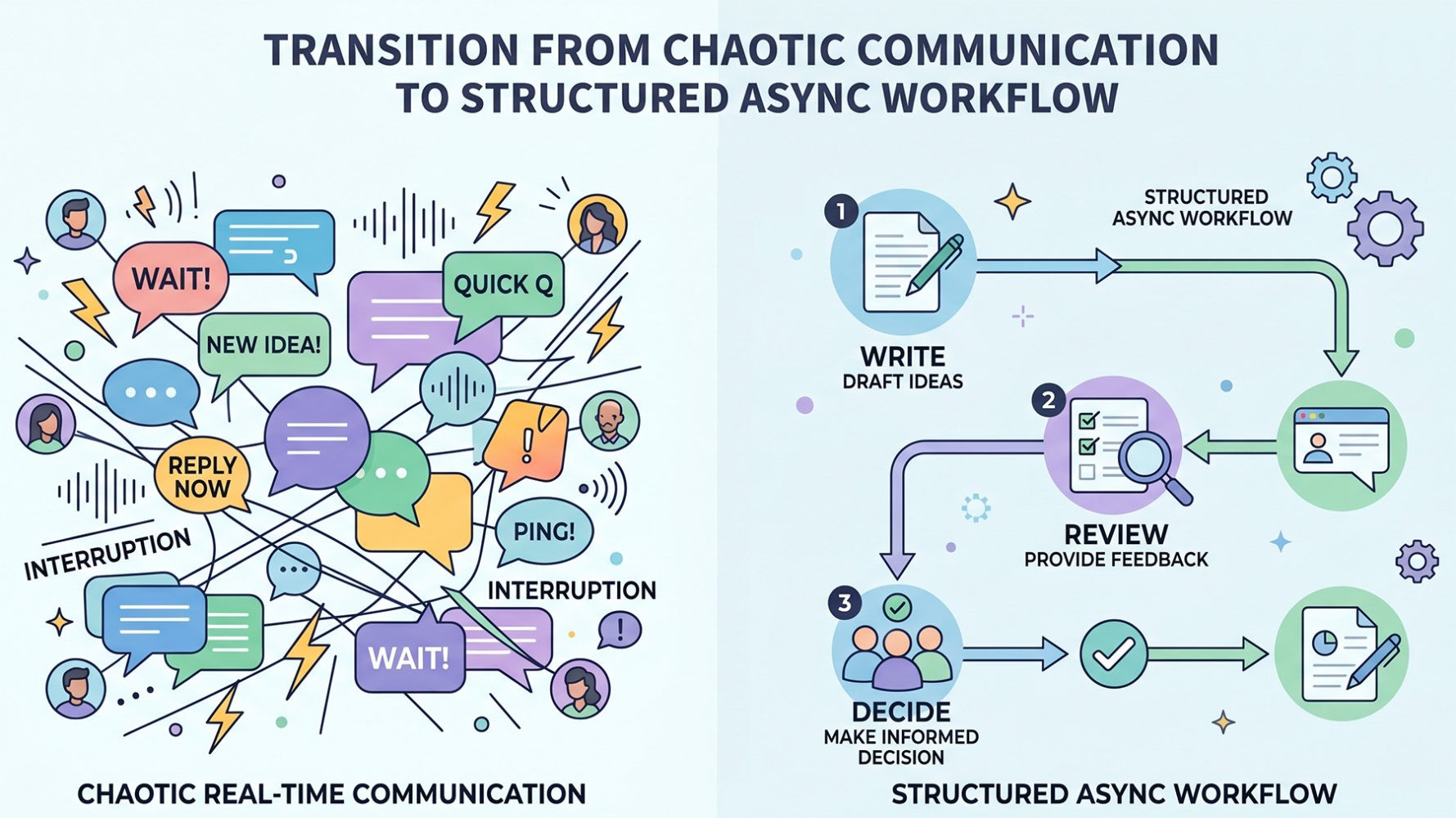
Why workflows break: the scaling friction paradox
The surprising part is this: most of the behaviors that cause coordination collapse are the same behaviors that made the team successful when it was small. Direct communication. Informal decision-making. Ad-hoc collaboration. These aren’t bad habits — they’re efficient habits that stop scaling.
A team of six can run entirely on Slack pings and informal standups. Context is shared because everyone is in every conversation. Decisions are fast because the person who needs to make them is always three feet away. Trust is implicit because you’ve seen each other work.
At twenty people, these same approaches start creating scaling friction — the compounding overhead cost of coordinating work as headcount grows. The friction isn’t linear. As documented in research on collaboration overload, coordination costs grow with the number of connection points — a dynamic similar to network scaling effects, where each additional team member increases communication paths faster than overall capacity. That’s not a people problem; it’s a network problem.
ℹ️ RELATED
If your team has recently restructured feedback loops, see when feedback becomes orphaned — a structural problem that often precedes coordination collapse by several months.
The four stages of coordination collapse
Coordination collapse tends to unfold in a recognizable sequence. Understanding which stage your team is in makes the fix significantly more tractable.
| 01 Context diffusion Shared knowledge begins living in individual heads rather than shared systems | 02 Decision bottleneck Decisions route upward because ownership is unclear | 03 Coordination overhead Meetings multiply to compensate for missing structure | 04 Execution stall Work slows visibly; attribution of cause becomes contested |
Most teams arrive at stage four and diagnose the wrong problem. They see slow execution and assume the issue is motivation, talent, or tooling. They run engagement surveys and buy new software. These interventions occasionally help at the margins, but they don’t address the structural failure underneath.
What breaks first when teams grow
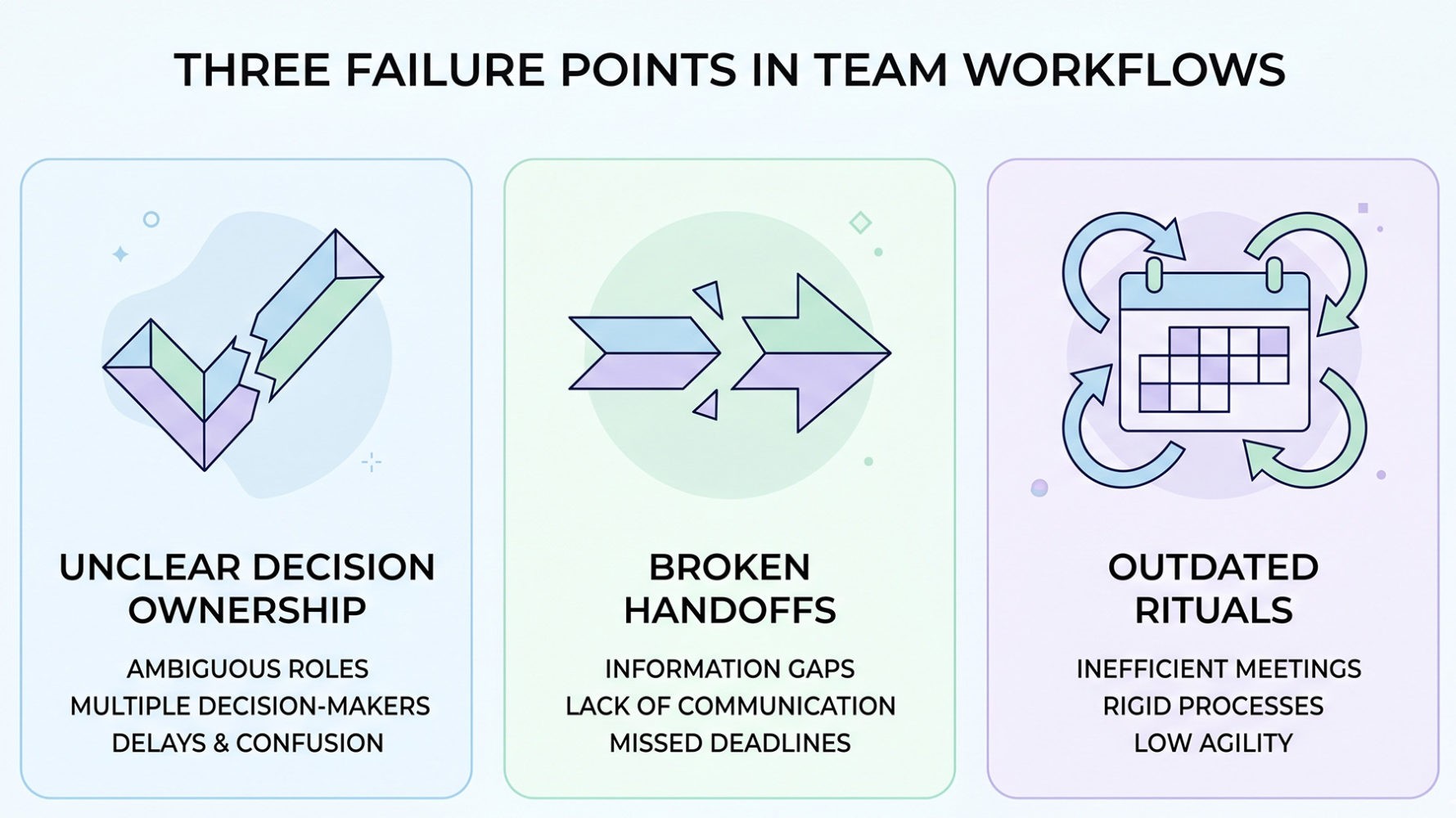
Three mechanisms account for the majority of workflow failures in scaling teams.
1. Decision rights go undocumented
In small teams, decision ownership is either obvious or negotiated in real time. As teams grow, ownership of many decisions becomes genuinely ambiguous — not because people are confused, but because the organizational structure hasn’t kept pace with the work. When it’s unclear who can say yes, teams default to caution and work stalls.
According to organizational decision-making research, research consistently shows that unclear accountability is a leading cause of organizational slowdown. Teams that run a decision rights audit — mapping which decisions get made, by whom, with what input — typically find a significant share of recurring bottlenecks can be resolved by clarifying ownership alone, without restructuring anything.
Teams often solve this by introducing a lightweight decision system. Tools like Notion or Confluence can act as decision logs, while Linear or Jira can attach ownership directly to product work. The goal isn’t heavier process, it’s making ownership visible at the point decisions are made.
2. Handoffs carry insufficient context
The other major failure mode is information loss at handoffs. When work passes between people — from research to design, from design to engineering, from engineering to QA — context bleeds out at every transition. The person receiving the work often lacks clarity on what was decided, what was tried and discarded, and which constraints are non-negotiable.
This is the structural layer of a problem that often gets framed as a communication problem. Feedback becomes orphaned not because people are poor communicators, but because there’s no system for carrying decisions forward. Good handoff infrastructure — decision logs, lightweight briefs, explicit “why not” documentation — closes most of this gap.
Coordination is infrastructure, not culture. You can’t talk your way out of a structural problem.
3. Coordination rituals don’t evolve
The standups, retrospectives, and planning sessions that served a team of eight rarely survive contact with a team of thirty unchanged. Yet most teams hold onto their coordination rituals long after they’ve stopped working — partly out of habit, partly because the rituals feel like culture.
The result is a productivity paradox: more meetings, yet less effective coordination. Rituals multiply without being redesigned, consuming time that could be spent on work without producing the shared context and alignment they were meant to create.
Many teams shift standups and updates into asynchronous channels using Slack or Microsoft Teams, reducing meeting load while preserving visibility. For planning and creative work, tools like Miro and Figma allow collaboration without requiring synchronous sessions, but only when rituals are redesigned, not just moved online.
A concrete example: 8 to 25 people
We saw this play out directly. When our product team crossed fifteen people, something shifted — not dramatically, but noticeably. Here’s what it looked like from the inside.
At eight people, the team ships fast. Feature decisions happen in a single Slack thread; the head of product is in every relevant conversation. When something is unclear, someone walks over and asks.
At fifteen, a second product manager joins. Suddenly, some decisions have two potential owners — and neither acts, assuming the other will. A sprint passes. The decision routes up to the head of product, who is now in back-to-back meetings. The feature slips by two weeks.
At twenty-five, this pattern has multiplied across design, engineering, and QA handoffs. No single decision feels catastrophic. Cumulatively, the team is running at noticeably lower velocity, but the cause looks, on the surface, like execution problems, not structural ones.
The fix, in this case, was a two-hour decision rights audit and a one-page handoff brief template. Not a reorganization. Not new tools.
How to fix workflow breakdown as your team scales
Solving coordination collapse requires structural change, not motivational change. These interventions are specific, high-leverage, and achievable without a full reorganization.
Map decision rights — Run a decision audit. List recurring decisions, assign clear owners, define who is consulted vs. informed.
Design handoff briefs — Lightweight docs that travel with work: decisions made, options discarded, constraints fixed.
Retire rituals annually — Every coordination ritual should have a review date. Kill what no longer produces shared context.
Default to async — Written decision docs, RFCs, and Notion/Linear threads for most coordination. Reserve sync time for genuinely ambiguous problems.
Ask “what structure is missing?” — When execution stalls, default to structural diagnosis before attributing cause to individuals.
Counterpoint: when informal systems still win
This framework applies to teams past early startup stage. For teams under eight to ten people — especially pre-product-market-fit — imposing formal coordination infrastructure often creates more drag than it removes. At that stage, speed and adaptability depend on informal context-sharing; adding process too early is its own failure mode. The lesson is directional: match your coordination infrastructure to your team size, not to a template.
The meta-pattern
Behind each of these fixes is a single insight: coordination is infrastructure, not culture. Culture shapes how people behave; infrastructure determines which behaviors are easy or hard.
Most teams treat coordination as a cultural problem — they try to fix it with better communication training, stronger norms, and more psychological safety. These investments aren’t wasted, but they can’t compensate for missing infrastructure. As modern team structure frameworks like Team Topologies argue, the way you organize work determines the work you’re able to do.
The teams that scale well are the ones that invest in coordination infrastructure proactively — before the collapse, not after. They redesign their rituals before the rituals break. They document decision rights before ambiguity creates bottlenecks. They build handoff systems before context starts leaking.
ℹ️ RELATED READING
Coordination collapse is one layer of a broader challenge. See also: the productivity paradox for scaling teams.
Coordination collapse is not a sign that a team has hired the wrong people or lost its culture. It’s a sign that the team has grown and that the infrastructure serving one size needs to be rebuilt for the next. That’s not a failure. It’s a milestone worth designing for.
⸻ Author Bio ⸻
Ann Wisniewska is a project management professional with a strong background in collaboration and cross-functional coordination. She focuses on aligning teams, optimizing workflows, and ensuring efficient delivery of complex initiatives. Her experience spans managing distributed teams and fostering productive partnerships that drive projects from concept to completion.