




You built a brand people can find on Google. Now you’re watching a different kind of search eat your pipeline, and you’re optimizing for the wrong engine.
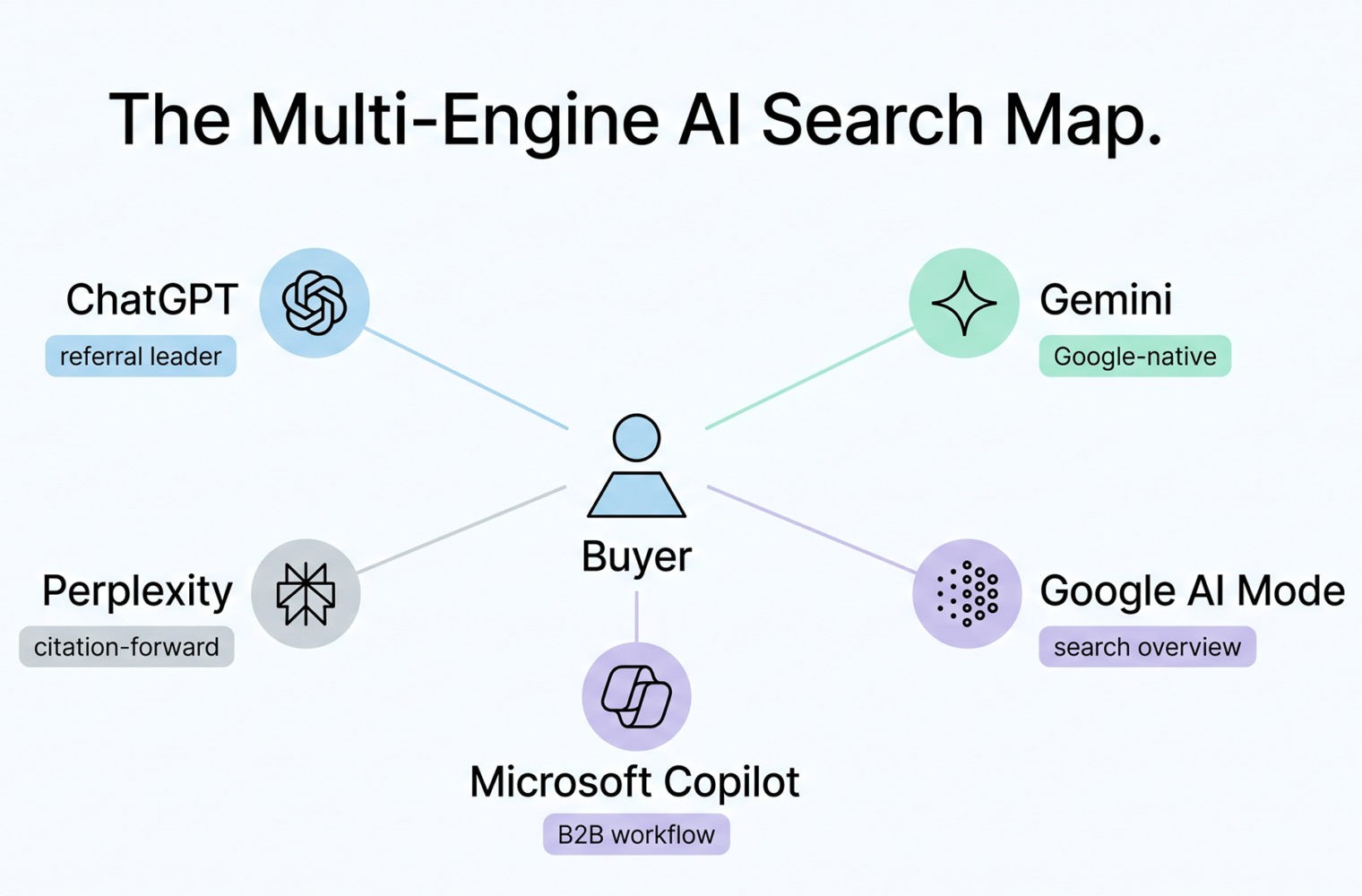
Here’s the number everyone cites: ChatGPT drives 87.4% of all AI referral traffic. It’s a real stat, and it’s also a trap, because that aggregate masks something founders need to understand before their next content investment. ChatGPT may dominate referral traffic, but it no longer dominates AI usage. Gemini’s share of generative-AI platform traffic jumped from under 6% to over 21% in a single year (Similarweb, January 2026), while ChatGPT’s share of that same pie fell from 87% to roughly 65%. Perplexity punches above its user base in technical and B2B categories. Microsoft Copilot is embedded inside the productivity stack of hundreds of millions of enterprise buyers. Google’s AI Mode is reshaping what actually appears in the world’s highest-volume search environment.
The playbook you’re running, “rank in ChatGPT,” is already outdated. AI search is fragmenting, each engine has a different retrieval logic, and the buyers you care about are not all in the same place.
Why the ChatGPT Monopoly Framing Is Wrong
The 87.4% referral figure is accurate in aggregate but misleading in application. It reflects total referral traffic across all industries and query types. It also measures only one thing: clicks back to your site. It says nothing about how many buyers form an opinion inside an AI answer and never click at all. When you zoom into specific verticals such as finance, cybersecurity, enterprise software, and healthcare, the distribution shifts.
Gemini has a structural advantage that most founders haven’t thought through. It is the native AI experience inside Google Search, Android, and Google Workspace. Every user on Gmail, Docs, or a stock Android phone is one tap from a Gemini response. That isn’t a niche. It’s billions of default placements. In industries where buyers live in Google’s ecosystem (which is most of them), Gemini’s recent climb in usage share is probably the early part of a longer curve.
Perplexity’s user base skews toward researchers, developers, and analytically minded professionals. Its answers cite sources directly and visibly, which changes how credibility works. Your brand needs to appear in the sources, not just the summary. If your buyers are technical evaluators or operators doing vendor due diligence, Perplexity matters more than its raw traffic share suggests.
Copilot is the sleeper engine in B2B. Microsoft 365 now has over 450 million commercial paid seats (Microsoft Q2 FY2026 earnings, January 2026), and Copilot is baked into Teams, Outlook, Word, and Edge. When an enterprise buyer opens a chat window to ask “what’s the best platform for X,” they’re often doing it inside Copilot without leaving their workflow. That query never shows up in your Google Analytics. It doesn’t show up anywhere unless you’re actively monitoring it.
The contrarian insight here is uncomfortable: the AI engine with the smallest reported referral share might be the one most likely to influence your biggest deals.
How Each Engine Actually Decides What to Surface
Understanding retrieval logic is more valuable than any single tactical tip. These engines don’t work the same way, and optimizing for one using another engine’s logic is how brands disappear from AI results without knowing why.
ChatGPT (including the web-browsing versions) draws on its training data, Bing’s web index for real-time queries, and a growing set of direct integrations. For brand visibility, what matters most is the volume and consistency of mentions across authoritative web sources, structured factual content that is easy to extract, and presence in sources that Bing indexes well. ChatGPT also weights recency for timely queries, so brands that publish consistently have an edge over those that published once and stopped.
Perplexity is citation-forward by design. It surfaces sources visibly and rewards content that directly answers specific questions with clear, verifiable claims. Long, exploratory content doesn’t perform as well here as tightly scoped, high-specificity answers. If your blog posts are written to rank for broad keywords, they may not be the content Perplexity pulls from, even if they rank on Google.
Google AI Mode, the successor to SGE, is where the traditional SEO playbook intersects most directly with generative AI. Google’s model still rewards E-E-A-T signals (Experience, Expertise, Authoritativeness, Trustworthiness), but the output format has changed. Instead of a blue link, your content might be absorbed into an AI-generated overview. The implication is blunt: ranking without being cited in the AI summary is increasingly a consolation prize. Structured data, clear authorship, first-hand experience signals, and factual density all matter.
Gemini retrieves from Google’s index and also integrates with Google Workspace data for logged-in users. Its weighting favors content that has accumulated trust signals in Google’s ecosystem, including backlinks, domain authority, and Core Web Vitals, but its summaries tend to synthesize more than Perplexity’s and cite less explicitly. Visibility here is more about being ingested than being attributed.
Microsoft Copilot is Bing-powered at its core, layered with enterprise context. For B2B brands, this means two things. Bing SEO is not dead, and thought-leadership content that appears in Microsoft-adjacent publications (LinkedIn, Microsoft’s own content network, Bing-indexed industry press) carries disproportionate weight. Copilot also has memory and user context in enterprise deployments, so repeated positive signals within a buyer’s workflow can compound over time.
The Fragmented Buyer, the Fragmented Engine
The practical implication of engine diversity is that your buyers are not all using the same tool.
A developer evaluating your API will likely use Perplexity or ChatGPT. A procurement manager inside a Fortune 500 comparing vendors will likely ask Copilot. A founder doing quick market research might use Google AI Mode or Gemini on their phone. A consumer-adjacent buyer might use ChatGPT because it’s what they downloaded last year.
Each of these buyers asks a different question, in a different interface, with a different retrieval system behind it. If your brand is optimized for one and absent from the others, you’re invisible to buyers who would have converted.
This is the strategic gap most startups are running into right now. They’ve done the work to appear in ChatGPT, either through deliberate Generative Engine Optimization (GEO) or just by accumulating enough web presence, and they’re calling the job done. But the fragmentation is accelerating, not slowing. In 2026, HubSpot renamed its flagship INBOUND conference to UNBOUND partly in response to the shift in how buyers discover and evaluate software, acknowledging that the traditional inbound model is being disrupted at its foundation. When a company with HubSpot’s distribution restructures its core event around AI-era discovery, the signal is hard to ignore.
The Monitoring Gap Nobody Talks About
Most analytics stacks were built for a world where search meant Google. They measure clicks, sessions, and referral sources, but AI engines often don’t send referral data. Answers are generated, not linked. Buyers read a summary, form an opinion, and arrive at your site (or don’t) with no traceable path.
This is the dark matter problem of AI search: influence without attribution. Your brand is shaping, or failing to shape, buyer perception inside these engines, and your current tools probably can’t see it.
The emerging toolset for multi-engine AI visibility monitoring is still uneven. A few approaches stand out:
- Profound tracks brand mentions across AI engines including ChatGPT, Perplexity, and Google AI Mode. It’s built for the “are we being cited?” question and gives you query-level data on where your brand surfaces and where it doesn’t.
- Semrush’s AI toolkit has expanded to include AI Overview appearances in Google Search, which makes it useful for brands whose primary concern is the Google AI layer on top of traditional SEO.
- Brandwatch and similar social listening tools catch secondary signals, such as when someone posts that they asked an AI about your category and you weren’t mentioned.
- Manual prompt auditing remains the most underrated tactic. Build a set of 20 to 30 prompts your ideal buyers might actually type into each engine. Run them monthly. Screenshot the results. Track whether your brand appears, where it appears in the response, and what is said about you. This takes about two hours a month and surfaces more actionable insight than most paid tools currently deliver.
The honest assessment: tooling for multi-engine AI visibility is still immature. No single platform gives you a clean cross-engine dashboard. Until one emerges, a manual audit combined with one or two specialized tools is the practical approach.
What You Can Actually Do This Week
Visibility in AI search is not primarily a technical problem. It’s a content and authority problem. The brands that appear consistently across engines are the ones with dense, trustworthy, well-distributed factual footprints. Here’s where to start.
Audit your “what is [your brand]” presence. Run that exact query across ChatGPT, Perplexity, Gemini, and Copilot. Does the description match your positioning? Is it accurate? Does your brand appear at all? This is your baseline. Do it today.
Build source-worthy content, not just rankable content. AI engines pull from sources they trust. Long, vague thought-leadership pieces that ranked well in 2021 are not what Perplexity cites. Write content that answers specific questions with specific claims, supported by data. “Here are three studies on X with direct findings” outperforms “here is our perspective on X” in AI retrieval.
Get cited in publications each engine trusts. For ChatGPT and Copilot, that means Bing-indexed authoritative press and industry publications. For Gemini, Google-trusted domains and content with strong E-E-A-T. For Perplexity, academic and research-adjacent sources plus well-cited technical blogs. These are not the same list.
Use structured data. Schema markup helps AI engines understand what your content is about and extract it accurately. FAQ schema, HowTo schema, and Organization schema all increase the probability that your content is parsed correctly and attributed to you.
Build entity authority where Copilot and Gemini already look. Copilot runs on Bing’s index, and for comparison queries like “best platform for X” it leans heavily on third-party review sites such as G2 and Capterra, not just your own pages. LinkedIn matters too. By early 2026, analytics firm Profound reported that LinkedIn had become the most-cited domain for professional queries across the major AI engines, with citations shifting toward published posts and articles rather than static profiles. For B2B brands, that makes your review-platform profiles and your team’s LinkedIn publishing visibility infrastructure, not afterthoughts. These are trust signals that sit entirely outside your own CMS.
Establish authorship signals. Google AI Mode weights E-E-A-T heavily. Named authors with demonstrable credentials, linked author pages, and consistent publishing histories signal that your content comes from a real person with relevant expertise. This matters more now than it did when algorithms were purely link-based.
The Meta-Strategy
The instinct to find the one channel that matters and double down on it is understandable. It’s how most startups survive early growth. But AI search has already made that instinct risky.
The brands that will own AI search visibility in 2026 and beyond are the ones treating it the way sophisticated marketers treat traditional search: as a multi-surface, multi-signal discipline that requires ongoing monitoring, content investment across formats and platforms, and a willingness to optimize for buyer journeys that don’t start where you expect them to.
ChatGPT is the biggest referral engine. But it isn’t your only audience, and in certain buyer segments (enterprise, technical, research-oriented) it may not even be the most influential one.
The playbook is not “optimize for AI search.” The playbook is “build a brand that AI engines trust enough to recommend, across every surface where your buyers are asking questions.”
Start with the audit. Then build toward the distribution.
Run the five-engine audit on your own brand this week. Query your category, your use case, and your brand name across ChatGPT, Perplexity, Gemini, Copilot, and Google AI Mode. What you find will tell you more about your actual AI visibility gap than any tool currently on the market.
About the author:
Eve Cichon specializes in marketing strategy, brand development, and digital growth. Working as a freelancer, she helps businesses connect product value with audience needs through data-informed strategy and creative execution. Her expertise spans brand positioning, campaign management, audience engagement, and building scalable marketing systems that support long-term growth.