




TL;DR: What Is the Best API for AI Visibility?
SE Ranking is the strongest all-around choice. Its AI visibility API covers Google AI Overviews alongside traditional rank tracking, backlink analysis, and technical site audits inside a single platform. SE Ranking works best for:
- SEO agencies building automated client reports
- In-house teams that need both classical SEO data and AI search tracking in one place
- Developers who need a reliable API for AI search visibility with complete, maintained documentation
The API is well-documented, returns structured JSON, and is stable enough for production reporting pipelines.
AI-generated answers increasingly shape how users discover brands. Google AI Overviews, ChatGPT, Perplexity, and Gemini now answer questions that once sent users to a list of blue links. Tracking whether your brand appears in those answers requires programmatic access to AI search data — and manual checking does not scale.
That is exactly what an API for AI visibility provides. This article compares five tools: SE Ranking, Peec AI, Profound, RankScope, and Ahrefs. Each exposes an AI visibility API, but with meaningfully different data coverage, pricing models, and target use cases.
Comparison Table: Best APIs for AI Visibility
| Tool | AI/LLM Tracking | Traditional SEO Data | API Access | Best For | Entry Price |
| SE Ranking | Google AI Overviews, Google AI Mode, Gemini, Perplexity, ChatGPT | Full suite | Yes | All-in-one SEO + AI visibility | $318/mo |
| Peec AI | ChatGPT, Claude, Gemini, Perplexity | None | Yes | Pure LLM monitoring | $95/mo |
| Profound | Multi-LLM analytics | None | Yes | Enterprise AI analytics | $99/mo |
| RankScope | Basic AI Overview detection | Rank tracking | Yes | Rank-first workflows | $49/mo |
| Ahrefs | AI Overview detection only | Industry-leading | Yes (Units) | Backlinks, keyword research | $129/mo |
SE Ranking API
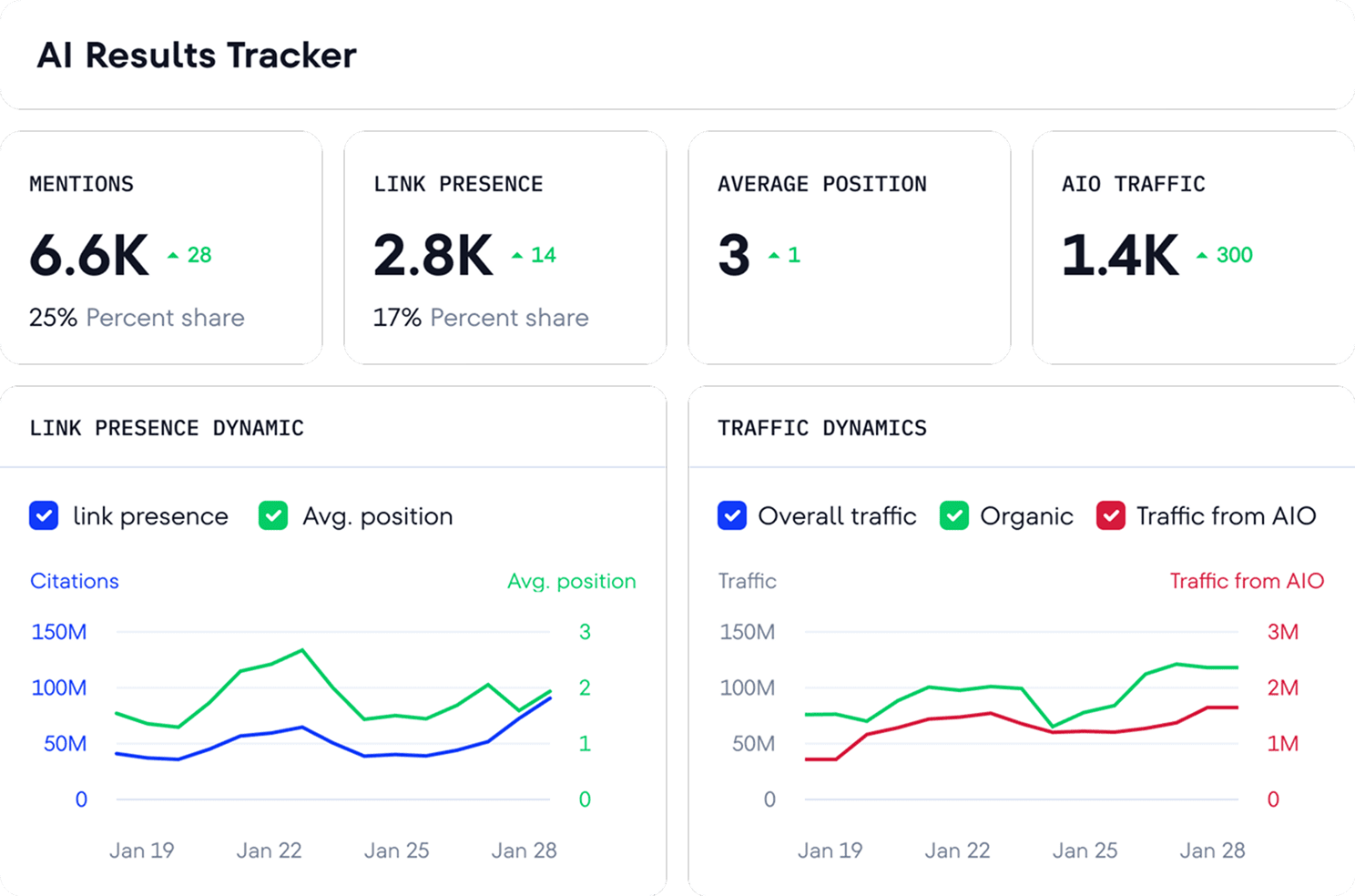
SE Ranking is one of the few platforms that functions as a genuine AI search visibility API rather than a tool that simply adds AI detection as a surface-level feature. It covers Google AI Overviews natively, not through a bolt-on module, and packages that alongside the full SEO data suite teams already rely on for weekly reporting.
What Are the Key Features of SE Ranking API?
- Tracks Google AI Overviews, Google AI Mode, Gemini, Perplexity, and ChatGPT
- Tracks when Google AI Overviews appear for target keywords and identifies whether your domain is cited inside them
- Daily or on-demand keyword rank tracking across Google, Bing, and Yahoo
- Backlink analysis with toxicity scoring, new and lost link alerts, and referring domain data
- Site audit API with crawl-based technical SEO data returned via structured endpoints
- Competitor tracking across up to 20 domains depending on plan tier
- White-label report generation that pulls live API data automatically
- Keyword research endpoints covering search volume, keyword difficulty, CPC, and SERP feature breakdowns
What Are the Pros and Cons of SE Ranking API?
Pros:
- Among the strongest AI search visibility tracking tools API options for teams that also need classical SEO data
- Competitive pricing compared to Ahrefs and Semrush at equivalent data depths
- AI Overview tracking is built into the core product
- Supports Google AI Overviews, Google AI Mode, Gemini, Perplexity, and ChatGPT
- Well-structured JSON responses make it a reliable AI search visibility API for reporting pipelines
- Active API documentation with a changelog and developer support channel
- Tiered pricing makes cost forecasting straightforward for agencies
Cons:
- API rate limits can constrain high-volume use cases at lower plan tiers
- User reviews note that API documentation has gaps in clarity
- The platform’s expanding feature set creates a steeper learning curve for newer users
What Is the Pricing of SE Ranking API?
- Core Plan: 25,000 credits/month; subscription starts at $103.20/mo billed annually.
- Growth Plan: Includes 100,000 Data API credits/month; subscription starts at $223.20/mo billed annually.
- Standalone Availability: You can purchase access without buying the normal SaaS dashboard. The annual billing plan starts at $318.00 per month.
- Yearly Credit Volume: The baseline $318 package provides 24 million credits for the entire year. You pay $3,816.00 upfront.
- Endpoint Specific Costs: SERP records cost 10 credits each. A single domain overview query deducts 100 credits instantly. Backlink queries charge exactly 1 credit for every single row returned in the payload.
- Machine Learning Premium: Any request interacting with the LLM prompt endpoints costs a massive 2,000 credits per single call.
- Free Trial Access: New accounts receive 100,000 free credits for 14 days.
SE Ranking provides two distinct APIs: the Data API, which uses a pay‑as‑you‑go credit system for raw data retrieval, and the Project API, which uses your subscription limits for project management functionality.
Peec AI API
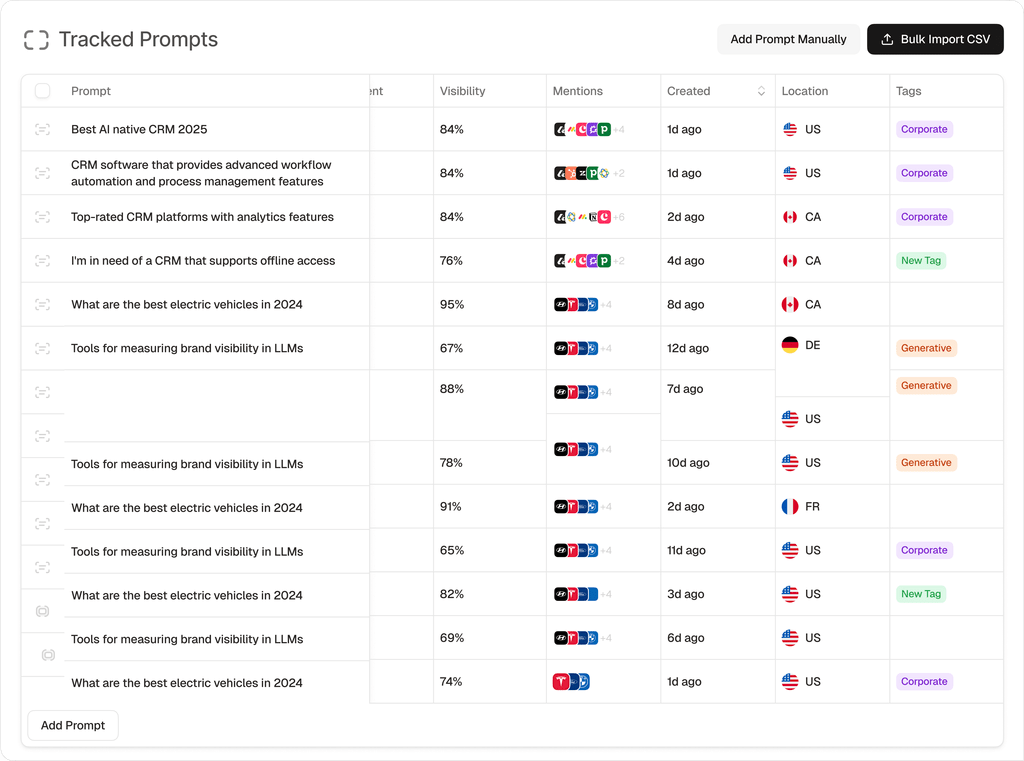
Peec AI is a purpose-built LLM visibility API. It does not try to replicate traditional SEO functionality. The platform tracks brand and product mentions across the most widely used AI models and delivers that data programmatically, making it one of the cleanest options available for teams whose priority is knowing exactly when and how their brand appears in AI-generated answers.
What Are the Key Features of Peec AI API?
- Monitors brand and product mentions across ChatGPT, Claude, Gemini, and Perplexity simultaneously
- Sends configurable prompts to multiple AI models on a schedule and logs which brands appear in responses
- Calculates share of voice across LLM outputs, showing how often a brand appears versus named competitors
- Supports recurring prompt tracking to build longitudinal visibility data over time
- Delivers results programmatically via API and webhooks for integration with BI tools and custom dashboards
- Segment data by prompt type, LLM, and topic category
What Are the Pros and Cons of Peec AI API?
Pros:
- Purpose-built for AI model monitoring rather than adapted from a rank tracking product
- Tracks mentions across the most widely used LLMs in a single interface
- Clean API output integrates with custom reporting stacks without significant development overhead
- Operates as genuine LLM visibility monitoring SaaS with API access for brand monitoring workflows
- Webhook support enables event-driven data pipelines
Cons:
- No traditional SEO data — no backlinks, SERP rankings, or site audit functionality
- Pricing is not publicly listed, which makes direct budget comparisons difficult
- Relatively new platform; historical data depth is shorter than established players
- Not suitable as a standalone enterprise AI visibility and tracking API when classical SEO metrics are also required
What Is the Pricing of Peec AI API?
- Starter plan: $95/mo — 50 prompts, 3 AI models, 1 project, daily tracking, unlimited users
- Pro plan: $245/mo — 150 prompts, 3 AI models, 2 projects, daily tracking, unlimited users
- Advanced plan: $495/mo — 350 prompts, 3 AI models, 5 projects, daily tracking, integrations (Looker, GA, GSC)
- Enterprise plan: custom pricing — 300+ prompts, all AI models, unlimited projects, API access, SSO, dedicated support
- Additional details: extra AI models cost $35/month each; annual billing ~15% discount; API access available on plans for agencies
Profound API
Profound positions itself as an enterprise AI visibility and tracking API for brands with mature content operations. Its differentiator is source attribution, identifying which specific URLs are being referenced inside AI-generated answers. That data is rare across this category and genuinely useful for content teams that want to know which pages are earning AI citations.
What Are the Key Features of Profound API?
- Tracks how AI search engines respond to queries in your category and identifies which brands appear
- Maps which topics and questions generate AI-written answers relevant to a given industry vertical
- Shows competitor share of voice across AI-generated results for tracked query sets
- Identifies which URLs are cited inside AI-generated answers — a capability most AI search visibility tracking tools API products do not offer
- Provides longitudinal trend data showing how AI answer patterns shift over time
- Designed for executive-level reporting with category-wide context
What Are the Pros and Cons of Profound API?
Pros:
- Source attribution data is a clear differentiator across API for AI search visibility tools
- Topic modeling gives strategic context beyond simple brand mention counts
- Strong fit as an AI search visibility API for reporting for brands running category-level content strategies
- Designed for enterprise reporting workflows where stakeholders need share-of-voice context, not just raw counts
Cons:
- Custom pricing only; inaccessible for smaller agencies and independent consultants
- No traditional SEO data
- Best used alongside a full SEO platform rather than as a replacement
- Less market history than Ahrefs or SE Ranking; long-term reliability is less proven
What Is the Pricing of Profound API?
- Starter plan: $99/month — ChatGPT tracking only, ~50 prompts, basic tracking, no exports, no API
- Growth plan: $399/month — ChatGPT + Perplexity + Google AI Overviews, ~100 prompts, CSV/JSON exports, limited content generation (≈3–6 articles/month)
- Enterprise plan: Custom pricing — 10+ AI engines (including Gemini, Claude, Copilot, Grok), unlimited prompts (negotiated), API access, SSO, dedicated strategist, advanced analytics
RankScope API
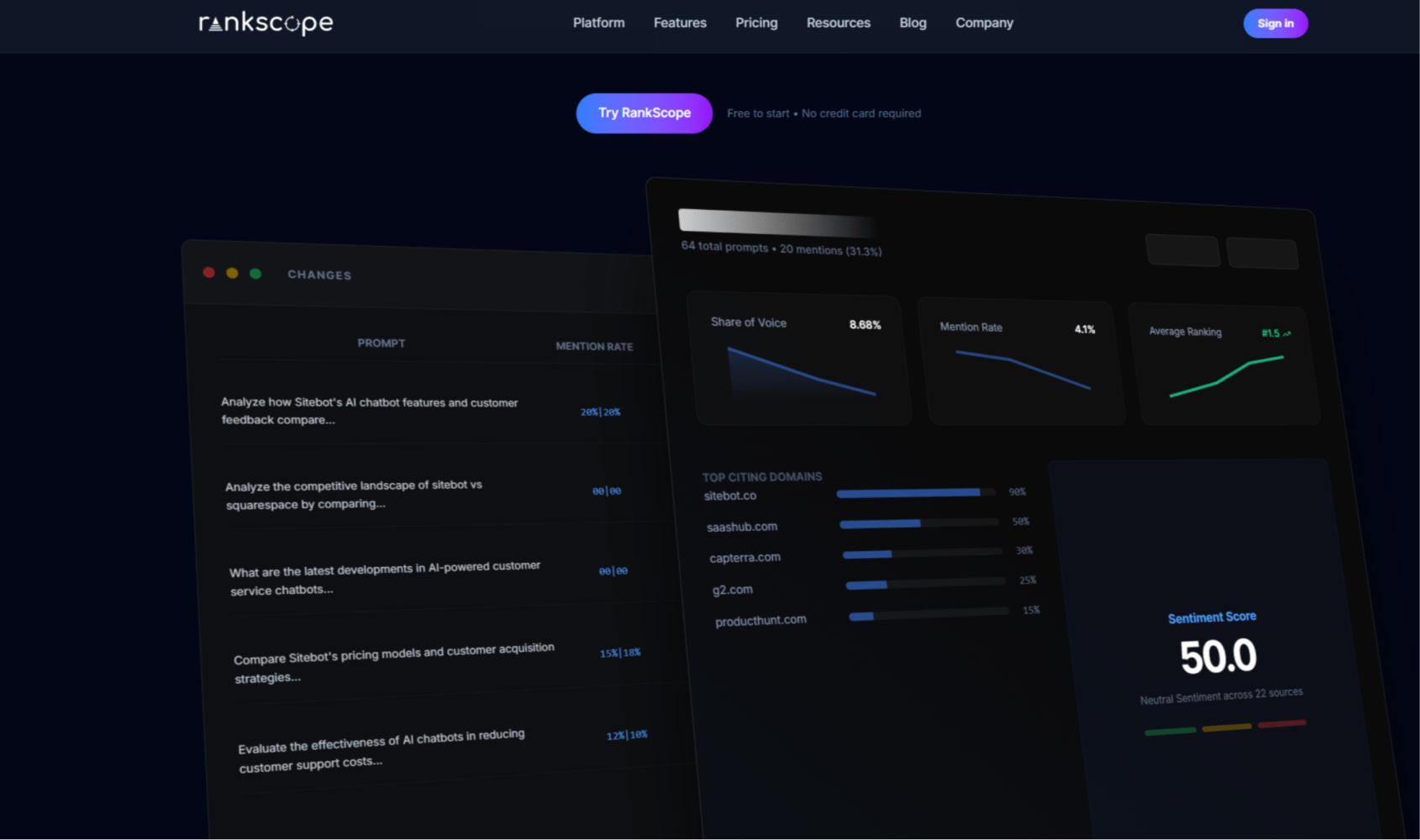
RankScope is a rank tracking tool first. Its API for AI visibility coverage is more limited than SE Ranking or Peec AI, but teams whose core requirement is SERP position data may find that basic AI Overview detection layered on top of strong rank tracking is all they need without switching platforms.
What Are the Key Features of RankScope API?
- Daily SERP position tracking for target keywords across Google and Bing
- Detects AI Overview presence for tracked keywords (presence/absence, not citation depth)
- Multi-location rank tracking for brands with regional or local presence requirements
- Side-by-side competitor SERP comparison across specified competing domains
- Programmatic API endpoints for ranking data integration into custom dashboards or third-party tools
What Are the Pros and Cons of RankScope API?
Pros:
- Strong rank tracking accuracy across standard Google SERP features
- Clean API with accessible documentation
- Lower price point than SE Ranking and Ahrefs at comparable rank tracking depth
- Provides basic API for AI search visibility without requiring a full platform change
- Reasonable option for teams without dedicated developer resources
Cons:
- AI tracking is limited to presence/absence detection; no citation analysis, share of voice, or brand mention depth
- Does not monitor LLM outputs from ChatGPT, Perplexity, Claude, or Gemini
- Backlink and keyword research data is limited compared to Ahrefs or SE Ranking
- Not a meaningful API for LLM visibility in the way Peec AI or Profound are
What Is the Pricing of RankScope API?
- Free plan: $0/month — 10 prompts, 1 AI engine (ChatGPT), 1 project, daily scans, limited credits, basic tracking
- Starter plan: $49/month — 50 prompts, 1 AI engine (ChatGPT), 25 topics, weekly scans, 5 competitors per topic
- Professional plan: $99/month — 100 prompts, all AI engines (ChatGPT, Gemini, Claude, Grok, Perplexity), daily scans, 25 topics, 5 competitors per topic
- Enterprise plan: Custom pricing — higher prompt limits, API access, multi-project scaling, advanced features, priority support
Ahrefs API
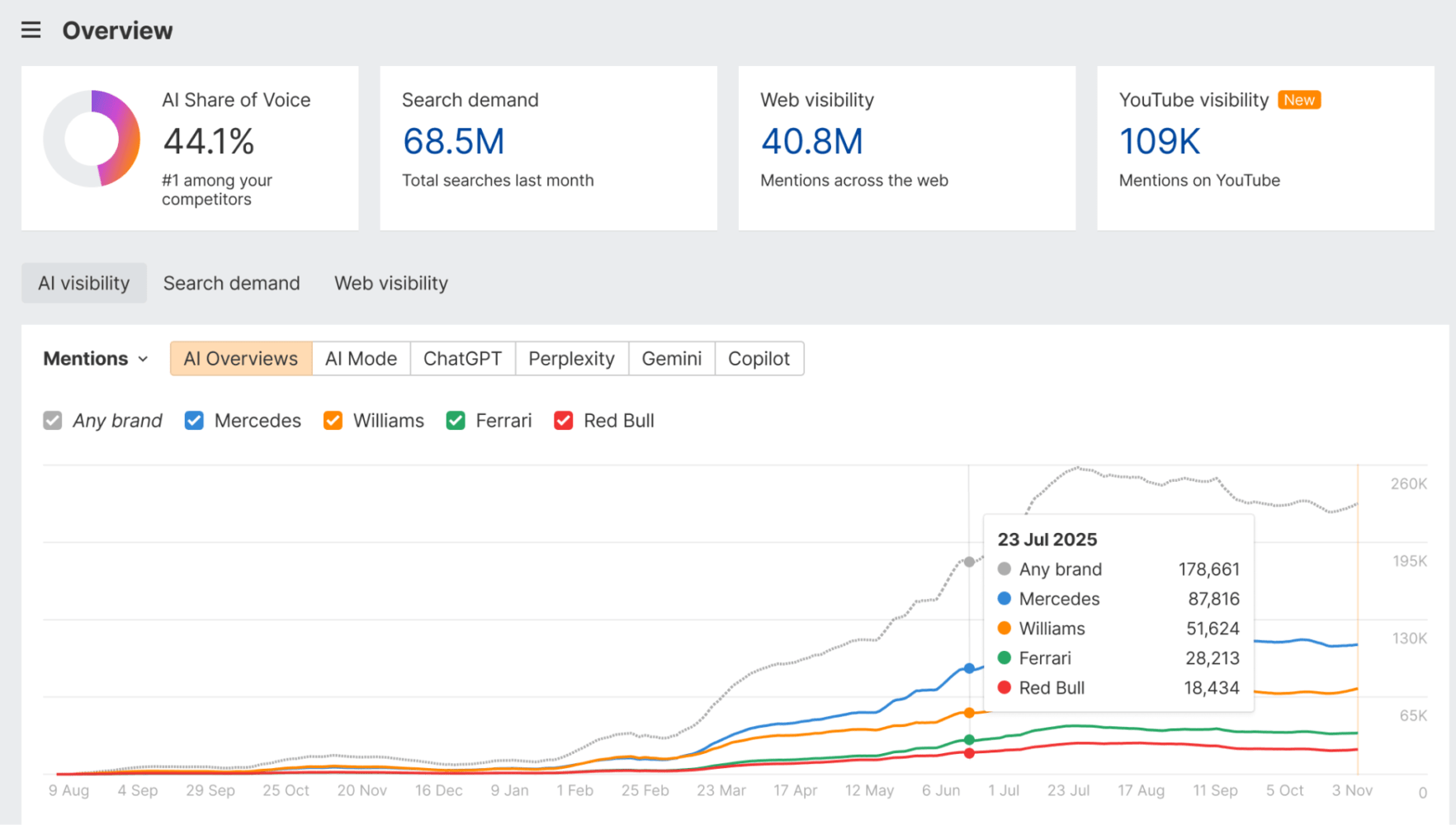
Ahrefs is the gold standard for backlink intelligence and keyword research. Ahrefs has expanded its AI coverage in 2026 with Brand Radar, a standalone tool that monitors brand mentions across more than 300 million search-backed prompts on six AI platforms. For teams whose primary need is backlink and keyword data, this may be sufficient. For teams that need citation-level tracking or share-of-voice across LLM outputs, it remains a secondary option rather than a primary AI visibility platform.
What Are the Key Features of Ahrefs API?
- One of the largest and most continuously updated backlink databases accessible through any SEO API
- Keyword explorer data covering search volume, keyword difficulty, CPC, and SERP history across billions of keywords
- Site audit crawl data accessible programmatically via structured endpoints
- Keyword position tracking with SERP feature detection across Google
- Content gap analysis comparing keyword coverage across competing domains
- Batch analysis and scheduled data exports for large-scale workflows
What Are the Pros and Cons of Ahrefs API?
Pros:
- Deepest backlink data of any tool on this list
- Keyword difficulty scores are among the most trusted across the industry
- Mature API with extensive documentation and years of production use behind it
- Works well alongside a dedicated AI search visibility API for teams running a split-stack approach
- Covers a broader range of SEO data types than any other tool here
Cons:
- Units-based API pricing makes costs difficult to predict at scale; high-query workflows can become expensive quickly
- AI visibility coverage is minimal; Ahrefs is not designed as an AI search visibility tracking tools API
- No LLM mention tracking across ChatGPT, Claude, Gemini, or Perplexity
- Does not qualify as LLM visibility monitoring SaaS with API access in any functional sense
- Enterprise API costs compound significantly as query volume increases
What Is the Pricing of Ahrefs API?
- Starter: $29/month — basic access to Site Explorer, Keywords Explorer, and Site Audit, limited credits, 1 project
- Lite: $129/month — 5 projects, 750 tracked keywords, 6 months historical data, 100,000 crawl credits
- Standard: $249/month — 20 projects, 2 years historical data, 2,000 tracked keywords, expanded reporting and tools
- Advanced: $449/month — 50 projects, 5 years historical data, 5,000 tracked keywords, higher limits and team features
- Enterprise: $1,499/month — custom scale, unlimited historical data, advanced controls (SSO, audit logs), API access, large-scale usage
How to Choose an SEO API for AI Visibility?
Picking the right tool comes down to what your workflow actually requires. These are the questions worth working through before committing.
Define whether you need Google AI tracking, LLM mention tracking, or both
Google AI Overviews appear inside SERPs. LLM outputs come from chat interfaces like ChatGPT and Perplexity. SE Ranking and RankScope address the Google side. Peec AI and Profound address the LLM side. An API for AI visibility that covers only one type may leave significant blind spots depending on where your audience actually encounters your brand. If you need coverage across both categories, a two-tool approach is currently the most realistic option.
Decide whether classical SEO data is required alongside AI tracking
If your stack already handles backlinks and rank tracking through a separate tool, a standalone LLM visibility API like Peec AI or Profound may be all you need. If you want a single platform for everything, SE Ranking is the clearest option. Ahrefs remains essential for backlink research but functions poorly as a primary API for LLM visibility.
Check API documentation quality before buying
A raw API for AI search visibility is only useful if your team can implement and maintain it. SE Ranking and Ahrefs have the most complete developer documentation on this list. RankScope and Peec AI are accessible but have thinner ecosystem support. Profound is enterprise-only, which typically includes hands-on implementation assistance from the vendor.
Evaluate pricing models against your actual query volume
Ahrefs’ Units model and Profound’s custom enterprise pricing make cost forecasting difficult. SE Ranking’s flat monthly tiers are easier to budget, especially for agencies managing multiple client accounts. Per-project API consumption matters as much as the base subscription price when you are scaling across 20 or 30 client domains.
Match tool maturity to your risk tolerance
Peec AI and Profound are newer entrants. Their AI tracking capabilities are strong, but historical data depth is shorter and product roadmaps are less predictable. SE Ranking and Ahrefs have years of production API use behind them. Teams that need guaranteed uptime and SLA commitments should look at SE Ranking’s Business tier or an enterprise AI visibility and tracking API contract with Profound.
Think about who consumes the data and how
Agencies need white-label dashboard output. In-house teams often need Looker Studio connectors. Executive stakeholders want trend charts and share-of-voice breakdowns rather than raw JSON logs. The best AI search visibility API for reporting for your team is the one that delivers data in a format your actual audience can act on.
Wrapping Up
The market for AI visibility APIs is still maturing. A year ago, most SEO platforms had no LLM tracking at all. The gap between tools is now significant.
SE Ranking is the best starting point for most SEO teams. It gives you a complete AI search visibility API that spans Google AI Overviews, Gemini, Perplexity, ChatGPT, and the full classical SEO data suite, priced accessibly for agencies and in-house teams. For pure LLM mention tracking across ChatGPT, Claude, and Perplexity, Peec AI and Profound are more focused. Both work well as LLM visibility monitoring SaaS with API access for dedicated brand monitoring programs.
RankScope fills a useful middle ground for rank-first teams that want basic AI Overview detection without switching platforms.
Ahrefs is essential for backlink research. It is not, by any reasonable definition, a primary API for AI visibility. Use it alongside a dedicated AI tracking tool if your workflow requires both data types.
The most practical setup for most mid-market SEO teams: SE Ranking as the core API, with Peec AI or Profound added for LLM-specific monitoring when clients or stakeholders need that layer of data.
FAQ
1. What is the difference between an AI visibility API and an LLM visibility API?
An AI visibility API typically tracks how brands appear in AI-generated search results, most commonly Google AI Overviews integrated into standard SERPs. An API for LLM visibility goes further, monitoring brand mentions inside outputs from large language models like ChatGPT, Claude, Gemini, and Perplexity. Some platforms cover both. Most specialize in one. SE Ranking covers Gemini, Perplexity, and ChatGPT.
2. Which API for AI search visibility is best for SEO agencies?
SE Ranking is the most practical choice for agencies. Its AI search visibility API for reporting includes white-label dashboard output, multi-project management, and stable API endpoints with documented rate limits and predictable pricing. It also includes enough traditional SEO data that most agencies can consolidate onto a single platform rather than stitching together multiple subscriptions.
3. Can I track brand mentions inside ChatGPT using any of these APIs?
Peec AI and Profound both monitor LLM outputs, including ChatGPT. SE Ranking covers Google AI Overviews, AI Mode, Gemini, Perplexity, and ChatGPT. RankScope and Ahrefs focus on Google SERPs and do not cover ChatGPT or Perplexity. If ChatGPT visibility is your primary concern, Peec AI is the most direct option on this list. It is designed specifically as an API for LLM visibility rather than a SERP-first tool.
4. Is there an enterprise AI visibility and tracking API with dedicated support?
Profound and SE Ranking’s Enterprise tiers both offer enterprise AI visibility and tracking API contracts with dedicated onboarding and support. Profound focuses more narrowly on AI answer analytics. SE Ranking includes the full SEO data environment alongside AI tracking. The better fit depends on whether you need AI-only data or a combined SEO and AI reporting platform.
5. How do AI search visibility tracking tools APIs typically integrate with reporting stacks?
Most AI search visibility tracking tools API products return data in JSON format compatible with Google Looker Studio, Power BI, Tableau, and custom-built dashboards. SE Ranking and Ahrefs have the most complete developer documentation for integration. Peec AI supports webhook delivery for event-driven workflows. Profound includes implementation support as part of enterprise contracts, which reduces the technical lift on the buyer’s side.
About the author:
Mashum Mollah is an entrepreneur, founder, and CEO at Blogmanagement.io, a blogger outreach agency that drives visibility, engagement, and proven results. He blogs at Blogstellar.