




Developers building SEO tools or custom dashboards often need programmatic access to search data without paying for a full SaaS seat. Whether you are hitting Semrush’s ERROR 134 (total limit exceeded) or ERROR 429 (request rate limit), or simply want to avoid locking a team into an expensive subscription, there are strong alternatives worth evaluating. This guide compares eight Semrush API alternatives in 2026 across pricing models, endpoint coverage, and realistic use cases — so you can match the right infrastructure to your actual query volume.
Key Takeaways
| Platform | Pricing Model | Entry Cost | Key Strength |
|---|---|---|---|
| SE Ranking | Pay-as-you-go / Subscription | $50 minimum (PAYG) | Clean endpoint modularity |
| DataForSEO | Pay-as-you-go | $50 minimum | $0.0006 per SERP call |
| Ahrefs | Annual Subscription | $14,990/year (Enterprise) | Massive backlink index |
| SimilarWeb | Annual Subscription | $15,000+/year | Traffic firmographics |
| Serpstat | Subscription + PAYG | $129/month (Team) | 7.1 billion keywords |
| BrightLocal | Subscription + PAYG | $29/month | Local directory management |
| Raven Tools | Monthly Subscription | $49/month | No-code workflows |
| SEO PowerSuite | Annual Subscription | $299/year | Low-cost backlink credits |
* Ahrefs entry cost reflects Enterprise tier, which is required for full API access. Self-serve plans start at $29/month. SEO PowerSuite entry cost reflects the Professional annual license. Prices verified June 2026.
A few things stand out from this overview:
- SE Ranking offers a strong ratio of cost to capability, particularly for agencies that want both a dashboard and API access from a single subscription.
- DataForSEO costs fractions of a cent per standard SERP call — the most cost-efficient option for high-volume programmatic use.
- Ahrefs requires a $14,990 annual Enterprise commitment for full API access, though self-serve plans with limited API units start lower.
- SimilarWeb uses a multi-variable credit formula that can make cost forecasting complex for batch queries.
- Raven Tools still relies heavily on XML output formats, which may be a friction point for teams expecting modern JSON responses.
- BrightLocal is purpose-built for local citations and rankings — it has no meaningful global organic data.
- SEO PowerSuite is the most cost-efficient option for raw backlink data, though data freshness and accuracy trail cloud-based rivals.
- Serpstat is a capable mid-budget option with a large keyword database and solid API documentation.
1. SE Ranking API
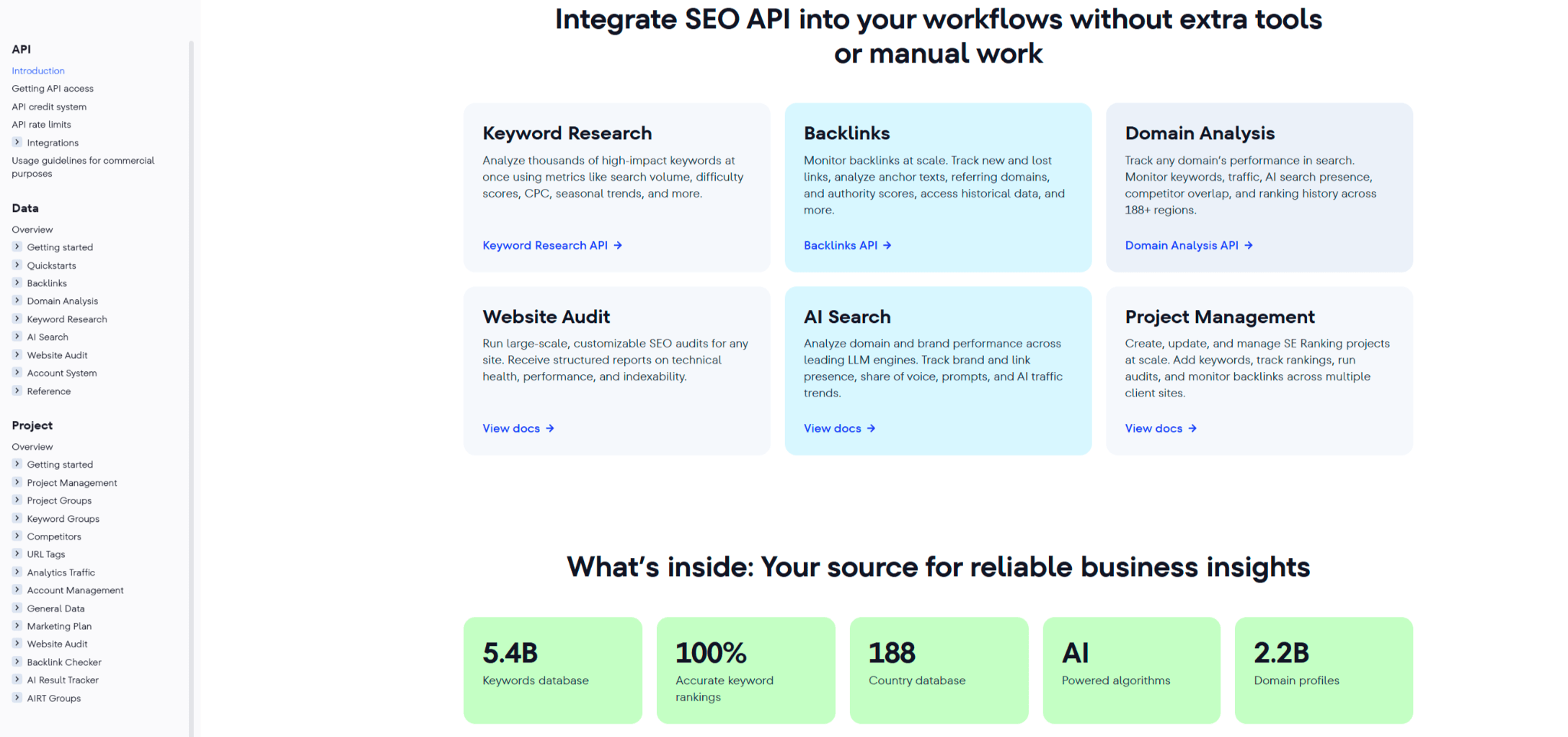
SE Ranking’s API operates independently from its standard dashboard, which means developers can purchase standalone data packages without buying seat licences. The platform covers the full SEO stack — domain research, keyword analysis, site audit, backlinks, project management, and AI search visibility — all drawing from a single credit balance under one subscription. It also integrates natively with Make, n8n, and Looker Studio, which makes it practical for agencies building automated reporting pipelines.
The AI Search API is a genuine differentiator in 2026: it tracks brand visibility across Google AI Overviews, AI Mode, ChatGPT, Gemini, and Perplexity. None of the other mid-market platforms in this list offer native LLM tracking at this tier.
Key Features
- Domain Research endpoints
- Keyword Research processing
- Website Audit diagnostics
- Backlinks parsing
- Project Management controls
- AI Search tracking (Google AI Overviews, ChatGPT, Gemini, Perplexity)
Pricing
| Plan | Monthly Cost (Annual) | API Credits Included | Notes |
|---|---|---|---|
| PAYG Wallet | $50 minimum deposit | 250,000 credits | Credits never expire |
| Core | $103.20/mo | 25,000/month | Includes MCP access |
| Growth | $223.20/mo | 100,000/month | Historical data, API add-on |
| Standalone API | From $179/mo | 12M credits/year | Annual billing only; sales-negotiated |
| Enterprise | Custom | 100,000+/month | Volume discounts available |
Prices verified June 2026 from seranking.com. The standalone API plan requires annual billing and is sales-negotiated for volume. PAYG wallet credits never expire; annual plan credits reset at end of billing cycle.
Best For
Agencies needing modular endpoint access across specific regional databases. Developers building custom client dashboards who also want a ready-to-use dashboard from the same subscription. The 14-day trial with 100,000 free credits makes it low-risk to test before committing.
Pros
- Pre-built connectors for Make, n8n, and Looker Studio
- PAYG credits roll over indefinitely; failed requests are not charged
- Standalone API access — no forced dashboard subscription required
- 14-day trial includes 100,000 free credits, no credit card required
- 188 countries, 420M domains, 6B pages crawled daily
- All APIs run from a single credit balance
Cons
- Historical backlink data spans a shorter timeframe than Ahrefs or Semrush
- Standalone API plan requires annual commitment and goes through sales for higher volumes
2. Raven Tools
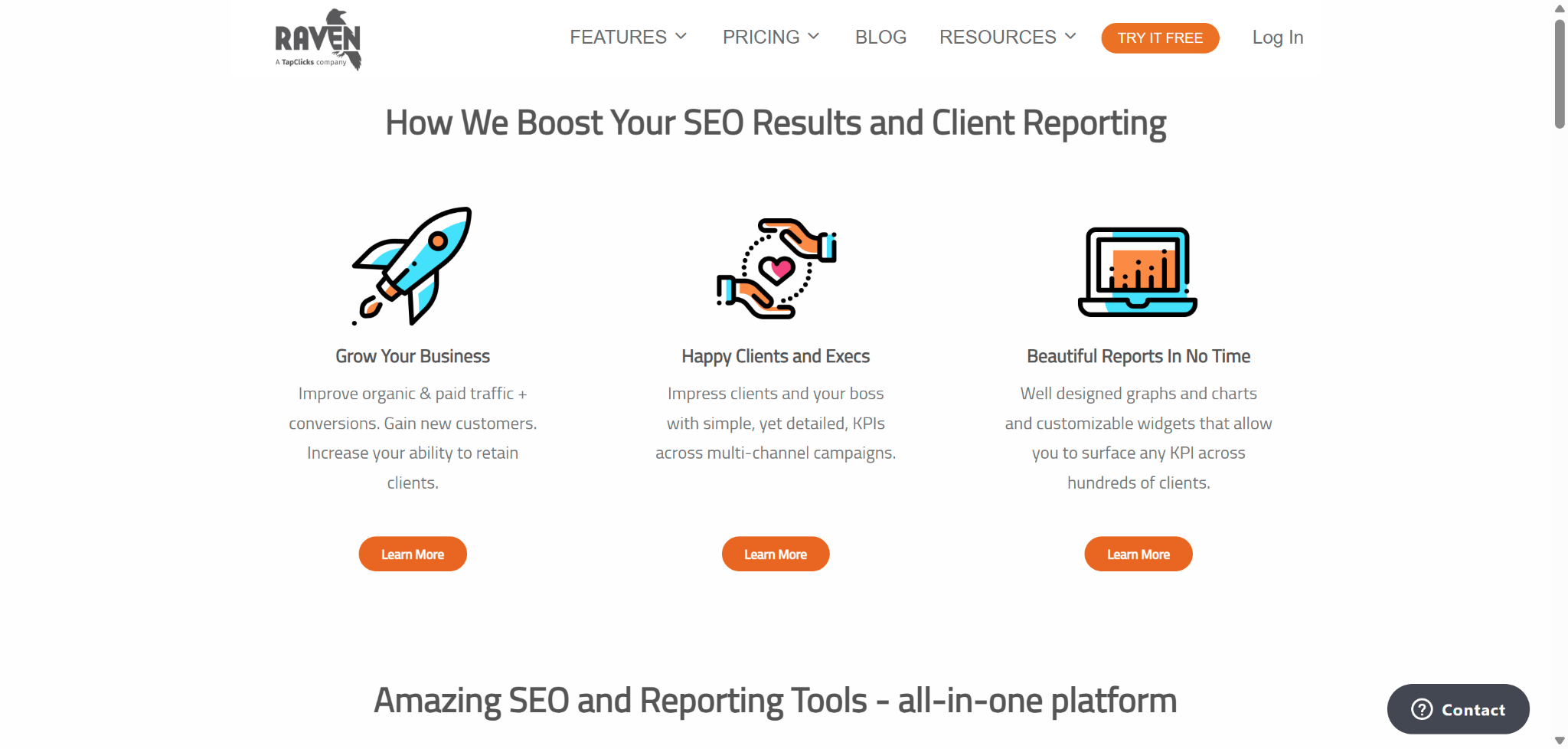
Raven Tools has been around long enough to accumulate a loyal agency base, and its white-label reporting remains a genuine strength. The platform handles rank tracking, basic site auditing, backlink reporting, and social metrics, making it a reasonable all-in-one for small agencies that prioritise client reporting over raw data volume. Developers evaluating it for programmatic use should note that its API layer returns XML rather than JSON — a meaningful friction point if you are building modern parsing pipelines.
Key Features
- Domain information retrieval
- Rank tracking
- Site audit
- Backlink reporting
- White-label report generation
Pricing
| Plan | Monthly Cost | Campaign Limit | Position Checks |
|---|---|---|---|
| Small Biz | $49 | 2 | 1,500 |
| Start | $109 ($79 annual) | 20 | Varies |
| Grow | $199 ($139 annual) | Varies | Varies |
| Thrive | $299 ($249 annual) | 160 | 25,000 |
| Lead | $479 ($399 annual) | 320 | 30,000 |
Best For
Small agencies managing a handful of client sites, particularly those already using n8n or similar no-code tools. It works well for local keyword rank tracking without the overhead of a more complex platform.
Pros
- Native connections with no-code automation tools
- Strong white-label reporting mechanics
- Predictable campaign-based pricing
Cons
- Forced upgrade paths can frustrate users as campaigns scale
- No AI citation or LLM visibility tracking
- API responses rely on XML rather than JSON
- Keyword difficulty metrics feel outdated compared to current alternatives
3. SEO PowerSuite
SEO PowerSuite is a desktop application suite comprising four tools: Rank Tracker, WebSite Auditor, SEO SpyGlass, and LinkAssistant. Its programmatic data layer is built on the WebMeUp backlink index, which holds approximately 3.6 trillion external links across 264 million domains. The biggest draw is cost: at $299/year for a Professional licence and $499/year for Enterprise, it is the most affordable entry point for bulk backlink data in this comparison. That said, data freshness and accuracy trail cloud-based platforms like Ahrefs, and team collaboration requires working through cloud storage services rather than a shared dashboard.
Key Features
- Link verification and backlink discovery
- WebMeUp backlink index access
- Rank tracking automation
- Prospect search and outreach management
- Competitor domain monitoring
Pricing
The Professional licence costs $299/year; Enterprise costs $499/year. A fully functional free tier is available for unlimited evaluation. Backlink API access for external integrations is available on custom plans — contact SEO PowerSuite directly for volume pricing.
| Provider | Index Size | Annual License |
|---|---|---|
| SEO PowerSuite | 3.6 trillion links | $299–$499/year |
| Ahrefs | Industry-leading | From $1,548/year (Lite) |
| Semrush | Not publicly disclosed | From $1,679/year (Pro) |
Index sizes are based on vendor-published figures. Cloud platforms (Ahrefs, Semrush) update more frequently than SEO PowerSuite’s desktop-based index. Annual licence costs reflect base plans only; backlink API access for external tools is priced separately. Prices verified June 2026.
Best For
Independent consultants and bootstrapped startups with heavy backlink processing needs and limited budgets. Data scientists running bulk link analysis who do not require real-time latency.
Pros
- Very low annual licence cost relative to cloud competitors
- Large index covering 264 million domains
- No recurring monthly fees for desktop use
- Free tier available for unlimited evaluation
Cons
- Desktop software consumes local machine resources
- Requires cloud storage for team collaboration — no shared dashboard
- Data freshness and backlink accuracy trail Ahrefs and Semrush
- High-volume backlink API access requires a custom plan
4. SimilarWeb
SimilarWeb operates in a different weight class from the other platforms in this list. It is designed for institutional buyers — hedge funds, large technology firms, and enterprise marketing teams — who need granular global traffic intelligence, audience demographics, and competitive benchmarks. The infrastructure supports direct Snowflake connections and Amazon S3 data dumps, and a 2026 addition is an MCP server for Claude and Cursor, which brings its data into AI-native workflows. For teams with the budget, the depth is unmatched; for everyone else, the entry cost makes it impractical.
Key Features
- Web traffic tracking and audience engagement metrics
- App download and firmographic data
- Audience demographics
- Shopper intelligence metrics
- Sales signals endpoints
- MCP server integration for Claude and Cursor
Pricing
Annual contracts typically start between $15,000 and $40,000, with enterprise tiers exceeding $90,000. The credit consumption model multiplies domains by endpoint cost, granularity, country filters, time range, and results per domain — a single request analysing one keyword across two countries over three months can consume hundreds of credits. Review SimilarWeb’s documentation credit calculators carefully before estimating your budget.
Best For
Institutional analysts, hedge funds, and large technology teams feeding market data into proprietary models. Not suitable for agencies or developers on standard budgets.
Pros
- Unmatched granularity in global web traffic analysis
- MCP server enables context-rich AI-native querying
- Tracks mobile web and desktop independently
- Transparent credit calculators in documentation
Cons
- Entry costs exclude small and mid-sized agencies entirely
- Annual minimum commitment required
- Credit calculation math becomes complex for batch queries
- Keyword data depth is weaker than dedicated search platforms
5. DataForSEO API
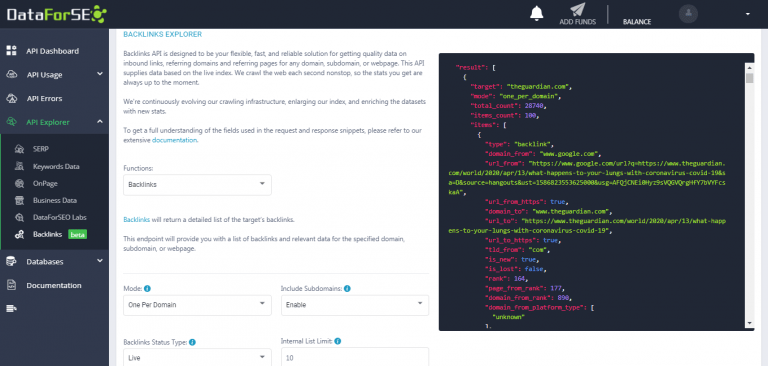
DataForSEO is a pure headless data infrastructure — there is no dashboard, and you interact entirely through programmatic endpoints. It covers SERP scraping across 170+ countries, Google Ads metrics, business reviews, on-page auditing, and app store databases. Version 3, which has been the recommended version for over a year, improved pricing transparency, speed, and stability; v2 was formally retired on 5 May 2026 after a six-month migration period. At $0.0006 per standard SERP call, it is the most cost-efficient option in this list for high-volume scraping — a typical agency workload of 50,000–100,000 monthly SERP calls runs $30–$60, compared to $129/month or more for equivalent data from subscription-based tools.
Key Features
- SERP scraping across Google, Bing, YouTube, and more
- Google Ads metrics
- Google Reviews retrieval
- On-page auditing
- App Store and Google Play databases
- LLM Mentions API for AI search visibility
Pricing
| Queue Type | Latency | Cost per Request |
|---|---|---|
| Standard (Normal) | ~5 minutes | $0.0006 |
| Standard (High Priority) | 1–5 minutes | $0.0012 |
| Live | < 2 seconds | $0.0020 |
$50 minimum deposit to open an account. PAYG credits never expire. A free Sandbox environment is available for testing authentication and response schemas at zero cost. Prices verified June 2026 from dataforseo.com.
Best For
Software engineers building native reporting applications. Agencies tracking local map packs across thousands of locations. AI developers needing structured training data at scale.
Pros
- Excellent cost efficiency at high query volumes
- Credits never expire
- Free Sandbox environment for pre-production testing
- Coverage across 170+ countries
Cons
- No graphical interface — requires technical implementation
- Standard queue latency averages five minutes; use Live queue for real-time needs at higher cost
- Backlink index volume trails Ahrefs and Semrush
6. Serpstat API
Serpstat indexes approximately 7.1 billion keywords across 230 regional Google databases, making it one of the larger keyword datasets in this comparison. The API follows the JSON-RPC 2.0 standard and covers domain classification, SERP crawling with AI overview scraping, keyword volume scanning, backlinks, and site auditing. It is a capable mid-tier choice for teams that need a broad keyword database without committing to Ahrefs or Semrush pricing. One important cost note: scraping AI Overviews triggers a 2x multiplier on the base keyword rate, which can significantly inflate budgets for teams tracking AI search visibility at scale.
Key Features
- Domain classification tools
- SERP crawling with AI Overview scraping
- Keyword volume scanning
- Backlink and external link parsing
- Site audit diagnostics
Pricing
API access requires an active subscription. The Team plan, which includes API access, costs $129/month. A separate data plan is available for heavier usage, ranging from $100 to $180 per million rows depending on volume. The minimum budget for data plans is $300.
| Request Volume | Cost per Keyword | Cost per 1M Credits |
|---|---|---|
| Low volume | $0.0013 | $180 |
| High volume | $0.00065 | $100 |
| AI Overview queries | Base × 2 | N/A |
Prices verified June 2026 from serpstat.com. AI Overview scraping doubles the base request cost.
Best For
Data analysts needing fast keyword gap tracking. Teams monitoring AI Overview presence across complex queries. Marketers filtering domains by search category.
Pros
- Large, frequently updated keyword database
- Unused credits carry over to the next billing period
- Failed requests do not consume credits
- Stable JSON-RPC 2.0 format ensures consistent parsing
Cons
- AI Overview tracking doubles costs — budget carefully for AI-focused use cases
- API access requires a baseline subscription; no standalone PAYG option
- Backlink index trails the top-tier platforms
- Only one API token per user account
7. BrightLocal API
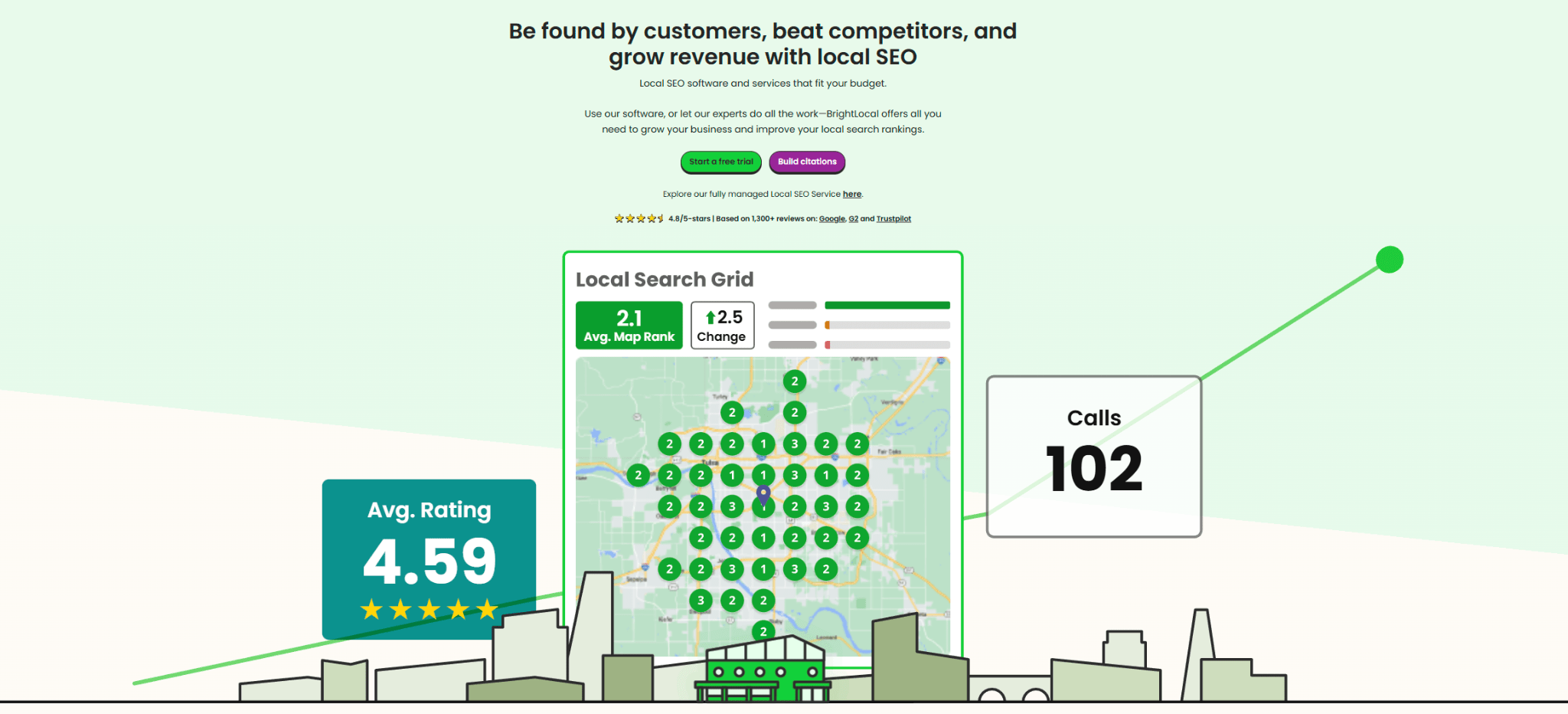
BrightLocal focuses exclusively on local search — citations, Google Business Profiles, Apple Maps, Bing Places, and Facebook directories. It separates endpoints into Management and Data categories: Management endpoints are free within your active subscription, while Data endpoints operate on a pay-per-request model. If your use case is local business auditing, citation building, or franchise location management, BrightLocal is the most purpose-built tool in this list. If you need global organic keyword data, it offers nothing useful.
Key Features
- Citation Builder submission
- Local ranking data retrieval
- Review aggregation and analysis
- Location management
- White-label report generation
Pricing
| Plan | Monthly Cost | Included Features |
|---|---|---|
| Track | $29 | Audits, rank tracking, citations |
| Manage | $44 | Listing sync, GBP posts |
| Grow | $44 (promo) | Review monitoring, SMS campaigns |
Management API endpoints are free within plan limits. Data API endpoints are pay-per-request. Manual citation submissions cost approximately $3.20 per site; bulk volumes reduce this to around $2.00. Duplicate removal adds a 20% surcharge. Prices verified June 2026.
Best For
Franchise managers monitoring hundreds of physical locations. Local search agencies auditing Google Business Profiles. Developers building automated store-finder applications.
Pros
- Management endpoints are free within plan limits
- Generous rate limits — 600 GET requests per minute
- Well-documented error handling, including specific codes like INVALID_COMPANY_NAME
- Citation submissions require no recurring yearly fees
Cons
- No global organic keyword tracking
- Data APIs require an active baseline subscription
- Duplicate removal adds a 20% surcharge to manual submissions
8. Ahrefs
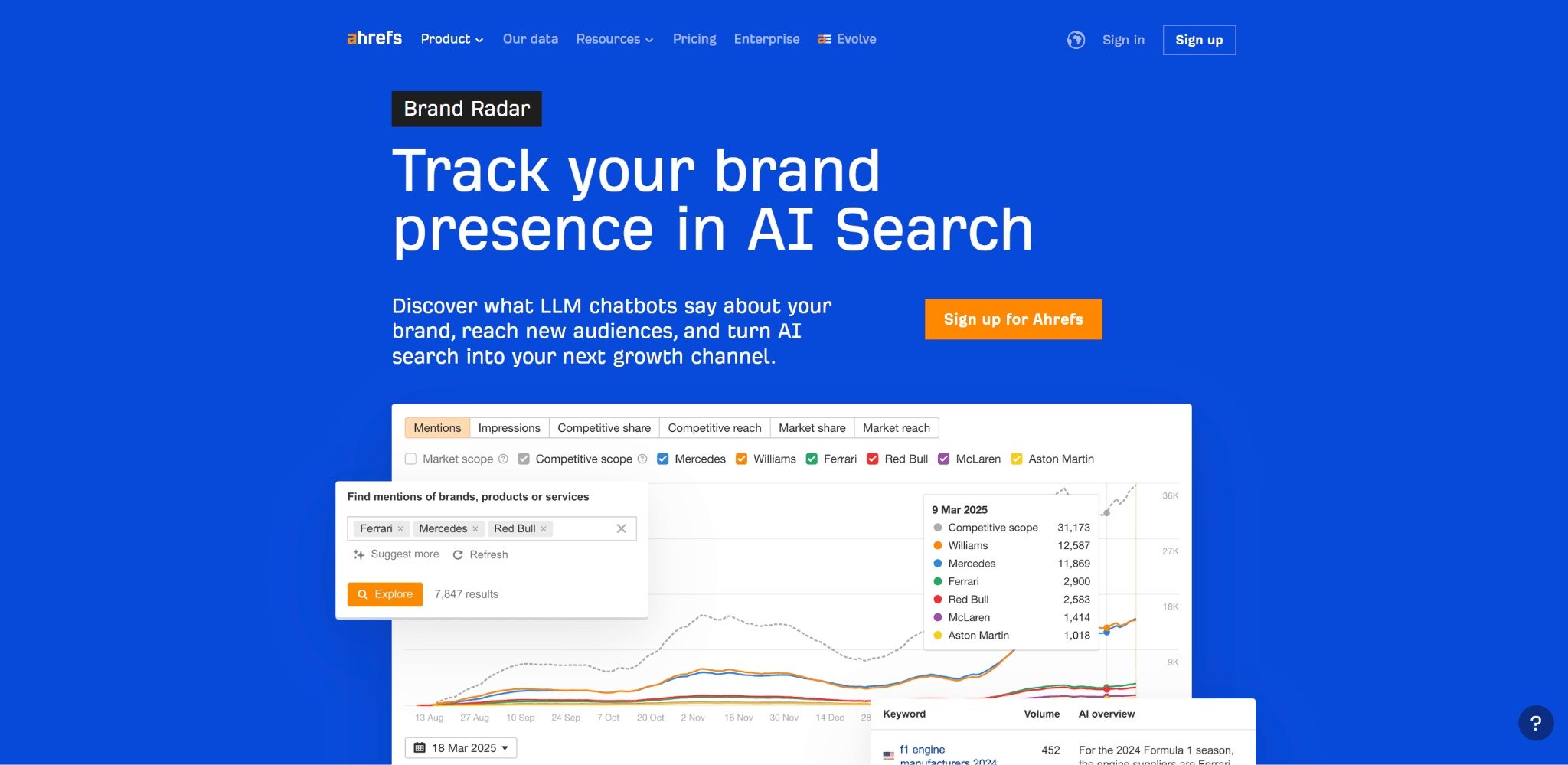
Ahrefs holds one of the largest and most frequently updated backlink indexes in the industry. Its programmatic API — available at the Enterprise tier — pushes raw data into custom data lakes and supports direct Looker Studio connections. Brand Radar, available as an add-on, tracks brand mentions across AI engines including Grok, ChatGPT, and Perplexity. For teams that specifically need the most comprehensive link database and have the budget to match, Ahrefs remains the benchmark. The trade-off is cost and access structure: full API access requires the $1,499/month Enterprise plan (annual commitment), and there are no endpoints for user or workspace management.
Note that self-serve plans start at $29/month (Starter) with limited API units, and the Advanced plan at $449/month includes API access. Enterprise is required for unlimited API integration at scale.
Key Features
- Backlink discovery and domain rating
- Keyword snapshot tracking
- Brand Radar — AI mention tracking across ChatGPT, Gemini, Perplexity, Grok
- Site audit metrics
- Programmatic keyword management (add/remove via API)
Pricing
Full programmatic API access at scale requires the Enterprise plan at $1,499/month (annual commitment only), totalling $14,990/year. This includes approximately 2,000,000 API integration units per month. Add-on units are available on a pay-as-you-go basis but expire after three billing months. Self-serve plans with limited API access start from $449/month (Advanced).
Best For
Enterprise marketing teams requiring the largest available link database. Custom dashboard builders connecting directly to Looker Studio. Teams tracking brand mentions inside ChatGPT and other LLMs.
Pros
- Industry-leading backlink index size and accuracy
- Programmatic keyword management via API
- Standard plans received up to 10x more rows per request in recent updates
- Brand Radar provides structured AI mention tracking
Cons
- Full API access requires $14,990/year Enterprise commitment
- 50-unit minimum charge per request
- Unused add-on units expire after three billing months
- No endpoints for workspace or user management
Frequently Asked Questions
Which provider offers the cheapest raw backlink data?
SEO PowerSuite offers the lowest annual licence cost at $299/year, with backlink API access available on custom plans. Cloud-based alternatives charge substantially more, though they generally offer better data freshness and accuracy. For pure cost-per-row at scale, SEO PowerSuite’s WebMeUp index is hard to beat — but factor in data quality requirements before committing.
How does DataForSEO handle rate limits and queueing?
DataForSEO operates three queue tiers. The Standard queue processes batch requests in approximately five minutes at $0.0006 per call. The High Priority queue reduces latency to one to five minutes at $0.0012. The Live queue delivers results in under two seconds at $0.002. For automated workflows and rank tracking, the Standard queue is the most cost-efficient; for user-facing products where a human is waiting for a result, use the Live queue.
Do any of these platforms track AI Overviews and LLM visibility?
Yes — several do. SE Ranking has a dedicated AI Search endpoint covering Google AI Overviews, AI Mode, ChatGPT, Gemini, and Perplexity. Serpstat supports AI Overview scraping directly via its API, though at double the standard keyword cost. Ahrefs tracks brand mentions in LLMs via Brand Radar. DataForSEO has an LLM Mentions API. SimilarWeb’s MCP server also supports AI-native querying. AI search visibility is increasingly standard infrastructure in 2026, not a premium add-on.
Can I access Ahrefs API on a standard plan?
Limited API access is available on the Advanced plan ($449/month), which includes 500,000 API units monthly. Full, unlimited programmatic access requires the Enterprise plan at $1,499/month on an annual contract. Earlier plan tiers (Lite, Standard) do not include API access.
How are SimilarWeb data credits calculated?
Credit consumption depends on five variables: number of domains, endpoint base cost, granularity level, country filters, and time range. A request pulling traffic data for one domain across two countries over three months can consume several hundred credits. Use SimilarWeb’s documentation credit calculators to model costs before signing a contract.
Conclusion
The right Semrush API alternative depends almost entirely on what you are building and at what volume. Paying for a full enterprise seat licence to run a few thousand queries a month is rarely justified — pay-as-you-go infrastructure exists precisely for this use case.
- Small agencies and developers testing scripts should start with SE Ranking’s $50 PAYG deposit or DataForSEO’s free Sandbox.
- Teams building local SEO dashboards or managing franchise locations should use BrightLocal.
- Data engineers processing millions of SERP results daily will find DataForSEO the most cost-efficient option.
- For backlink data at the highest level of accuracy and scale, Ahrefs has no real competitor — if the budget exists.
- Institutional analysts and large market intelligence teams should evaluate SimilarWeb.
Before committing, test latency against your actual workflow. Review the JSON schema documentation. Run trial queries at your expected monthly volume to model real costs — pricing scales non-linearly, and a plan that looks affordable at 10,000 calls per month can look very different at 500,000.
Disclosure: Pricing and feature data are sourced from each provider’s official documentation and were accurate at time of publication. Costs change frequently. Verify current pricing directly with each provider before making purchasing decisions.
About the author:
Mashum Mollah runs Blogmanagement.io, a blogger outreach agency. Through client work spanning keyword research, backlink analysis, and reporting automation, he has hands-on experience evaluating SEO data platforms and API-based workflows. He also writes about SEO tools and digital marketing at Blogstellar.