




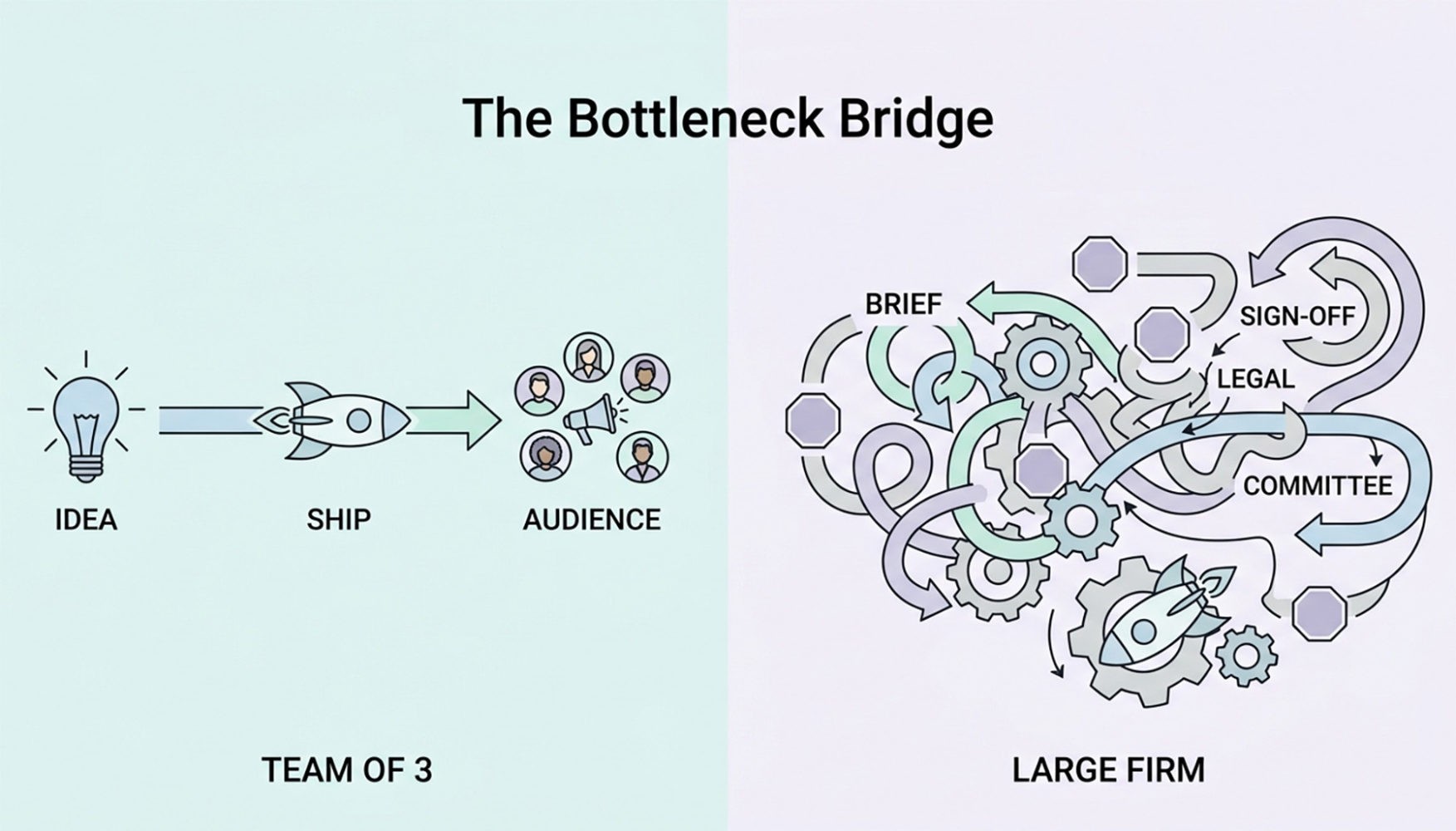
Here is a pattern I keep watching unfold. A scrappy team of two or three ships an entire product launch in under a week: landing page, email sequence, a month of social posts, a short promo video. Their much larger competitor is still routing the creative brief through a third round of internal sign-off. Same market, same buyers, budgets that aren’t remotely comparable. The small team reaches the audience first.
AI for small marketing teams has moved from novelty to baseline. They now use it for content production, repurposing, competitor research, design, and data analysis, which closes the output gap that used to favor big budgets. The durable advantage, though, isn’t the software, since everyone has the same tools now. It comes from the speed and editorial judgment to deploy them with a clear point of view. Here is how that works in practice, and where a big budget still wins.
A few years ago that story ran the other way. Output scaled with headcount and spend, so the team with the bigger budget simply did more. That math has changed, and changed fast.
The playing field leveled faster than anyone expected
The adoption numbers are not subtle. The U.S. Chamber of Commerce’s 2025 Empowering Small Business report found that 58% of small businesses now use generative AI, up from 40% the year before. A separate Thryv survey of small business decision-makers showed AI use among companies with 10 to 100 employees jumping from 47% to 68% in a single year, with content marketing the single most popular use case.
The reason for the surge is mundane and important: capability that used to require an engineering team now runs on a monthly subscription. Brookings, summarizing nationwide survey data, noted that small and mid-sized businesses have begun adopting AI at rates that rival much larger firms. That is a sharp reversal of the usual order, in which enterprises lead and everyone else catches up later.
For marketing specifically, the time savings are the headline. HubSpot’s research on generative AI in marketing reports that 67% of marketing teams now save ten or more hours a week, which works out to roughly three hours reclaimed per piece of content. For a small team producing a few posts and a couple of emails each week, that is most of a workday handed back, time a two-person operation never had to spend on busywork in the first place.
The contrarian part: the tools stopped being the advantage
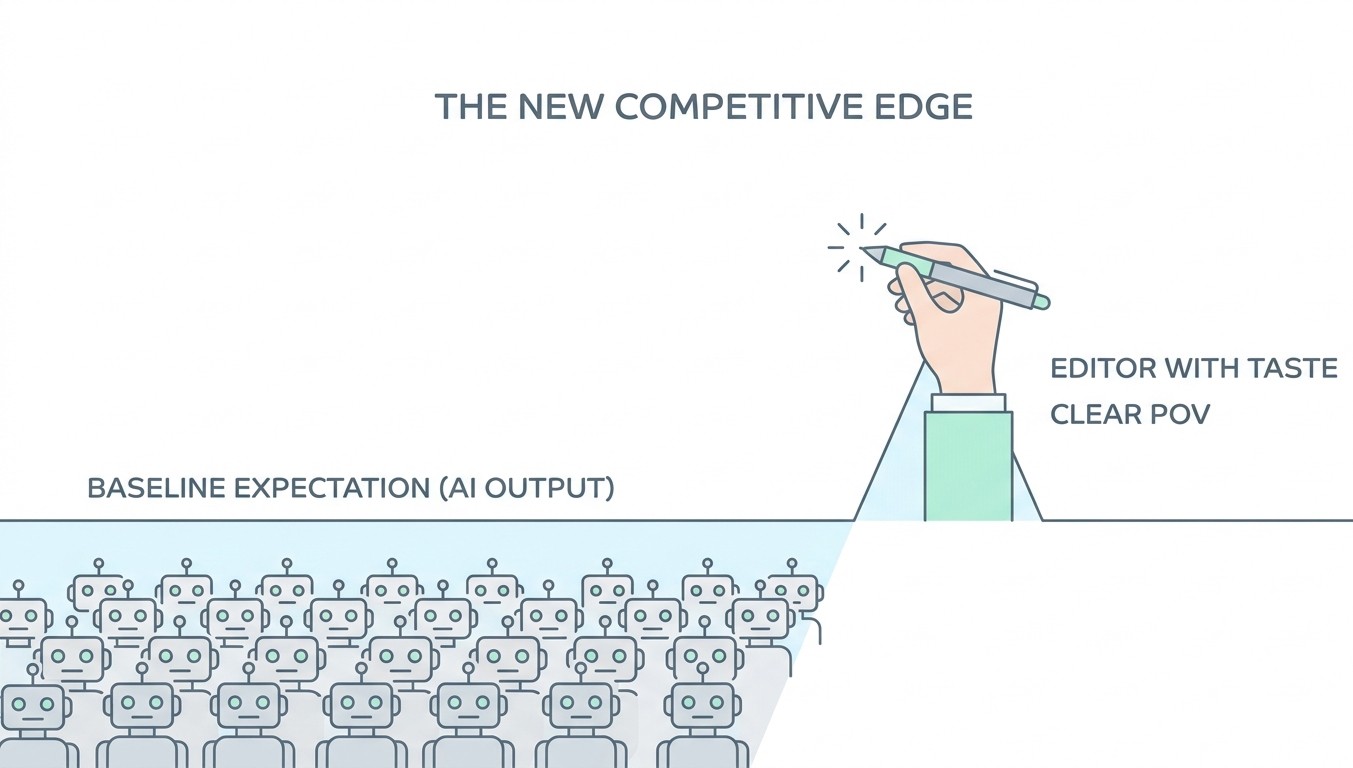
This is where most “AI for small teams” advice gets it wrong. It frames AI as the great equalizer, as if owning the same software as a Fortune 500 marketing department closes the gap. It doesn’t. The gap closed, then it moved.
HubSpot’s 2026 State of Marketing report puts it plainly: AI is now a baseline expectation, and the real divide is no longer who uses it but how well. The same research makes a sharper point worth sitting with. More content is now generated by AI than by humans, and most of it is average. Sixty-one percent of marketers say the field is going through its biggest disruption in two decades.
Read those two facts together and the implication is uncomfortable for the big spenders. If everyone has the same generative tools, and those tools default to producing competent, forgettable output, then volume and access are no longer the differentiators they used to be. What wins instead is what the tools can’t supply: a distinct point of view, a fast decision, and an editor with taste who knows when the draft is wrong.
That is precisely what small teams are built for. A large marketing organization has the budget to generate a thousand AI-assisted assets a month. It also has the brand guidelines committee, the legal review, the regional stakeholders, and the quarterly planning cycle that turn a good idea into a watered-down one by the time it ships. A team of three carries far less of that drag. They can form an opinion on Monday, test it Tuesday, and kill it Wednesday if it flops. Small teams have their own constraints, of course, like a founder bottleneck or processes held together with goodwill. But none of those take six weeks and four stakeholders to unwind.
AI didn’t give small teams a bigger engine. It removed the production bottleneck that used to make their speed irrelevant. Now the speed counts.
How small teams actually use AI day to day
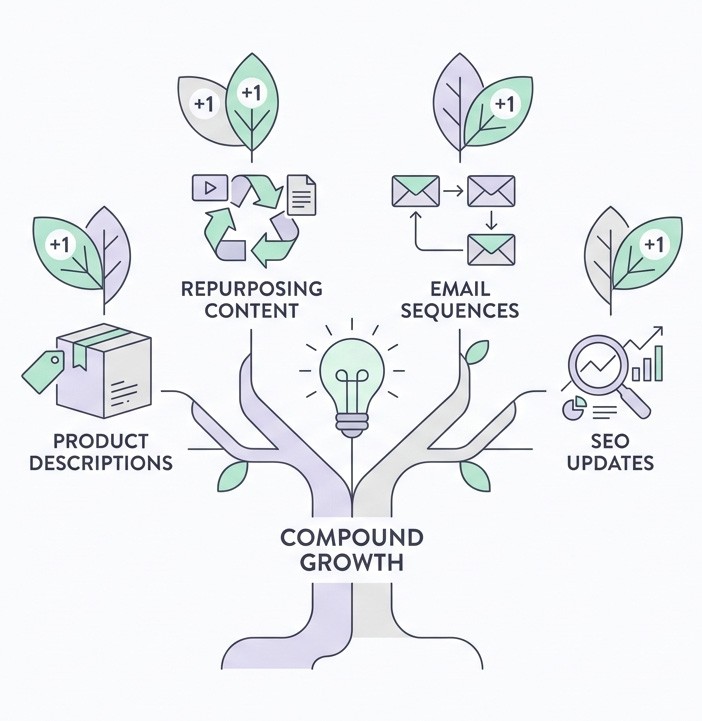
Henry’s House of Coffee, a small San Francisco roaster featured in the Chamber’s report, is a clean example. The owner credits AI with handling routine but time-consuming work: product descriptions, SEO, marketing emails. These are the exact tasks that used to force a small operator to choose between doing them badly or not at all. That’s the real mechanism. AI doesn’t replace the marketer on a small team; it removes the reasons a small team had to leave good marketing undone, from a neglected newsletter to the long-form post nobody had time to repurpose into a month of content.
The teams pulling ahead aren’t using AI to do dramatic new things. They’re using it to stop skipping the work that compounds.
Five ways small marketing teams use AI to compete
None of the following requires a budget approval or a new hire. Each one targets a task that small teams routinely abandon for lack of time.
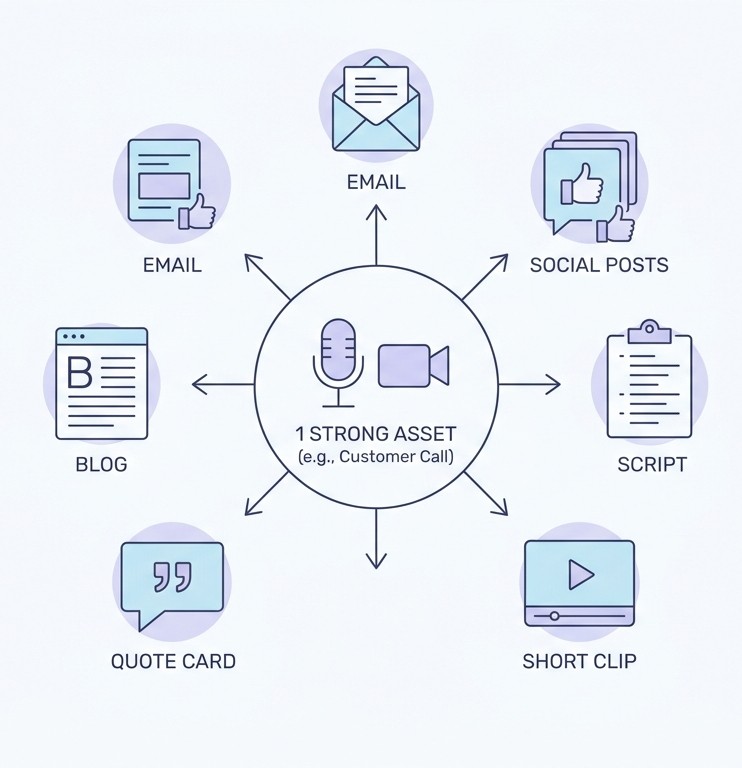
1. Turn one strong asset into ten
The highest-leverage habit is repurposing, not creating. Take a single thing you already did well: a customer call, a webinar, a long blog post, a founder’s LinkedIn rant that landed. Use a general-purpose model like ChatGPT or Claude to spin it into a week of social posts, an email, and a short script. You are not generating ideas from nothing; you are extracting the formats your one good idea can live in. For video and podcast source material, tools like Descript and Opus Clip will pull short, captioned clips out of long recordings automatically.
Start here because it has the best ratio of effort to output and the lowest risk of generic results. The source material is already yours and already good.
2. Use AI for the research you keep meaning to do
Competitive teardowns, audience research, and positioning work are the first things a busy small team drops. An AI research tool such as Perplexity, which cites its sources, can compress an afternoon of competitor analysis into twenty minutes, and the citations let you verify rather than trust. Ask it to map how three competitors describe the same product category, then look for the angle none of them are claiming. That gap is your point of view, and your point of view is the part AI can’t generate for you.
3. Draft in your voice, not the model’s default
A blank-page draft from any model arrives smooth and characterless. Fix this on the input side. Paste in two or three samples of your actual writing and instruct the model to match the cadence, then give it a specific brief rather than a vague one. ”Write three Instagram captions under 150 characters announcing our scheduling tool, emphasizing the five hours a week it saves, confident but not salesy” beats ”write some social posts” every time. The draft still needs you to cut, sharpen, and add the one specific detail only you know. That editing step is the work; the draft is just the head start.
4. Bring design and video in-house
Design used to be the hard wall for a team with no designer. It isn’t anymore. Canva’s AI features and Adobe Express handle on-brand graphics in minutes. Video is the place to be more careful: fully synthetic AI avatars still read as uncanny or cheap, and that impression lands on a small brand harder than on a household name. The better use of AI here is to polish real footage of real people, using a tool like Descript to cut filler words and dead air from something you actually filmed. The bar is ”good enough to ship consistently,” which for most small businesses beats “perfect but published twice a year.” Authentic beats synthetic almost every time.
5. Let AI read your data so you don’t have to
Most small teams collect analytics they never analyze. Drop a campaign export or a spreadsheet of results into a model and ask it to find what moved and what didn’t, then ask it to argue against its own conclusion. You are not outsourcing the decision; you are getting a fast first read so the decision actually gets made.
One caution before you go tool-shopping: you do not need all of these. A two-person team that masters one strong language model and one design suite will move faster than one juggling five subscriptions and the mental drag of switching between apps. Consolidate toward a small, dependable stack rather than chasing every launch. The advantage comes from a repeatable system, not a bigger collection of logins.
The trap that turns the advantage into a liability
The same speed that helps you can bury you. When generating a week of content takes ten minutes, the temptation is to ship all of it. That is how a small team voluntarily joins the flood of average AI content the data describes, and average content from a small brand is worse than silence, because it spends the limited attention you’ve earned on nothing memorable.
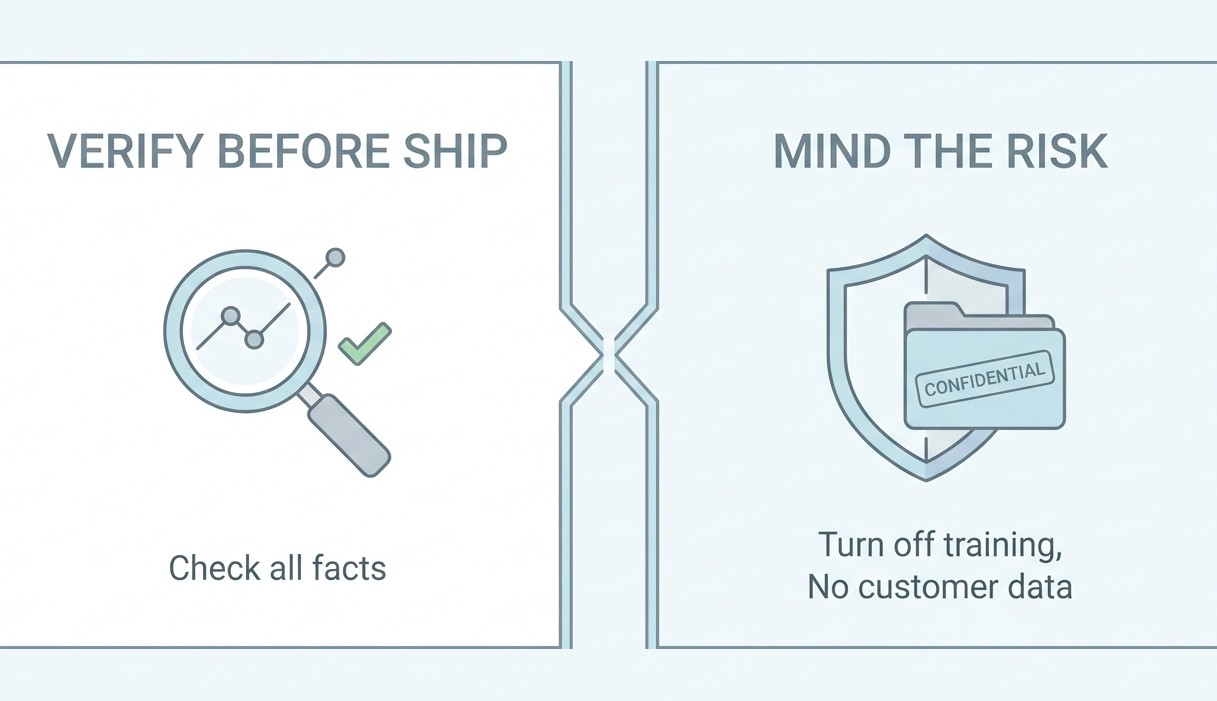
Four guardrails keep the edge sharp. First, every fact, statistic, and claim a model produces is a guess until you verify it; models invent plausible numbers and citations with total confidence, so check before you publish. Second, run every piece through one gut-check before it ships: does it say something the consensus doesn’t, does it include a detail or example a model couldn’t have known, and have you cut the filler words AI reaches for by default? If the answer is no on all three, it isn’t ready. Third, mind the risk that comes with having no legal or IT review of your own. Never paste customer data, confidential financials, or unreleased plans into a public AI tool, and assume that free consumer tiers may use your inputs to train future models. Turn off chat history and training in the settings, or use a Team or Enterprise account where that data is excluded by default, and treat an AI-generated image as an intellectual-property question, not just a creative one. Moving fast without a legal team is an advantage right up until it becomes a lawsuit or a leak. Fourth, slow down at the end, not the start. Generate fast, then edit slowly. The edit is where a small team’s taste shows up, and taste is the one input you can hire but can’t automate.
Where the big budget still wins
It would be dishonest to claim the gap has vanished entirely. It hasn’t, and pretending otherwise sets a small team up to pick fights it can’t win. Paid media is still a money game; a competitor with a seven-figure ad budget can simply outbid you for the same keywords and the same impressions, and no prompt fixes that. Proprietary first-party data at scale is another genuine moat. A company with millions of customer records can personalize and predict in ways a young brand with a few thousand contacts can’t approach yet. And brand awareness built over a decade and tens of millions of dollars doesn’t evaporate because a startup learned to use Claude. AI helps these companies too: it makes their existing content libraries, CRM data, and testing infrastructure more valuable, not less.
The mistake is treating those advantages as the whole board. They aren’t. They’re the parts of marketing where spend converts directly into reach, and a small team should mostly refuse to compete there on the incumbent’s terms. The smarter play is to concede the brute-force channels and pour the time AI frees up into the ones where judgment beats budget. Which raises the question of where, exactly, those channels are.
Win where volume can’t follow
There is a catch the optimistic version of this story skips. Producing better content does not guarantee anyone sees it. Most distribution channels still reward frequency and engagement signals, which means a competitor running an AI content farm can bury a small team’s best work under fifty mediocre posts a day. Out-publishing them is a losing game, and feeding the channels that reward sheer volume plays to the incumbent’s strength, not yours.
The move is to compete where volume is a disadvantage. Owned channels and human relationships don’t scale with a bot: a newsletter people actually open, a founder posting in their own voice on LinkedIn, a small community or Discord where members recognize each other, a guest spot on a podcast a model can’t fake its way onto. These are slow to build and impossible to spam, which is exactly why they favor a team with a real point of view over one with a bigger content budget.
This extends to search, which is shifting under everyone’s feet. As AI Overviews and answer engines summarize results before anyone clicks, content that merely restates the consensus gets absorbed and made invisible. What survives is the work with a specific stance, original data, or first-hand experience worth citing, and that is the kind of work a small team is better positioned to produce than a committee.
The takeaway
The question stopped being whether a small marketing team can compete with a big budget. The adoption data already answered it. The real question is whether your team will use AI to produce more forgettable content faster, or to finally do the sharp, opinionated, consistent work that bigger and slower competitors can’t get through their own approval chains.
Pick one task this week you’ve been skipping for lack of time: the repurposing, the competitor teardown, the email sequence you never finish. Hand the grunt work to a model, then spend the reclaimed hours making the output unmistakably yours and paying attention to how it performs. Volume was never the prize. The teams that pull ahead over the next few years will be the ones that learn fastest from what they ship, and a small team moving quickly with a clear point of view can learn faster than a committee ever will.
Frequently asked questions
What AI tools do small marketing teams use?
Most lean on a small stack: a general-purpose model like ChatGPT or Claude for writing and analysis, Perplexity for cited research, Canva or Adobe Express for design, and Descript for video editing. Mastering one or two beats subscribing to a dozen.
Can AI replace a small marketing team?
No. AI removes the production bottleneck that made small teams slow, but it can’t supply judgment, a point of view, or first-hand experience, so it frees up time for strategic work rather than replacing the marketer.
Is AI-generated content bad for SEO?
Generic, unedited AI content is a liability, since AI Overviews increasingly absorb anything that just restates the consensus. Content with a specific stance, original data, or real experience performs well regardless of how it was drafted.
How can a small marketing team compete with a bigger budget?
Concede the channels where money buys reach directly, like paid media, and compete where volume doesn’t win: a newsletter, a founder’s personal brand, or a tight community. Use the time AI frees up to publish sharper, more opinionated work faster than a larger competitor’s approval process allows.
About the author
Eve Cichon specializes in marketing strategy, brand development, and digital growth. Working as a freelancer, she helps businesses connect product value with audience needs through data-informed strategy and creative execution. Her expertise spans brand positioning, campaign management, audience engagement, and building scalable marketing systems that support long-term growth.