

For a creative operations lead, the initial novelty of generative AI has largely been replaced by a more pressing logistical headache: consistency. It is one thing for a solo creator to generate a striking hero image for a blog post; it is an entirely different challenge to have a distributed team of ten producers generate two hundred assets for a multi-channel campaign that all look like they belong to the same brand.
In the early stages of adoption, most teams operate on a ”prompt-and-pray” model. Individual contributors experiment in silos, resulting in what we call brand drift. One designer’s output has a cinematic, high-contrast aesthetic, while another’s — intended for the same campaign — leans toward a soft-focus, pastel palette. When these assets are placed side-by-side on a social grid or a landing page, the lack of visual cohesion is jarring.
To solve this, content teams must move away from treating AI as an unmanaged tool and start treating it as a governed production pipeline. Operationalizing generative media requires a shift in focus from the individual prompt to a centralized system that prioritizes technical predictability and precise refinement.
The Fragmentation of Visual Identity in Distributed Teams
The ”lone prompter” model is the natural starting point for many agencies, but it fails as soon as production scales. When a creative team attempts to launch a multi-channel campaign, the subtle variations in lighting, texture, and lens logic across different AI outputs become liabilities. If one asset uses a 35mm film aesthetic and another feels like a digital render, the brand’s professional veneer begins to crack.
This fragmentation carries a heavy operational cost. We often see a production bottleneck where human editors spend more time correcting AI-generated mistakes — fixing lighting inconsistencies or removing hallucinations — than they would have spent creating the asset from scratch using traditional methods. This mirrors broader industry data: unreliable output quality is cited by 34% of creators as a top barrier to AI adoption, according to Adobe’s global Creators’ Toolkit Report surveying over 16,000 creators across eight countries. The promise of speed is lost in the rework loop.
The core of the problem is that standard generative models are designed for variety, not uniformity. Without a shared technical bedrock, different users will naturally drift into different visual territories based on their personal prompting styles. To counter this, teams need to standardize the underlying platform and the methodology used to refine the results.
Establishing a Predictable Bedrock with Banana Pro AI
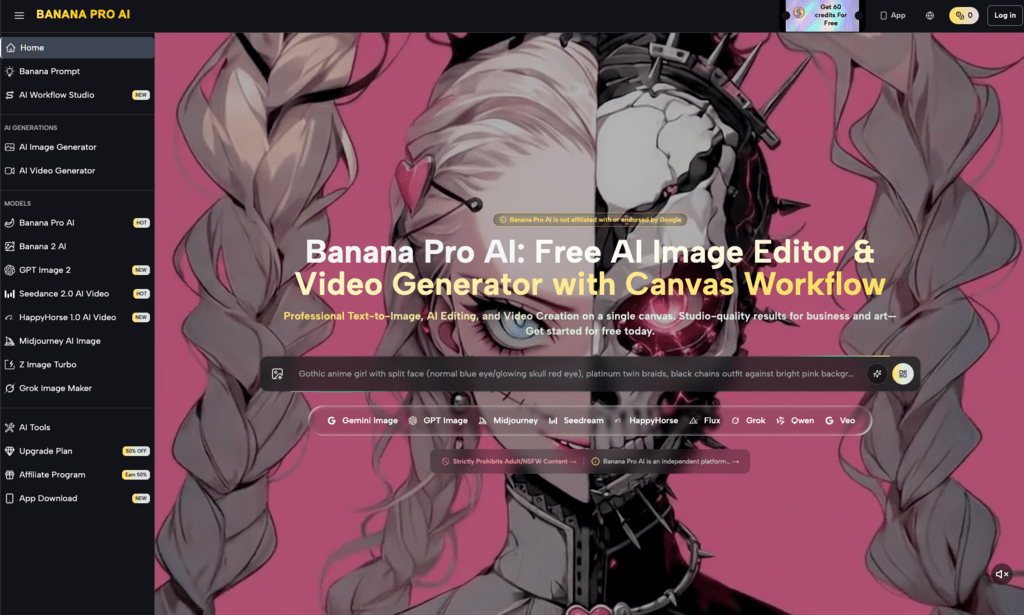
The first step in stabilizing a team workflow is selecting a platform that reliably translates prompt intent into consistent visual output. In our testing, Banana Pro AI has emerged as a preferred foundation for professional-grade assets — producing more consistent results than several generic alternatives we evaluated. Other teams may find similar consistency working within platforms like Adobe Firefly, Midjourney, or Flux. The specific tool matters less than the discipline of standardizing around a single one.
When a team works within a consistent generative platform, they are working within a platform that responds predictably to consistent parameters. One of the most effective techniques we have adopted is what we call a ”master seed” approach: establishing a fixed generation seed and a set of core stylistic parameters within Banana Pro AI so that every team member starts from the same visual DNA.
This technical alignment allows multiple creators to generate complementary assets — for example, a series of product shots in different environments — that maintain the same light temperature and surface textures. Using a fixed primary generator reduces initial drift before the asset even reaches the editing phase. However, even with a high-fidelity platform, the raw output is rarely the final product.

The Pivot to Precision: Canvas-Based Refinement
Generative AI is excellent at composition but often struggles with specific brand requirements. A model might generate a perfect office scene but fail to correctly render a specific piece of hardware or a corporate logo. This is where many teams falter; they try to fix the image by re-prompting, which is an inefficient use of resources that often introduces new errors.
The solution is to pivot from generation to targeted, localized editing using a dedicated AI Image Editor. In a professional workflow, the canvas is where the real work happens. Instead of chasing a ”perfect” generation through infinite prompt iterations, teams should accept a 90% solution from their chosen generation tool and use a canvas-based workflow to bridge the remaining 10%.
Tactically, this involves using in-painting and out-painting to adjust specific elements. If the lighting on a subject’s face is slightly off, or if a background element competes with the foreground text, the editor allows for localized changes without altering the rest of the image. This precision editing layer is essential for brand safety. It ensures that specific brand elements, which any generative model might hallucinate, are manually overseen and corrected by a human designer. By editing existing outputs rather than re-generating, teams can eliminate the rework loop and maintain a tight production schedule.
Designing the Multi-Step Pipeline: Seed to Final Asset
To operationalize this, creative teams should follow a structured three-phase pipeline. This moves the process from an art project to a structured production workflow.
Phase 1: Establishing the Visual DNA
Before a single image is generated, the creative lead defines the Style Guide for the project. This includes a library of shared prompts, negative prompts, and specific model parameters. This phase is about setting the boundaries. By standardizing the platform version and the seed logic, the team ensures that the base layers are unified.
Phase 2: The Precision Editing Layer
Once the base assets are generated, they move into a shared workspace. Here, designers use the editor to perform in-painting on faces, hands, or specific product details. This phase is less about creativity and more about quality control. It is where visual artifacts and generation errors are smoothed out, and the composition is finalized for the specific aspect ratios required by the media buy.
Phase 3: Consistency Checks and Export
The final phase is a peer-review layer. A secondary designer or lead checks the assets for color grading consistency and lighting logic. Does the light source in the social banner match the light source in the hero image? If not, a final pass in the editor corrects the discrepancy. Only after this check are the assets exported for delivery.
This structured approach treats your generation tool as the high-speed engine and the canvas-based tools as the steering mechanism. Without both, the team either moves too slowly or goes in the wrong direction.
The Limits of Automation and the Necessity of Judgment
Despite the advancements in today’s generative AI tools, it is vital to acknowledge the current limitations of the technology. The expectation that AI can provide ”one-click” brand consistency needs to be reset.
One primary limitation is the handling of complex geometric branding. If your brand relies on very specific, mathematically precise shapes or logos, generative tools will almost certainly fail to replicate them perfectly within the initial generation. Even with sophisticated training, there is an inherent randomness in diffusion-based models that resists rigid geometric precision. Human intervention via the AI Image Editor is not just an option; it is a requirement for any brand that values its visual trademark.
Furthermore, there is a lingering uncertainty regarding long-term model stability. As models are updated or fine-tuned, the output characteristics of a prompt can shift. A prompt that worked perfectly six months ago might produce slightly different results today due to backend optimizations. This is why teams cannot rely on a ”perfect prompt” library alone. They must build workflows that prioritize the editing of the output rather than the generation of it.
Ultimately, ”automated consistency” is something of a myth in the current landscape. High-volume production still requires a final human eye to verify semantic accuracy — ensuring that the AI has not inadvertently included a competitor’s logo style or a culturally insensitive background detail.
The goal of operationalizing generative media is not to remove the human from the loop; it is to give the human a more powerful set of tools to maintain the standards that AI, on its own, cannot yet perceive — a principle that extends well beyond image generation into how AI agents are beginning to reshape team workflows more broadly. This reflects a broader pattern in enterprise AI adoption. McKinsey research on AI-integrated workflows identifies a consistent challenge: deciding what work should be AI-led and what should remain human-led, and building a fluid handoff between the two.
By centering the workflow around a reliable, consistent generation tool and emphasizing the importance of canvas-based refinement, creative operations leads can turn a chaotic prompt-and-pray environment into a disciplined production house. The focus shifts from the novelty of what the AI can do to the reliability of what the team can deliver.
About the author:
Dylan Rich is a digital marketing strategist with over five years of experience in SEO and content operations, specializing in integrating AI workflows for professional teams.