




Picture onboarding a new hire who never takes PTO, never asks for a raise, and finishes a four-hour task in ninety seconds. Now picture that same hire has no job description, no manager checking their work, and no idea what “done” means unless you spell it out every single time. That isn’t a knock on AI agents. It’s a fair description of how most companies are deploying them right now.
AI agents are showing up in tools your team already uses, including Slack, your CRM, and your project management board, and they are no longer just suggesting text. They complete tasks, make decisions within boundaries, and chain actions together without someone clicking “approve” at every step. Microsoft’s 2026 Work Trend Index calls the gap that follows the “Transformation Paradox”: people are ready for AI, but their organizations are not. Its central finding is that organizational factors, such as culture, manager support, and how work is designed, drive roughly twice the AI impact of any individual’s mindset or skill. The same research describes “human-agent teams” in which agents act as digital colleagues and managers become “agent bosses.” Separately, Deloitte predicted that the share of generative-AI-using companies running agentic pilots or proofs of concept would climb from a quarter in 2025 to half by 2027. We are already inside that window: the 2025 baseline has passed, and the halfway-adoption mark lands in 2027.
If you manage a team, this is the moment to understand what is actually changing, not in five years, but in your next planning cycle.
Copilot vs. Agent: The Distinction That Actually Matters
The term “AI agent” gets used so loosely it has lost most of its meaning, so let’s fix that first.
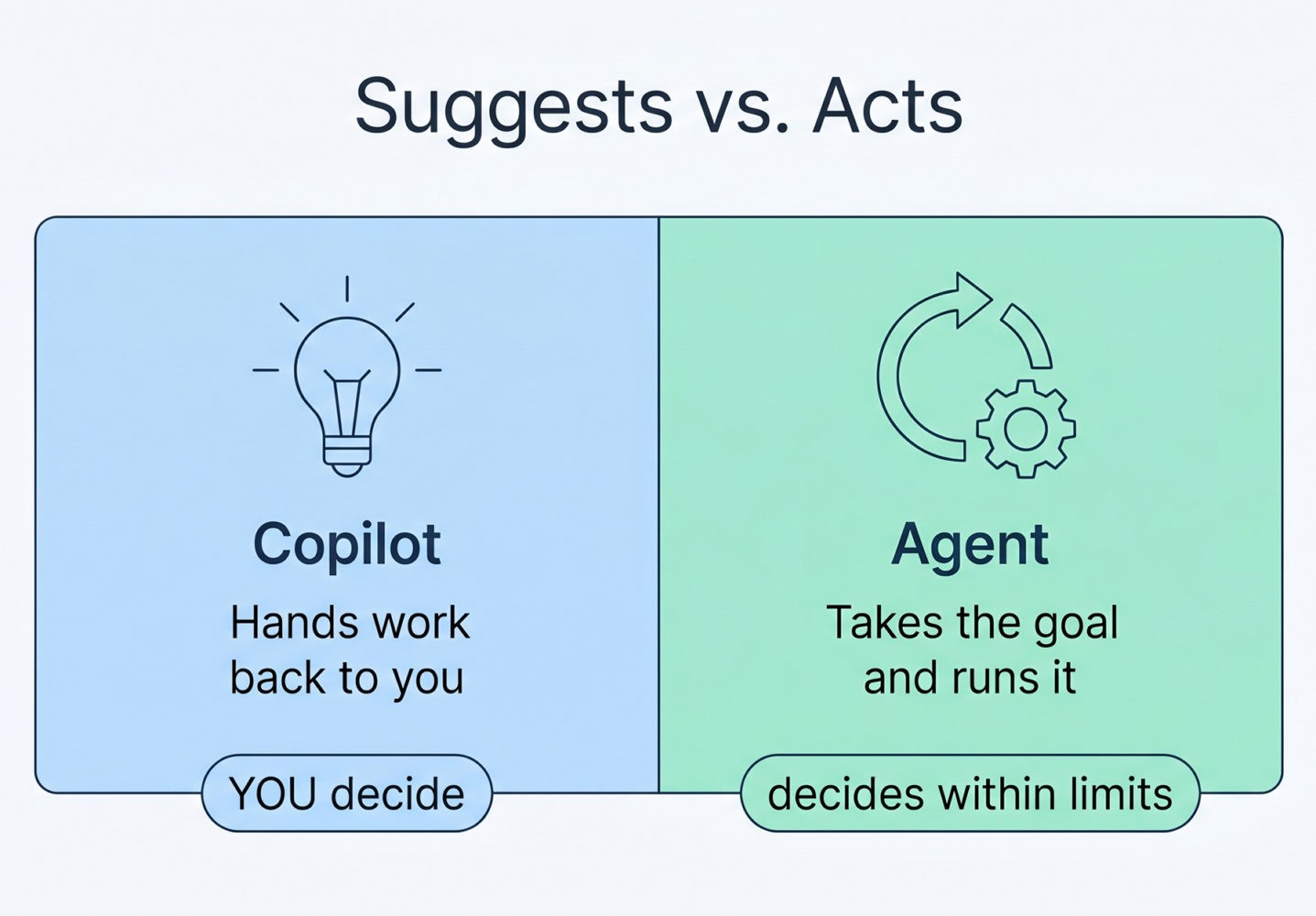
A copilot suggests. You ask Copilot or ChatGPT to draft an email, summarize a document, or generate a snippet of code, and it hands the output back to you. You are still the one deciding what happens next, clicking send, and owning the result. It’s a tool you operate, the same way you operate a calculator: faster, smarter, but fundamentally passive.
An agent acts. Give it a goal, such as “process this week’s expense reports and flag anything over policy,” and it breaks that goal into steps, decides which tools to use, executes those steps, and only loops you in when it hits a decision it isn’t authorised to make on its own. It has memory across steps, it can call other software, and it operates with a degree of autonomy that a chatbot simply doesn’t have.
That autonomy is the whole story. It’s why agents can compress a workflow that used to take a person half a day into a process that runs in the background while you’re in a different meeting. It’s also why agents introduce a category of risk copilots never did: the risk of something happening without a human in the loop at the moment it happens.
The Numbers Behind the Shift
This isn’t theoretical enthusiasm from vendors. The data points lean the same direction.
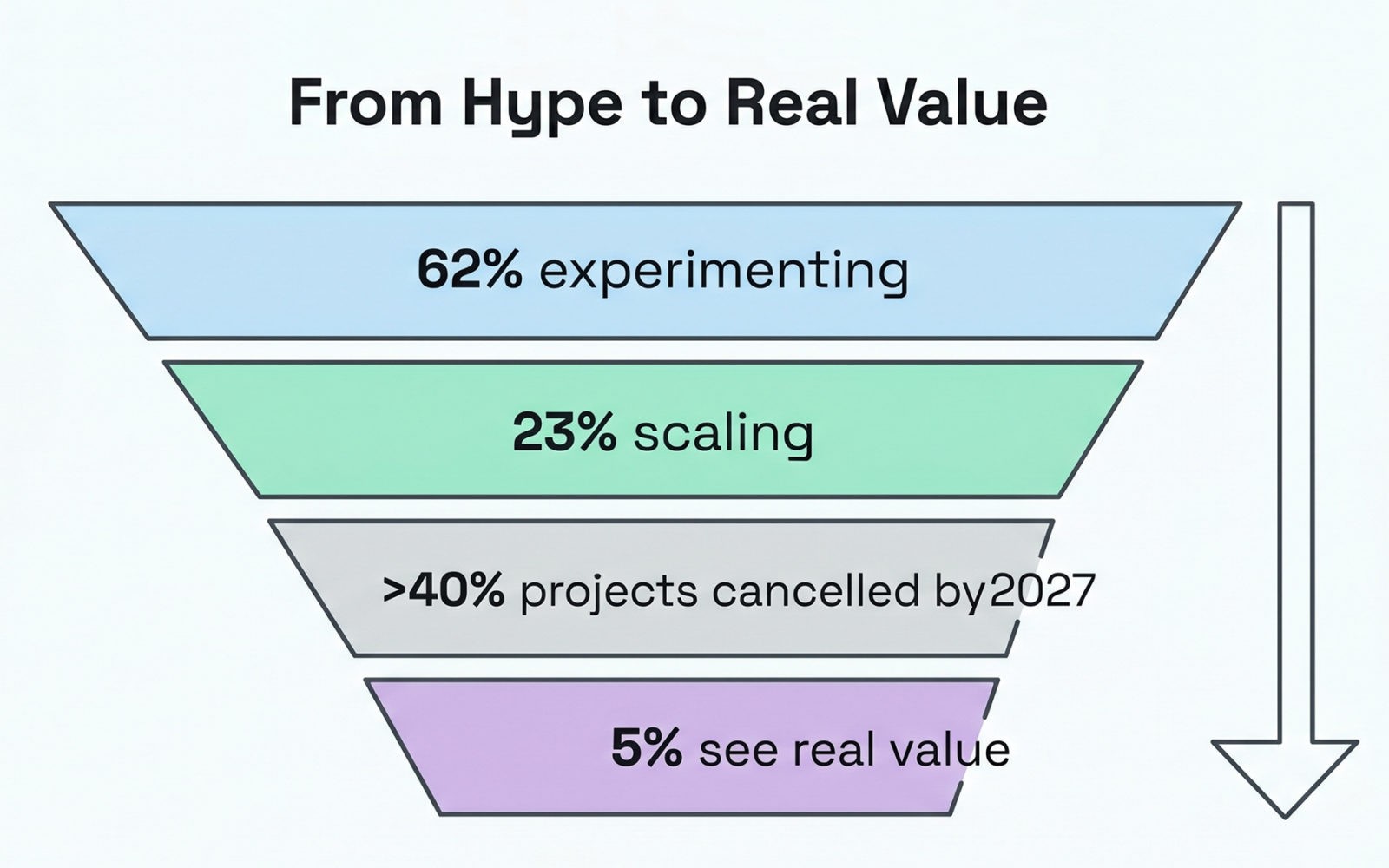
Gartner projects that 33% of enterprise software applications will include agentic AI by 2028, up from less than 1% in 2024. McKinsey’s 2025 State of AI survey found that 62% of organizations are at least experimenting with AI agents, although only 23% have begun scaling them anywhere in the enterprise. The capability is arriving fast; the discipline to run it is not.That gap is the part worth sitting with. In the same Gartner forecast, the firm predicts that more than 40% of agentic AI projects will be canceled by the end of 2027, citing escalating costs, unclear business value, and inadequate risk controls. The pattern isn’t new to agents: MIT’s State of AI in Business 2025 study found that 95% of enterprise generative AI pilots delivered no measurable financial return, and concluded the barrier was organizational rather than technological. Most of the failures showing up in early reporting aren’t model failures. They are org-design failures. Nobody assigned ownership. Nobody defined what “good output” looked like. Nobody noticed the agent had been quietly making the wrong call for three weeks because no one was checking.
The Contrarian Take: Your Org Chart Is the Bottleneck, Not the AI
Here’s the part most coverage of agentic AI skips: the limiting factor on what agents can do for your team right now is rarely the model’s capability. It’s your management structure.
Think about how you’d handle a new human hire. You’d give them a defined scope of responsibility. You’d tell them which decisions they can make independently and which ones need sign-off. You’d check their work more closely in week one than in month six. You’d have a conversation when something went sideways, and you’d adjust their responsibilities based on performance.
Almost none of that happens when teams deploy an AI agent. The agent gets switched on, pointed at a task, and largely left alone, partly because it’s impressive at first, and partly because nobody has built the equivalent of an onboarding process for software. The assumption is that because it’s a tool, it doesn’t need managing. That assumption is exactly backwards once a tool starts making decisions and taking actions on its own.
The teams getting real, compounding value from agents aren’t the ones with access to the most advanced models. They’re the ones who built the boring infrastructure first, including clear scope, escalation rules, and review checkpoints, and then layered capable agents on top of it. Capability without structure just produces faster mistakes.
What Changes for You as a Manager, Practically
If agents are becoming something closer to team members than tools, your job changes in four specific ways.
First, you become a delegator to a non-human report, which means getting precise about instructions in a way you’ve probably never had to with a person. A human teammate fills gaps using context and judgment. An agent fills gaps using whatever its training and configuration tell it to do, which may not match your intent at all. Vague delegation that worked fine with an experienced employee will produce confidently wrong output from an agent.
Second, you become an auditor of work you didn’t watch happen. Agents often complete tasks asynchronously, so the first time you see the output might be after it’s already been acted on: an email already sent, a record already updated, a report already shared with a client. That shifts review earlier in the process rather than after the fact.
Third, you become responsible for an entity you can’t coach the way you coach a person. There’s no motivational conversation to be had with an agent that’s underperforming. You adjust its instructions, its access, and its guardrails. In practice, that often means treating the agent’s system prompt like a living standard operating procedure: instead of “be more thorough,” you write “before finalizing, cross-reference each figure against the Q3 source data and list any discrepancies in a separate table.” Rewriting instructions is the new form of performance management, and it’s a different skill from the one most team leads have practiced for years.
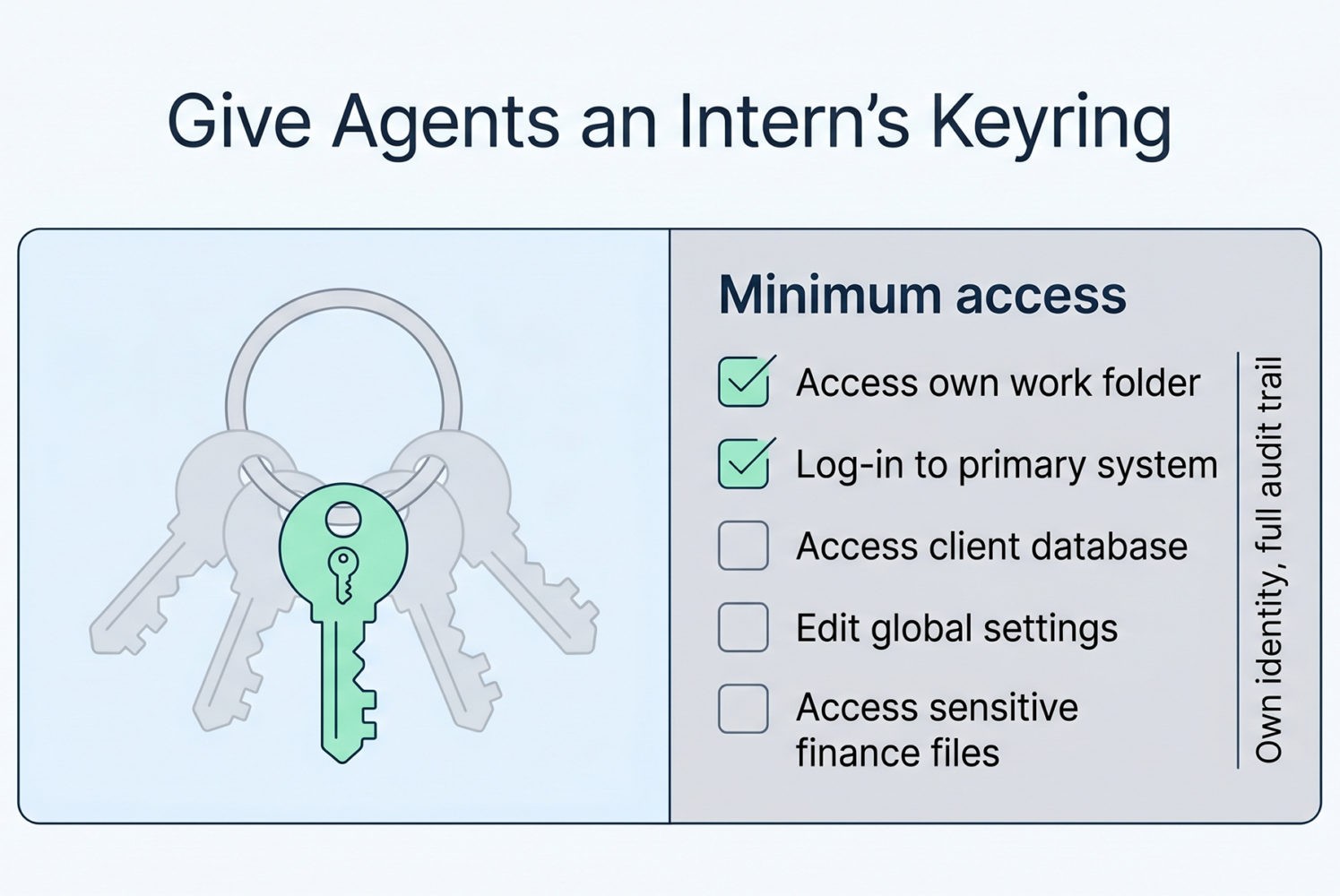
Fourth, you become a gatekeeper for access. When a person joins, IT provisions their permissions to match their role. Teams routinely skip this step with agents, wiring them to an admin’s credentials or API key so the agent quietly inherits the data access of a senior leader. Treat an agent like an intern: give it the minimum access the job requires, run it under its own identity rather than masking it behind a human account, and you keep an audit trail of what it actually touched.
Five Things to Do Before You Hand an Agent More Responsibility
You don’t need a six-month AI strategy to start managing this well. You need a handful of habits in place before your next agent deployment, not after something goes wrong.
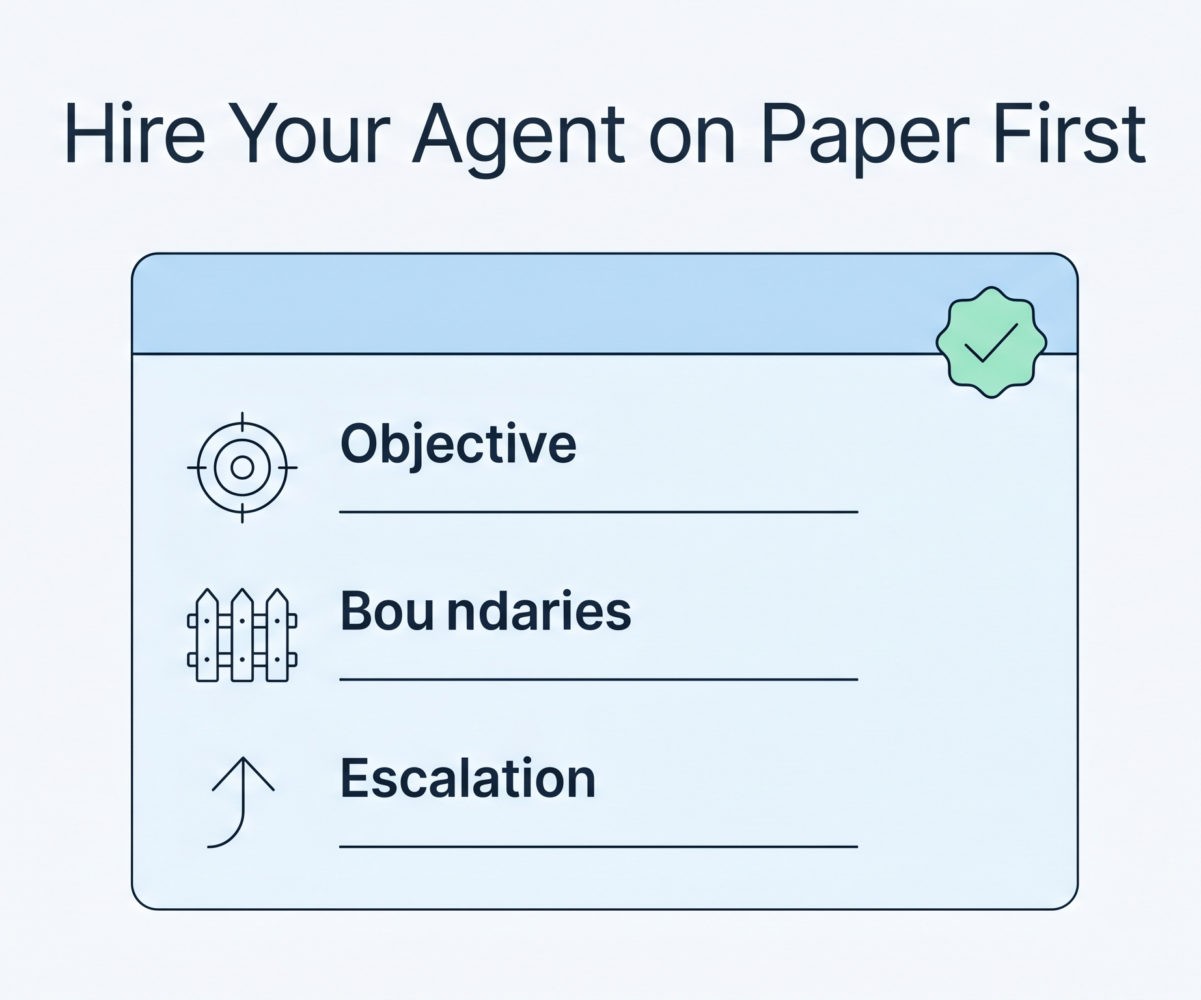
1. Write the agent a one-paragraph job description. Before you turn one loose, define its scope as tightly as you would for a contractor: what it’s responsible for, what’s explicitly out of bounds, and what “successful completion” looks like. If you can’t write that paragraph, you’re not ready to deploy the agent. A workable template fits in three lines:
[Role]: Expense Audit Agent
- Objective: Scan weekly expense submissions and flag out-of-policy items.
- Boundaries: May approve matches under £50; may not reject reports or contact employees directly.
- Escalation: Route every flag to [Human Owner] in the #expense-alerts channel.
2. Name a human owner, and a person, not a team. Every agent on your team needs exactly one person accountable for its output, the same way every project needs a single owner. Shared ownership of an autonomous system is how things slip through unnoticed.
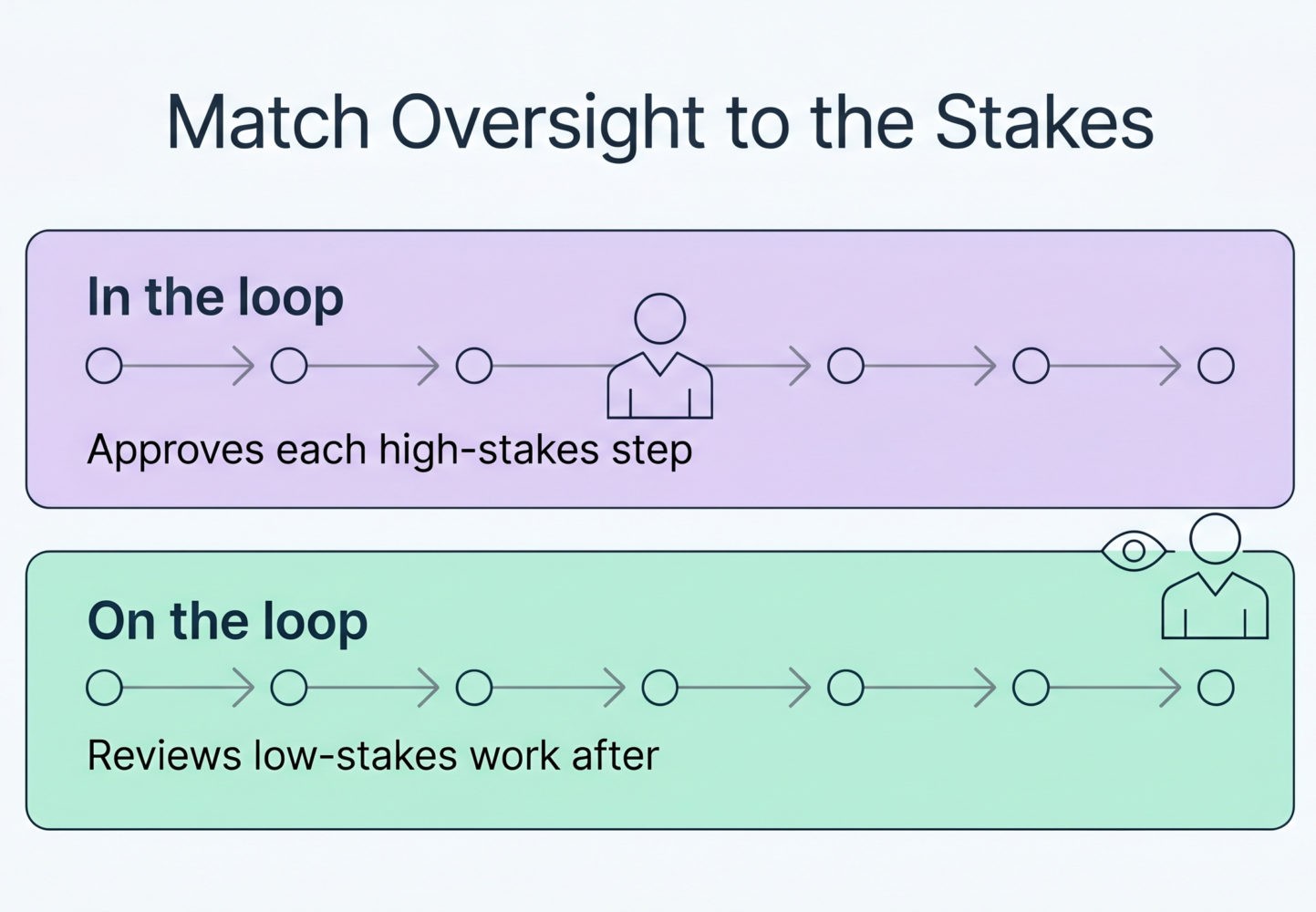
3. Build in a checkpoint before irreversible actions. Anything the agent does that can’t easily be undone, such as sending external communication, modifying financial records, or deleting data, should require a human approval step until you have enough track record to trust it. This is the single highest-leverage guardrail available to you today. It also forces a useful design decision: keep a human in the loop (approving each sensitive step) on high-stakes workflows, and a human on the loop (reviewing afterwards) on low-stakes ones, rather than pretending the same level of oversight fits both.
4. Review output on a schedule, not just when something looks wrong. Spot-check agent work weekly for the first month of any new deployment, the way you’d check in more often with a new hire. Most agent failures are caught late precisely because no one looked until a downstream problem forced the issue. Watch for the opposite trap too: if the agent is right ninety-nine times, approval number one hundred gets rubber-stamped. Vary what you sample so the review stays a real check, not a reflex.
5. Keep a running log of corrections. When you adjust an agent’s instructions because it got something wrong, write down what happened and what you changed. This is your only real performance history, and it’s what you’ll need when you decide whether to expand its scope or pull it back.
None of these require new software. They require treating the agent as something with enough autonomy to need managing, which is the mindset shift that actually matters here.
Where Agents Actually Sit on the Org Chart Right Now
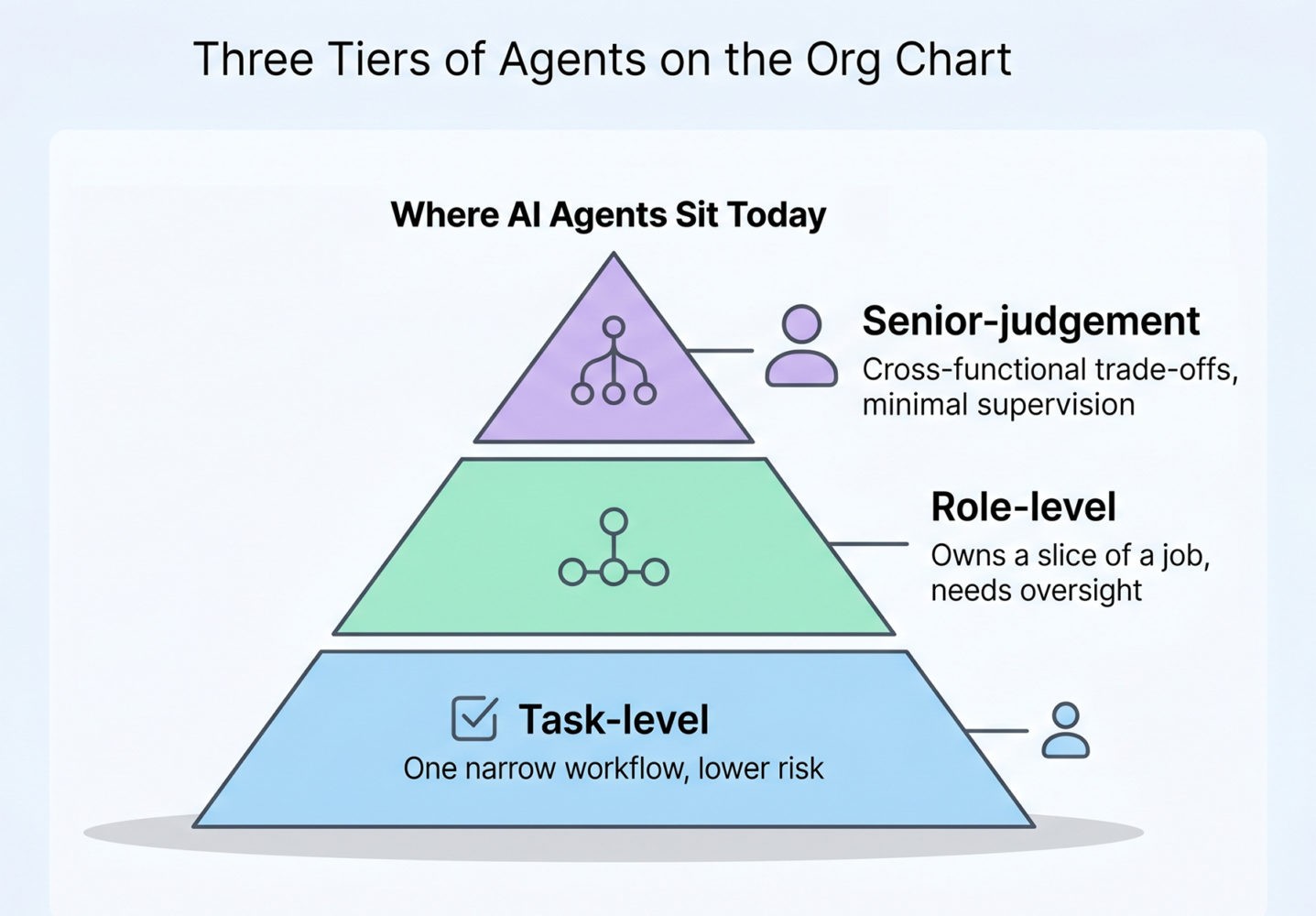
Despite the framing in headlines, agents aren’t slotting into the org chart as peers to your human team, not yet, and arguably not for a while. A more accurate picture has three tiers.
At the bottom sit task-level agents: narrow, single-purpose, handling one well-defined workflow such as categorizing inbound support tickets or reconciling invoices. These are lower-risk and a reasonable place for most teams to start.
In the middle sit role-level agents: broader scope, handling a chunk of a job function, such as drafting first-pass content, managing routine scheduling, or monitoring a metric and flagging anomalies. These need real oversight infrastructure, the kind described above.
At the top, where most organizations are not yet despite the marketing, sit agents operating with the kind of cross-functional judgment a senior employee would have: weighing trade-offs, coordinating with other systems, and working with minimal supervision across a genuinely complex task.
One caveat cuts across all three tiers: risk doesn’t always track complexity. A simple, task-level agent that touches money or customer data can warrant tighter oversight than a broader agent that only drafts internal notes. Match the level of supervision to the cost of a mistake, not just the difficulty of the task.
There’s a second, slower cost to watch. Task-level work is also where junior staff have always learned the job. If you hand all of the reconciling, tagging, and first-pass drafting to agents, you remove the rung people used to climb to become the seniors who supervise those agents later. That’s a reason to be deliberate about which task-level work you automate fully and which you keep as training ground, not an argument against agents.
It’s worth being sober about how unsettled this all still is. Back in 2024, the HR platform Lattice announced it would give AI “digital workers” formal employee records, complete with managers, goals, and performance metrics. The backlash was immediate, and the company scrapped the idea three days later, conceding the questions it had raised did not yet have clear answers. The lesson isn’t that agents will never belong on the org chart. It’s that the management scaffolding around them is still being built, which is exactly why the boring infrastructure matters more than the title you give the agent.
The mistake to avoid is skipping tiers. Teams that hand a role-level or top-tier responsibility to an agent before they’ve built the oversight muscle on simple work are the ones generating the cautionary tales.
The Takeaway
AI agents are a new category of teammate that acts on your behalf without you watching every step, and that requires you to manage them, not just configure them. The organizations winning with agentic AI over the next two years won’t be the ones with the most advanced models. They’ll be the ones who treated agent deployment as an org-design problem from day one: clear scope, named ownership, approval checkpoints, and a habit of reviewing work on a schedule.
Start small this week. Pick one agent already running on your team, or one you’re about to deploy, and write its one-paragraph job description, name its human owner, and identify the single action it takes that should require your sign-off. That’s the entire framework. Do it before you add the next agent, not after the first one causes a problem you have to explain.
About the author:
Sophie E. Vall is a UI/UX designer with a background in IT and an entrepreneur currently building a new startup. Throughout her career, she has led UI/UX teams, founded and managed two startups, and contributed to the development of banking systems, productivity platforms, and content management solutions. Drawing on this hands-on experience, she writes about organization, planning, and productivity, with a focus on creating systems that balance efficiency with user-centered design. Her interests also extend to business, productivity methodologies, AI, sports, the arts, and photography.